
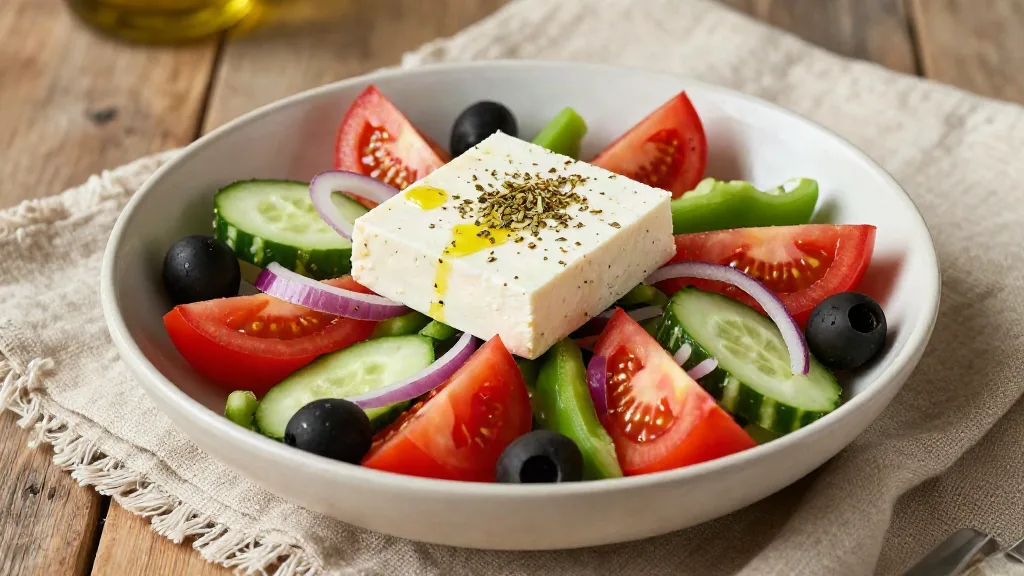
Horiatiki: Greek Village Salad With a Whole Slab of Feta
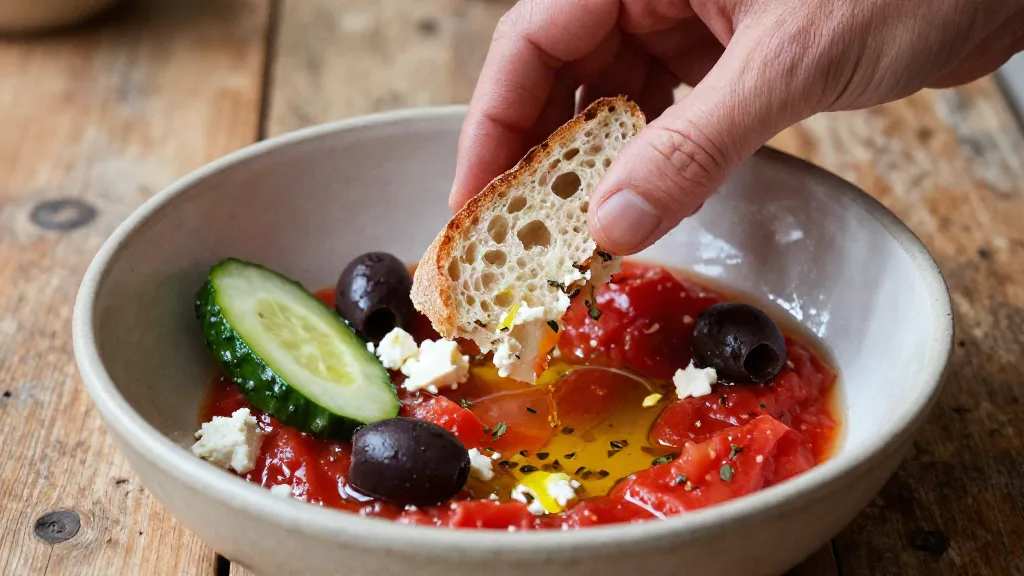
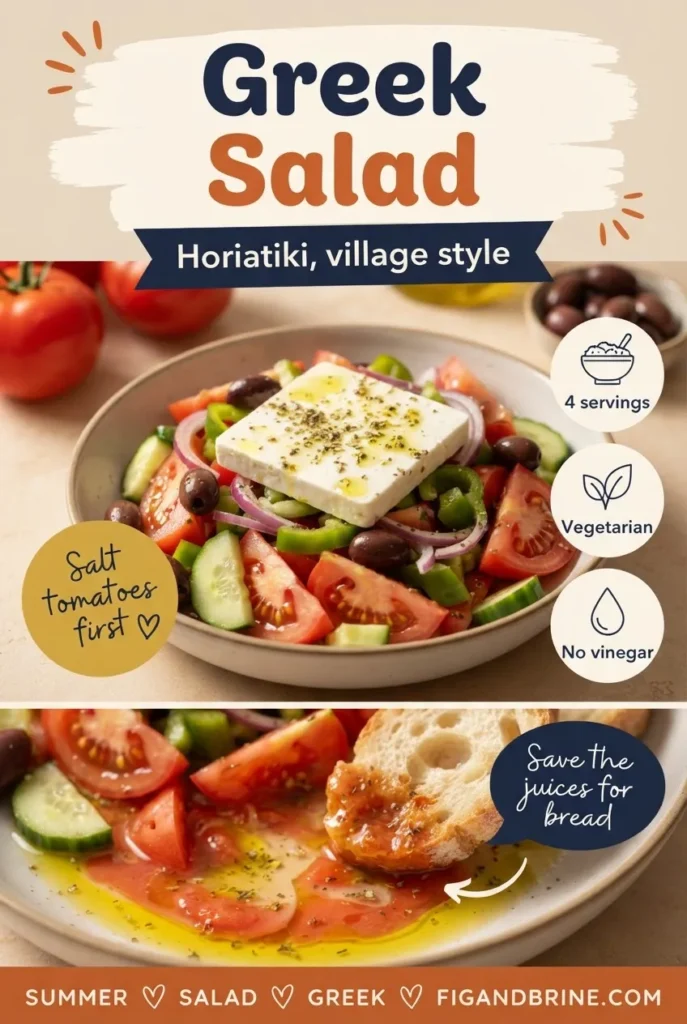
A real horiatiki has no lettuce and no fuss: ripe tomatoes, cucumber, onion, green pepper, olives and a thick slab of feta, all glossed with olive oil and a scatter of oregano. It’s the salad of Greek summer tables, and the best part comes last, when you drag a piece of bread through the tomato juice and oil left in the bowl.
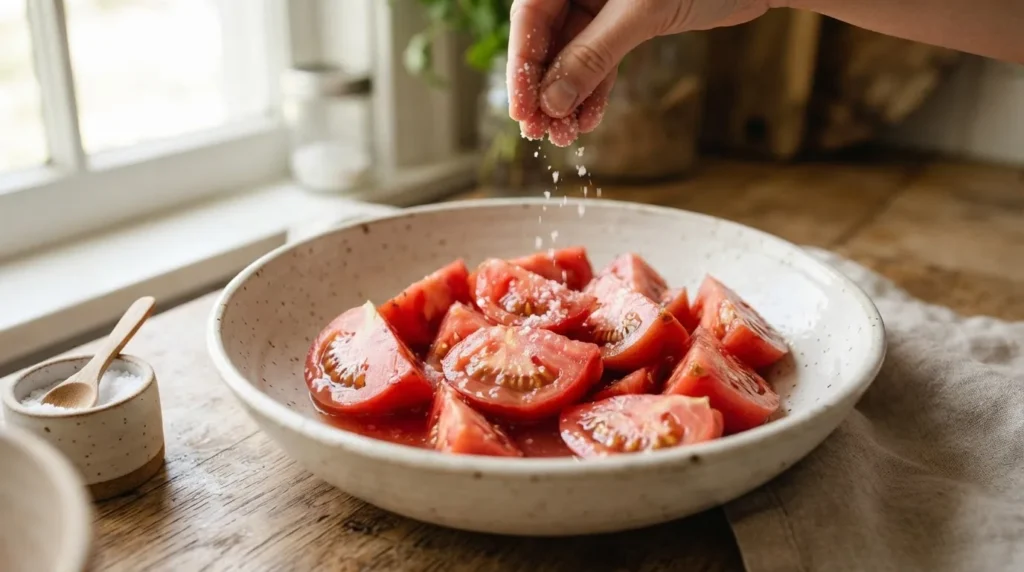
Three batches taught me one thing above the rest: salt the tomatoes 12 minutes before you build the salad. In my side-by-side test, the bowl with pre-salted tomatoes tasted seasoned all the way through, and its juice mixed with the oil into a simple dressing. It also needed no vinegar at all.
The feta matters too. Under EU rules, Feta PDO is made from sheep’s milk, or sheep’s milk with up to 30% goat’s milk, and stored in brine, which is exactly the salty, creamy cheese this salad wants. Use a fragrant dried oregano too; my comparison of Greek oregano vs. regular oregano explains why the Greek kind is worth finding. Follow this recipe, and you’ll make a juicy, balanced village salad that tastes like the tomatoes, not the dressing.
What I Learned From Testing This Recipe
Recipe Testing Note Tested in 3 batches: September 20, September 28 and October 4, 2026. The final version is batch 3. Key variables tested: tomatoes salted 12 minutes ahead vs. salted at assembly (side by side), vinegar vs. none, crumbled feta vs. one slab. Measured: liquid in each comparison bowl 15 minutes after assembly; final salad about 1,445 g from about 1,449 g of ingredients; 4 side servings of about 360 g.
Batch 1 was a dressed version: 600 g tomatoes, 15 g red wine vinegar, 3 g added salt, 45 g olive oil and 200 g of crumbled feta. It tasted too sharp and too salty, and the dressing was louder than the tomatoes. The crumbled feta spread through everything, so it looked like a tossed chopped salad rather than a village salad.
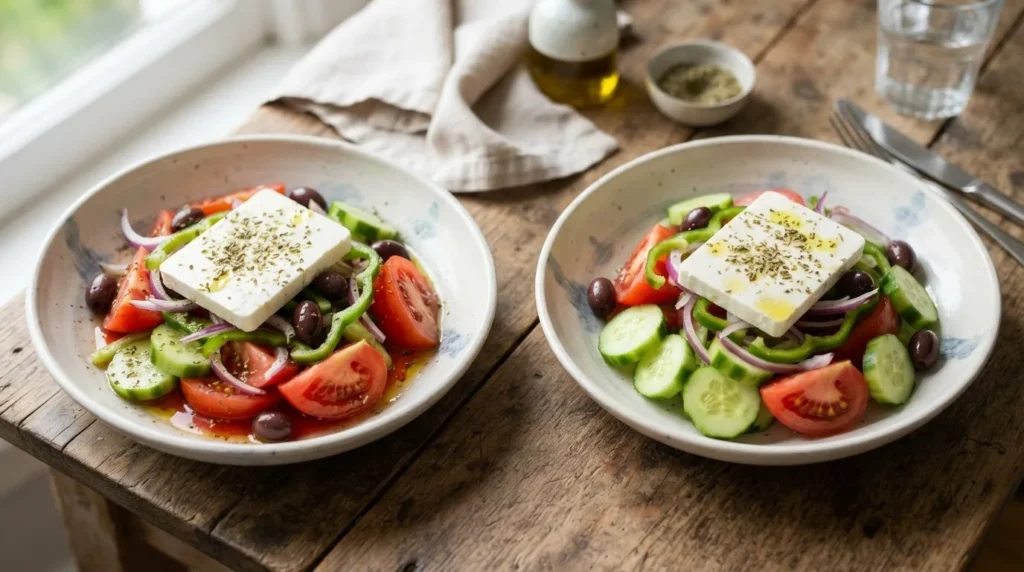
For batch 2 I dropped the vinegar, cut the added salt to 2.4 g, kept the feta in one slab and made two bowls side by side to test when to salt. One honest caveat: because I changed the salt and the feta at the same time as the vinegar, this doesn’t prove the vinegar alone was the problem. It does show the salad doesn’t need it.
Batch 3 repeated the winning bowl as a full recipe, with the oil poured over instead of tossing everything hard.
What I changed after testing: Vinegar from 15 g to 0 g, added salt from 3 g to 2.4 g, feta from crumbled to one 200 g slab, and the salt moved onto the tomatoes 12 minutes before assembly. Batch 1 tasted sharp and salty, with the dressing drowning out the tomatoes.
Side-by-Side Results
Both bowls in batch 2 used half the recipe: 300 g tomatoes, 150 g cucumber, 40 g red onion, 60 g green pepper, 50 g olives, a 100 g feta slab, 22.5 g olive oil, 1 g oregano and 1.2 g salt. Only the timing of the salt changed. I measured the liquid in each bowl 15 minutes after assembly.
| What I compared | Bowl A: tomatoes salted 12 minutes ahead | Bowl B: salted at assembly |
|---|---|---|
| Liquid after 15 minutes | About 28 ml | About 12 ml |
| Tomato flavor | More seasoned and concentrated | Fresher, less concentrated |
| Cucumber | Slightly softer at the edges | Crisper |
| Look | More tomato juice beneath the vegetables | Cleaner, drier-looking bowl |
| Feta | Salt balanced by the tomato juices | Salt more noticeable against the firmer vegetables |
| My pick | Better flavor: the final recipe | Better if the salad must sit before serving |
How this recipe evolved
Tap each batch to see what went wrong and what changed.
Batch 1 (September 20): too sharp and salty
600 g tomatoes, 15 g red wine vinegar, 3 g salt, 45 g olive oil, 200 g crumbled feta.
Tasted sharp and salty; the dressing was louder than the tomatoes.
Crumbled feta made it look like a chopped salad.
Batch 2 (September 28): two bowls side by side
No vinegar, 2.4 g salt in total, feta in one slab.
Bowl A, tomatoes salted 12 minutes ahead: about 28 ml liquid after 15 minutes, better seasoned tomatoes.
Bowl B, salted at assembly: about 12 ml liquid, crisper but less tomato flavor.
Batch 3 (October 4): the final recipe
Bowl A repeated as a full recipe: 2.4 g salt on the tomatoes 12 minutes ahead, oil poured over, no hard tossing.
About 1,445 g finished: 4 side servings of about 360 g.
Ingredients
Makes 4 side servings (about 360 g each)
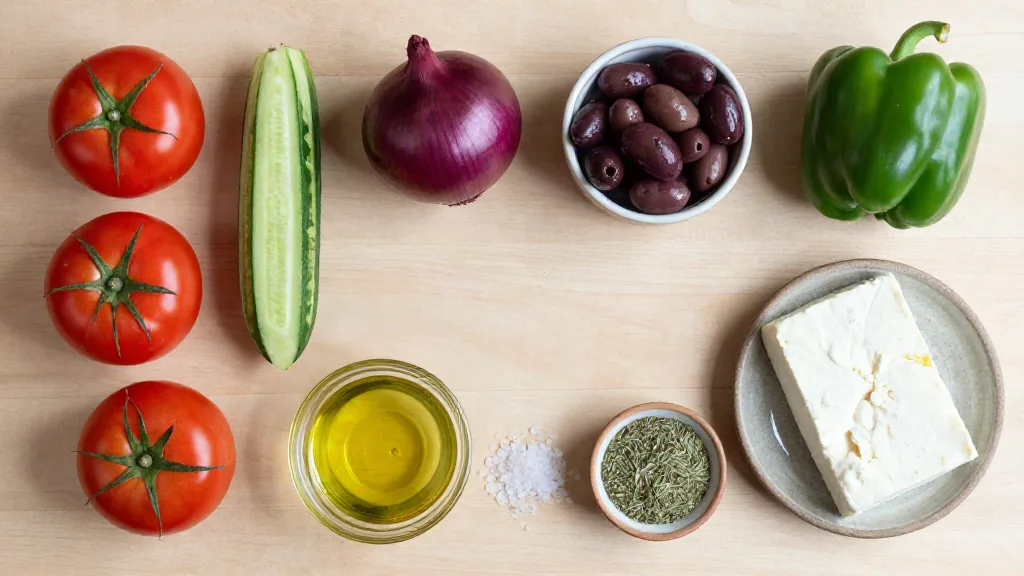
- 600 g ripe round tomatoes, fully red and fragrant but still firm enough to cut cleanly
- 300 g cucumber, peeled in alternating strips, seeds left in
- 80 g red onion
- 120 g green bell pepper
- 100 g Kalamata olives, pitted and drained weight
- 200 g Greek feta, sheep’s milk, packed in brine, in one slab
- 45 g extra-virgin olive oil (about 3 tablespoons plus 1 teaspoon)
- 2 g dried Greek oregano (about 2 teaspoons)
- 2.4 g fine salt (a scant ½ teaspoon), all of it for the tomatoes
No vinegar and no capers. The feta and olives bring enough salt and tang, so taste before you add anything at the table.
Shopping list
Send the list to yourself via WhatsApp or email.
- 600 g ripe but firm round tomatoes
- 300 g cucumber
- 80 g red onion
- 120 g green bell pepper
- 100 g pitted Kalamata olives (drained)
- 200 g Greek sheep's-milk feta in brine, one slab
- Extra-virgin olive oil (45 g)
- Dried Greek oregano (2 g)
- Fine salt (2.4 g)
- Crusty bread to serve
By the Numbers
- Batches: 3, including one two-bowl side-by-side test
- Salting time: 12 minutes at room temperature before assembly
- Liquid after 15 minutes (half batches): about 28 ml with tomatoes salted ahead, about 12 ml salted at assembly
- Salt: 3 g in batch 1, 2.4 g in the final recipe
- Vinegar: 15 g in batch 1, none in the final recipe
- Yield: about 1,445 g finished, 4 side servings of about 360 g, or 2 to 3 lunch portions
Before You Start: What to Watch For
- Pick ripe but firm tomatoes. Very soft tomatoes made the salad look less structured. You want deep red, fragrant tomatoes that still slice cleanly. My Mediterranean seasonal vegetable calendar shows when they’re at their best.
- Cut big. Wedges about 2 to 3 cm thick held their shape better than smaller pieces, and 1 cm cucumber half-moons stayed crunchier than thin slices.
- Keep the tomato juice. The juice the salt draws out is the dressing. Don’t drain it away.
- Don’t toss hard. Pour the oil over, set the feta on top and tilt the bowl once. Tossing breaks up the feta and bruises the tomatoes.
- Use good oil. With no vinegar, the olive oil carries the whole dressing. My guide to extra-virgin vs. light olive oil explains why only extra-virgin works here.
- Taste before salting at the table. The brined feta and olives are already salty. The final recipe needed no extra salt once served.
Doneness Cues at a Glance
| Stage | Look | Feel or sound | Smell or taste |
|---|---|---|---|
| Tomatoes (before cutting) | Fully red | Ripe but firm, cuts cleanly | Fragrant |
| Salted tomatoes (12 minutes) | Juice gathering in the bowl | Seasoned all the way through | |
| Onion | Thin 2 mm slices | Sharpest right after cutting, more mellow once it meets the juice and oil | |
| Finished salad | Feta slab intact on top, juice and oil pooling below | Cucumber still crunchy | Tomato-forward, not sharp |
Method
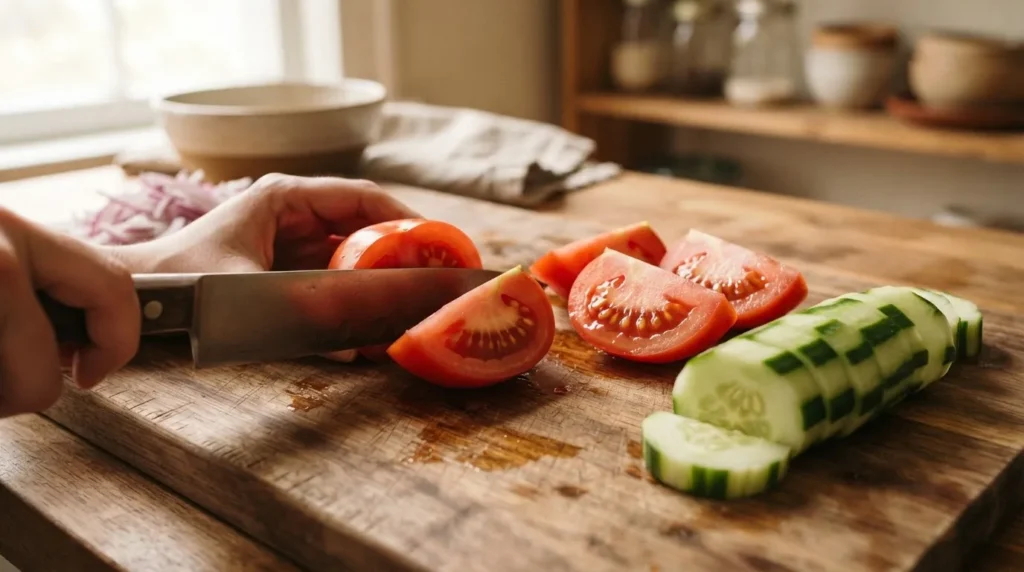
- Cut the tomatoes. Core 600 g tomatoes and cut them into wedges about 2 to 3 cm thick. Put them in a wide serving bowl. Keep the wedges generous; smaller pieces lost their shape in my tests.
- Salt the tomatoes. Sprinkle all 2.4 g of fine salt over the tomatoes and leave them at room temperature for 12 minutes. Within that time, juice starts to collect at the bottom of the bowl. Keep every drop.
- Prepare the cucumber. While the tomatoes sit, peel the cucumber in alternating strips so some green skin stays on. Leave the seeds in and cut it into half-moons about 1 cm thick.
- Slice the onion and pepper. Cut the red onion into thin slices, about 2 mm. Cut the green pepper into strips about 3 mm thick. I used the onion raw, without soaking; at this thickness it had a clear bite without overwhelming the tomatoes.
- Assemble. After 12 minutes, add the cucumber, onion, pepper and 100 g olives to the tomatoes and their juice. Arrange rather than toss, so the tomatoes stay whole.
- Pour the oil. Pour 45 g extra-virgin olive oil over the vegetables. It mixes with the tomato juice at the bottom into a light dressing.
- Add the feta and oregano. Set the 200 g feta on top in one piece and sprinkle 2 g Greek oregano over the feta and vegetables.
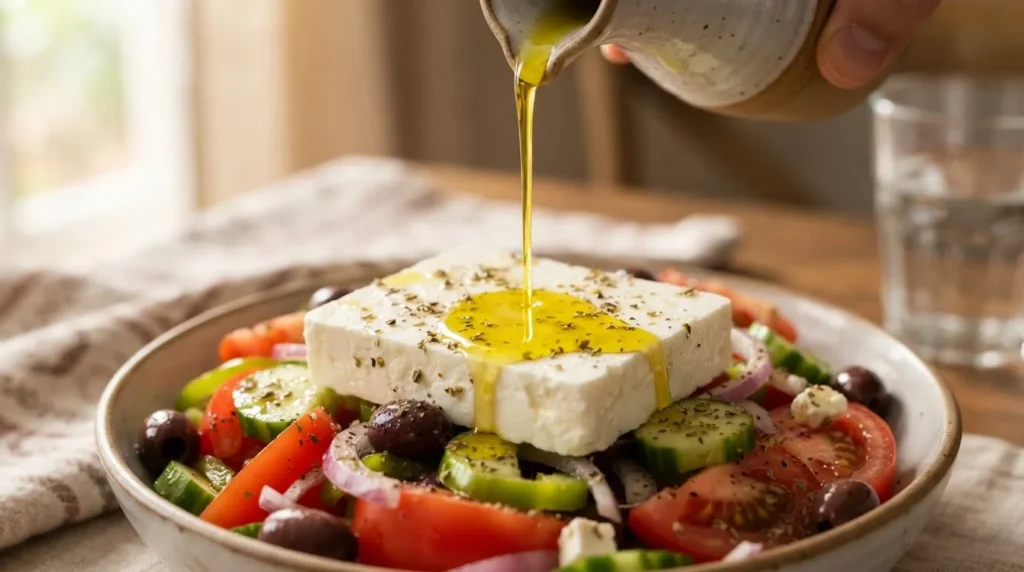
- Tilt once and serve. Tilt the bowl gently once to spread the juices without breaking the feta. Serve soon after assembling, while the cucumber is still crunchy. Let everyone break off pieces of feta as they eat.
Tested Substitutions
| Original ingredient | Tested substitute | Result |
|---|---|---|
| No vinegar | 15 g red wine vinegar (tested in batch 1) | Too sharp alongside 3 g salt and crumbled feta. The salt and feta also changed, so this didn’t isolate the vinegar. |
| One feta slab | 200 g crumbled feta (tested in batch 1) | Spread through the salad, made the saltiness more uniform and looked like a chopped salad. |
| Tomatoes salted 12 minutes ahead | All salt added at assembly (tested) | Crisper and drier, with less liquid, but the tomatoes tasted less seasoned. |
| Round tomatoes | Cherry tomatoes (untested) | I haven’t tried this yet. Let me know in the comments. |
| Raw red onion | Onion soaked in cold water (untested) | Next on my list to test. |
| Cucumber with seeds | Seeds removed (untested) | I haven’t tried this yet. |
| Green pepper | Left out (untested) | I haven’t tried this yet. |
| No capers | Capers (untested) | I haven’t tried this yet. |
| Kalamata olives | Other olives (untested) | I haven’t tried this yet. |
Why This Recipe Can Fail (And How to Fix It)
Common Problems
- Sharp or harsh: In batch 1, 15 g vinegar with 3 g salt and crumbled feta tasted too sharp, and the dressing drowned the tomatoes. Leave out the vinegar and let the tomato juice and olive oil be the dressing.
- Too salty: Brined feta and olives are already salty, and crumbling the feta spreads that salt everywhere. Use 2.4 g salt, all on the tomatoes, keep the feta in one slab and taste before adding more.
- Bland tomatoes: Salting everything at the last minute left the tomatoes less seasoned in my side-by-side test. Salt the tomato wedges 12 minutes before assembly and keep their juice.
- Watery or soft cucumber: Salting ahead draws more liquid (about 28 ml vs. 12 ml in a half batch after 15 minutes) and softens the cucumber edges slightly. Cut the cucumber 1 cm thick, add it only at assembly and serve soon after.
- Looks like a chopped salad: Small pieces and crumbled feta lose the village-salad look. Cut tomatoes into 2 to 3 cm wedges, keep the feta whole and tilt the bowl instead of tossing.
- Mushy tomatoes: Very soft tomatoes don’t hold their shape. Choose ripe tomatoes that are still firm enough to cut cleanly.
What went wrong?
Tap your problem to see the cause and the fix.
Sharp or harsh
Cause: 15 g vinegar with 3 g salt and crumbled feta tasted too sharp, and the dressing drowned the tomatoes.
Fix: Leave out the vinegar and let the tomato juice and olive oil be the dressing.
Too salty
Cause: Brined feta and olives are already salty, and crumbled feta spreads that salt everywhere.
Fix: Use 2.4 g salt, all on the tomatoes, keep the feta in one slab and taste before adding more.
Bland tomatoes
Cause: Salting everything at the last minute left the tomatoes less seasoned.
Fix: Salt the tomato wedges 12 minutes before assembly and keep their juice.
Watery or soft cucumber
Cause: Salting ahead draws more liquid and softens the cucumber edges slightly.
Fix: Cut the cucumber 1 cm thick, add it only at assembly and serve soon after.
Looks like a chopped salad
Cause: Small pieces and crumbled feta lose the village-salad look.
Fix: Cut tomatoes into 2 to 3 cm wedges, keep the feta whole and tilt the bowl instead of tossing.
Mushy tomatoes
Cause: Very soft tomatoes don't hold their shape.
Fix: Choose ripe tomatoes that are still firm enough to cut cleanly.
Serving Suggestions
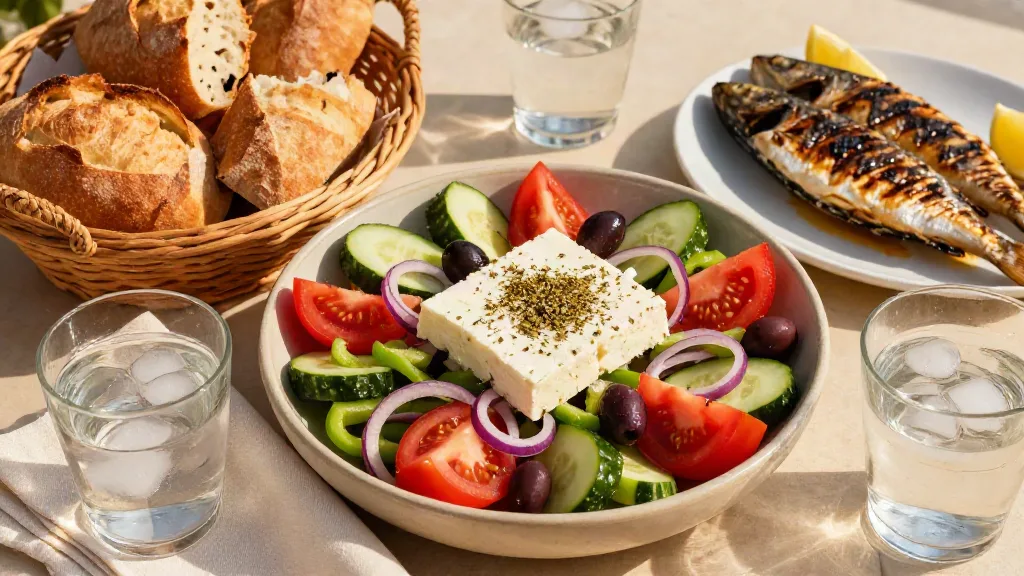
Serve horiatiki in the middle of the table with plenty of crusty bread for the juices, which are as much a part of the dish as the vegetables. It’s a natural partner for crisp spinach and feta spanakopita or a dish of gigantes plaki, Greek baked giant beans, for a full Greek meal. Sharing one bowl is the point: UNESCO, which lists the Mediterranean diet as Intangible Cultural Heritage with Greece among its countries, calls eating together the foundation of the region’s cultural identity.
Storage, Reheating & Make-Ahead
Horiatiki is a salad to assemble and eat. My only measured holding test is the 15-minute side-by-side: even in that short time, the pre-salted bowl gathered more juice and its cucumber softened slightly at the edges. I didn’t track the salad over longer times, so I won’t give you numbers I don’t have.
For the best texture, serve it soon after assembling. If you have leftovers, the USDA advises refrigerating them within 2 hours (1 hour above 90°F) and using them within 3 to 4 days. Expect softer vegetables. I haven’t tested cutting the vegetables ahead, so if you try it, keep them separate and salt the tomatoes only 12 minutes before serving.
There’s no reheating here, and freezing doesn’t suit a fresh salad.
What I’d Test Next
- Raw vs. soaked red onion: half the onion soaked in cold water for 10 minutes, the same 2 mm slices and identical salad, to see whether soaking improves the balance or removes too much bite.
- Holding times: measured liquid and texture at 30 minutes and 1 hour, and the next day.
- Cherry tomatoes for the months when good round tomatoes are hard to find.
Continue Cooking
- Greek lemon potatoes, roasted until golden
- Greek briam, oven-roasted summer vegetables
- The Mediterranean diet for beginners

Authentic Greek Horiatiki Salad
- Total Time: 12 minutes
- Yield: 4 servings
- Diet: Vegetarian
Description
A refreshing traditional Greek salad made with ripe tomatoes, cucumbers, onions, green peppers, olives, and feta cheese, dressed simply with olive oil and oregano.
Ingredients
- 600 g ripe round tomatoes
- 300 g cucumber, peeled in alternating strips
- 80 g red onion
- 120 g green bell pepper
- 100 g Kalamata olives, pitted
- 200 g Greek feta, in one slab
- 45 g extra-virgin olive oil
- 2 g dried Greek oregano
- 2.4 g fine salt
Instructions
- Cut the tomatoes into wedges about 2 to 3 cm thick and place in a serving bowl.
- Salt the tomatoes with 2.4 g of fine salt and leave at room temperature for 12 minutes.
- Prepare the cucumber by peeling in alternating strips and cutting into half-moons about 1 cm thick.
- Slice the onion into thin slices and cut the green pepper into strips.
- Assemble the salad by adding cucumber, onion, pepper, and olives to the tomatoes along with their juice.
- Pour the olive oil over the vegetables.
- Add the feta on top and sprinkle oregano over everything.
- Serve immediately while the cucumber is still crunchy.
Notes
For best results, use firm ripe tomatoes and high-quality extra-virgin olive oil. Serve with crusty bread to soak up the juices.
- Prep Time: 12 minutes
- Cook Time: 0 minutes
- Category: Salad
- Method: No cooking required
- Cuisine: Greek


