

Spanakopita (Greek Spinach and Feta Phyllo Pie With a Crisp Bottom)
There’s a sound a good spanakopita makes when the knife goes in: a dry, papery crackle, then a soft give as it reaches the green filling. My first one didn’t make that sound at the bottom. The top was golden, but the center underneath was soft and damp.
Four batches later, the lesson was clear: the spinach’s moisture matters more than almost anything else. Adding more phyllo alone didn’t fix my soggy bottom. What fixed it was the combination of genuinely dry spinach (1 kg fresh, wilted and squeezed down to 420 g, with about 190 g of liquid removed), a metal pan, a 200°C oven and a longer bake.
A whole kilo of spinach, one of the dark-green vegetables on MyPlate, disappears into this pie. If you like spinach in Greek cooking, my Greek spinach rice (spanakorizo) is its stovetop cousin. Follow this recipe, and you’ll get crisp layers on top, a golden base underneath and a filling that holds when you lift a piece.
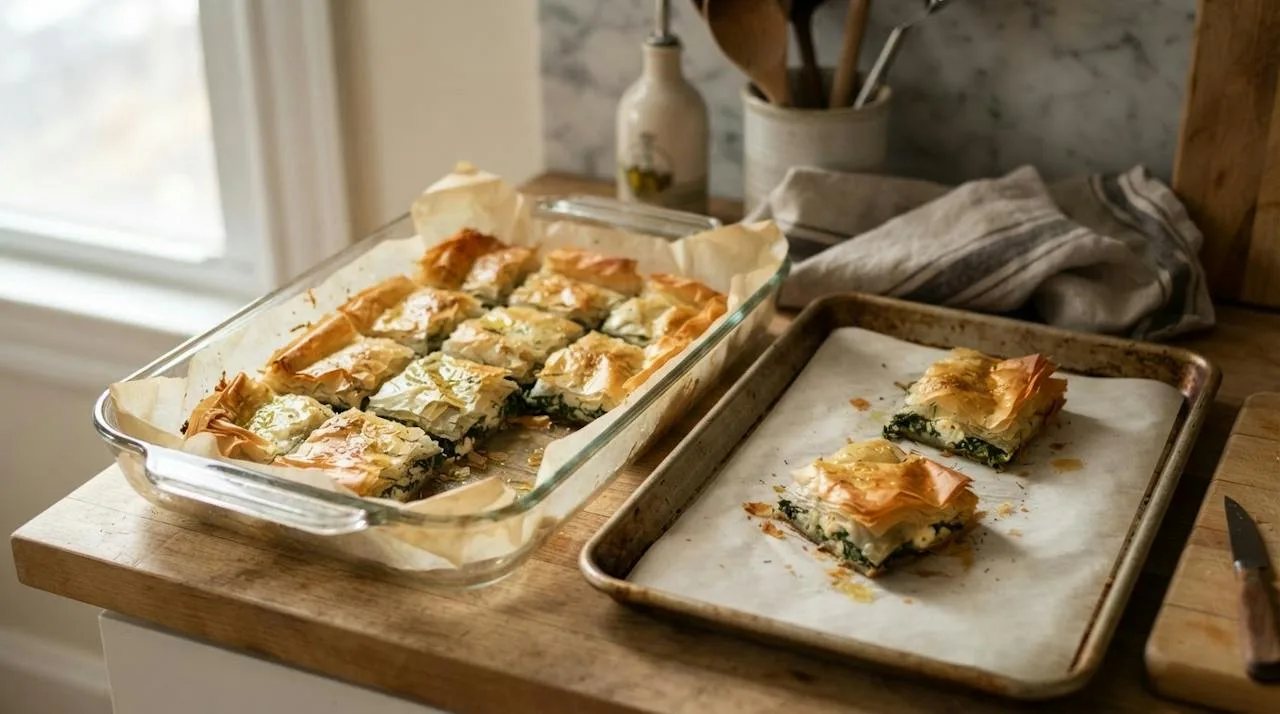
What I Learned From Testing This Recipe
Recipe Testing Note Tested 4 times: September 8, 16 and 25, and October 4, 2026. The final version is batch 4. Equipment: conventional electric oven (no fan) at 200°C, rack one position below the center; 33 × 23 cm metal baking pan about 3 cm deep; soft silicone pastry brush; large stainless-steel skillet; cotton kitchen towel for squeezing. Key variables tested: fresh vs. frozen spinach, olive oil vs. butter, glass vs. metal pan, 6 vs. 8 phyllo sheets under the filling, feta and ricotta amounts, bake and rest times. Measured: spinach 1,000 g raw, about 610 g wilted, 420 g squeezed; filling about 1,030 g.
Batch 1 used frozen spinach and a glass dish, and it went wrong in several ways. I squeezed 800 g of frozen spinach (about 520 g thawed) down to 380 g, removing only about 140 g of liquid, and it still felt wet. The filling released visible moisture in the oven. With 300 g feta, no ricotta and 1 g of added salt, it was clearly too salty when eaten warm. And with 6 phyllo sheets under the filling and 6 on top, baked in the glass dish at 190°C for 45 minutes, the top looked golden but the center of the bottom was noticeably soft and pale.
Batches 2 and 3 fixed those problems; batch 4 confirmed the final recipe.
What I changed after testing: I switched from 800 g frozen to 1,000 g fresh spinach (squeezed to 420 g instead of 380 g), cut the feta from 300 g to 250 g, added 150 g ricotta, dropped the added salt from 1 g to none, went from 6 to 8 phyllo sheets under and over the filling, raised the oven from 190°C to 200°C, swapped the glass dish for metal, baked for 49 minutes instead of 45 and rested it for 35 minutes instead of 20. The first pie was salty and soft underneath.
Side-by-Side Results
| What I compared | Version A | Version B | What happened | My pick |
|---|---|---|---|---|
| Spinach | Frozen | Fresh | Frozen was darker, more compact, harder to dry and gave a slightly wetter cut edge and a less evenly browned bottom. Fresh had brighter green flecks, distinct strands, a cleaner cut edge and a noticeably drier bottom | Fresh |
| Fat (half-size comparison in batch 3) | Olive oil | Butter | Olive oil kept the phyllo light and crisp with visible layers and a cleaner taste next to the feta. Butter gave deeper color and a richer aroma, but a more brittle top and a heavier-tasting filling | Olive oil |
| Pan (batch 1 vs. batch 2, among other changes) | Glass | Metal | In glass, the top and edges crisped but the bottom stayed noticeably paler. In metal, the top browned evenly, the bottom turned golden and crisp, and the edge held its shape | Metal |
| Phyllo under the filling (batch 1 vs. batch 2) | 6 sheets | 8 sheets | Six gave a thinner base that softened faster under the heavy filling. Eight gave a firmer base, clearer layers and pieces that were easier to lift | 8 sheets |
How this recipe evolved
Tap each batch to see what went wrong and what changed.
Batch 1 (September 8): frozen spinach, glass dish
800 g frozen spinach squeezed to 380 g, only about 140 g liquid removed; the filling released moisture.
300 g feta, no ricotta, 1 g salt: clearly too salty.
6 sheets under, 6 over, 190°C for 45 minutes in glass: golden top, soft and pale bottom.
Batch 2 (September 16): fresh spinach, metal pan
1,000 g fresh spinach squeezed to 405 g; feta 275 g, ricotta 125 g, no added salt.
8 sheets under and over, 90 ml olive oil, 200°C for 50 minutes, 30-minute rest.
Batch 3 (September 25): spinach and fat compared
Spinach squeezed to 420 g; feta 250 g, ricotta 150 g.
Half-size olive oil vs. butter test: olive oil chosen. Bake 48 minutes, rest 35.
Batch 4 (October 4): the final recipe
1,000 g fresh spinach to 420 g (about 190 g liquid out), 250 g feta, 150 g ricotta, no added salt.
Metal pan, 200°C, 49 minutes, 35-minute rest: crisp top, golden dry bottom, filling that holds.
By the Numbers (Batch 4)
- Spinach: 1,000 g raw, about 610 g after wilting, about 420 g after squeezing
- Liquid squeezed out: about 190 g (batch 1’s frozen spinach gave up only about 140 g)
- Filling: about 1,030 g
- Phyllo: all 16 sheets (about 450 g), 8 under and 8 over
- Olive oil for brushing: 90 ml, about 5 to 6 ml per sheet
- Bake: 49 minutes at 200°C, then a 35-minute rest
- Yield: 12 pieces, 6 servings of 2 pieces
Taster Notes
Three family members tasted the final pie. Two preferred the olive oil version, one of them noting that the filling tasted balanced rather than overly salty; the third preferred the butter comparison for its darker crust and richer aroma. All three preferred fresh spinach over frozen, the metal pan, 8 sheets under the filling and the 35-minute rest. Their shared criticism: day 3 and 4 leftovers lost the delicate texture of the fresh pie.
Ingredients
Makes one 33 × 23 cm pie: 12 pieces, 6 servings.
For the filling:
- 1,000 g fresh spinach, thick stems trimmed
- 15 ml extra virgin olive oil, for cooking the spinach and onion
- 120 g yellow onion, finely diced
- 8 g garlic (about 2 cloves), finely chopped
- 80 g scallions, thinly sliced
- 250 g Greek sheep’s milk feta in brine, crumbled into medium, irregular pieces (larger pieces give salty, creamy pockets)
- 150 g whole-milk ricotta, drained in a sieve for about 10 minutes
- 2 large eggs (about 100 g without shells)
- 25 g fresh dill, chopped
- 12 g fresh parsley, chopped
- 8 g fresh mint, finely chopped
- 2 g black pepper (about ¾ teaspoon)
- 0.5 g freshly grated nutmeg (about ¼ teaspoon)
- No added salt (the feta brings enough)
For the pie:
- 1 package phyllo, 16 sheets (about 450 g, 33 × 23 cm), thawed according to the package
- 90 ml extra virgin olive oil for brushing
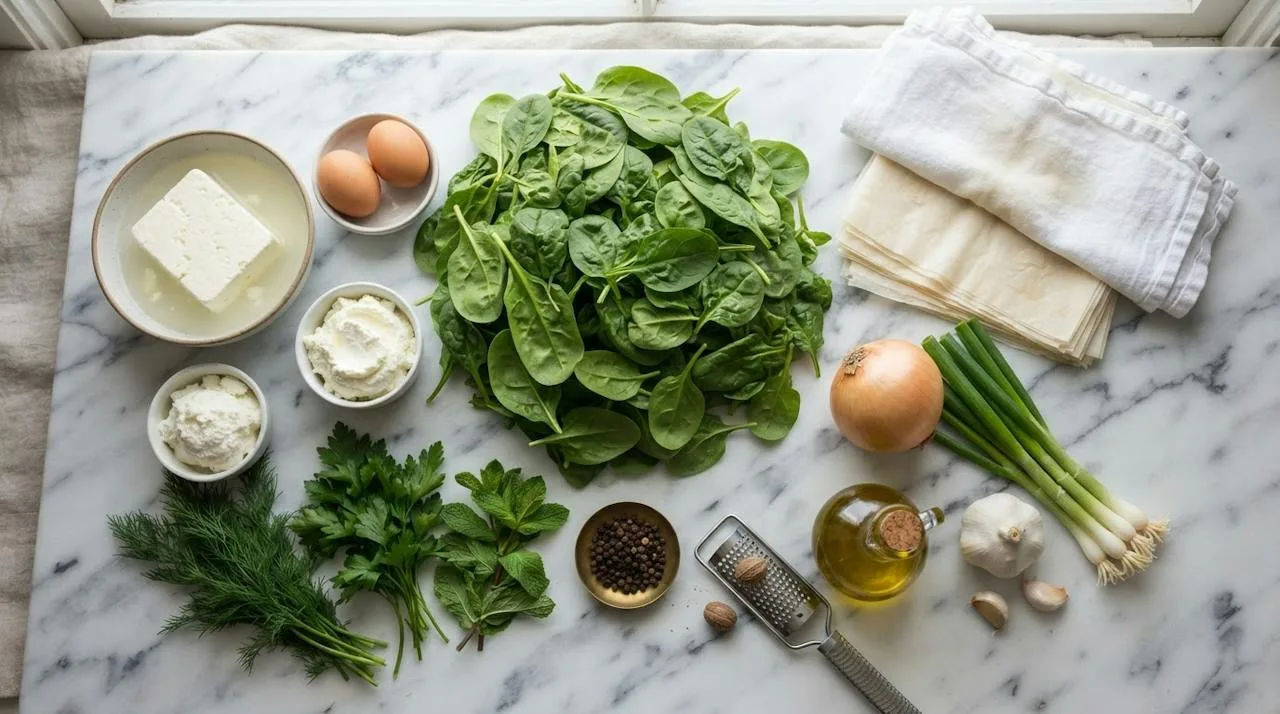
Shopping list
Send the list to yourself via WhatsApp or email.
- 1,000 g fresh spinach
- 250 g Greek sheep's milk feta in brine
- 150 g whole-milk ricotta
- 2 large eggs
- 120 g yellow onion
- 80 g scallions
- 2 garlic cloves (8 g)
- 25 g fresh dill
- 12 g fresh parsley
- 8 g fresh mint
- Black pepper and whole nutmeg
- 1 package phyllo, 16 sheets (about 450 g, 33 x 23 cm)
- Extra virgin olive oil (105 ml)
Cost check: my ingredients came to about $16.85 at a Walmart supermarket in October 2026, about $2.81 per serving.
Before You Start: What to Watch For
- Squeeze the spinach until it’s damp, not dripping. When you squeeze it again, only a little liquid should come out. Frozen spinach was much harder to get this dry.
- Use a metal pan. My 33 × 23 cm metal pan, about 3 cm deep, browned the bottom far better than a glass dish of the same size.
- Bake below the center. I used a conventional oven (no fan) at 200°C with the rack one position below the middle.
- Keep the phyllo under a slightly damp towel. Damp, not wet, or the sheets turn sticky.
- Brush lightly. About 5 to 6 ml olive oil per sheet; 90 ml covers all 16. My guide on how to cook with olive oil explains why I bake with it instead of butter.
- Balance the herbs. Dill leads (25 g), with parsley (12 g) and a smaller amount of mint (8 g) keeping the filling fresh without tasting minty. My Mediterranean herbs and spices guide covers all three.
Doneness Cues at a Glance
| Stage | Look | Feel or sound | Smell or taste |
|---|---|---|---|
| Squeezed spinach | Damp but not dripping | ||
| Onion | Soft, translucent, first pale-golden edges | Garlic sweet, not browned | |
| Filling | No free liquid in the bowl | Moist, holds together when pressed | |
| After 30 minutes in the oven | Pale golden, starting to blister | Edges clearly crisp | |
| Done (about 49 minutes) | Deep golden brown, raised layers; underside golden | Bottom dry, not pale or greasy | |
| After the 35-minute rest | Distinct cut edge | Pieces lift without the filling sliding |
What time do you want to eat?
Pick the column with your dinner time. Have the pie assembled and the oven hot by the first time shown.
| Step | Eat at 18:30 | Eat at 19:00 | Eat at 19:30 |
|---|---|---|---|
| Pie assembled and scored, oven at 200°C: start baking | 17:06 | 17:36 | 18:06 |
| First check: pale golden, starting to blister | 17:36 | 18:06 | 18:36 |
| Deep golden and dry underneath: take it out and rest | 17:55 | 18:25 | 18:55 |
| Cut along the scoring and serve | 18:30 | 19:00 | 19:30 |
Method
- Wilt the spinach. Cook the fresh spinach in a large skillet with the 15 ml olive oil over medium-high heat for about 4 minutes, turning often, until every leaf has collapsed and no large dry leaves remain. Mine went from 1,000 g to about 610 g.
- Cool it. Tip the spinach into a colander and let it cool for about 8 minutes, until you can handle it.
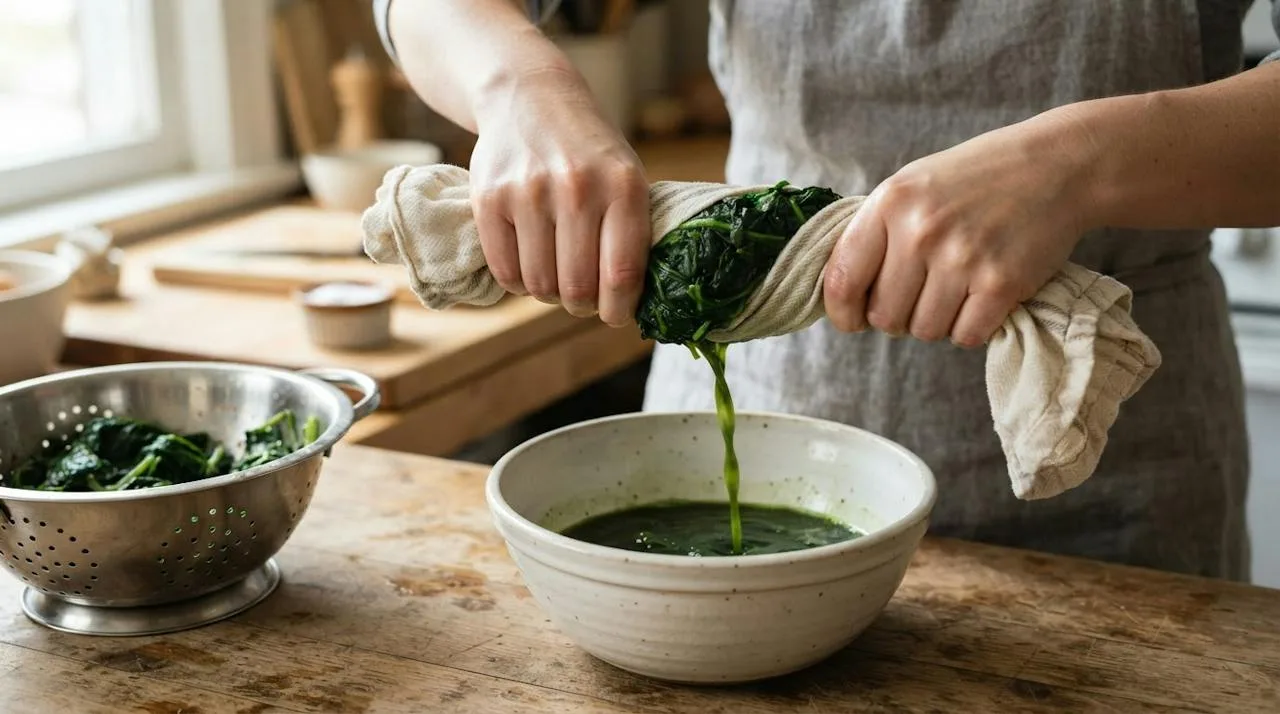
- Squeeze it dry. Gather the spinach in a clean cotton towel and squeeze firmly over the sink for about 2 minutes. About 190 g of liquid came out of mine, leaving about 420 g. It should feel damp but not dripping. Chop it into shorter strands.
- Cook the onion. In the same skillet, cook the onion (and any chopped thick spinach stems) over medium heat for about 6 minutes, until soft and translucent with the first pale-golden edges. Add the garlic for the final 45 seconds so it stays sweet. Take it off the heat and cool for 5 minutes.
- Make the filling. In a large bowl, gently combine the spinach, onion and garlic, scallions, feta, ricotta, eggs, dill, parsley, mint, pepper and nutmeg with a wooden spoon. It should be moist but hold together when pressed, with no liquid pooling in the bowl. Mine weighed about 1,030 g.
- Heat the oven. Preheat to 200°C conventional (no fan), with a rack one position below the center.
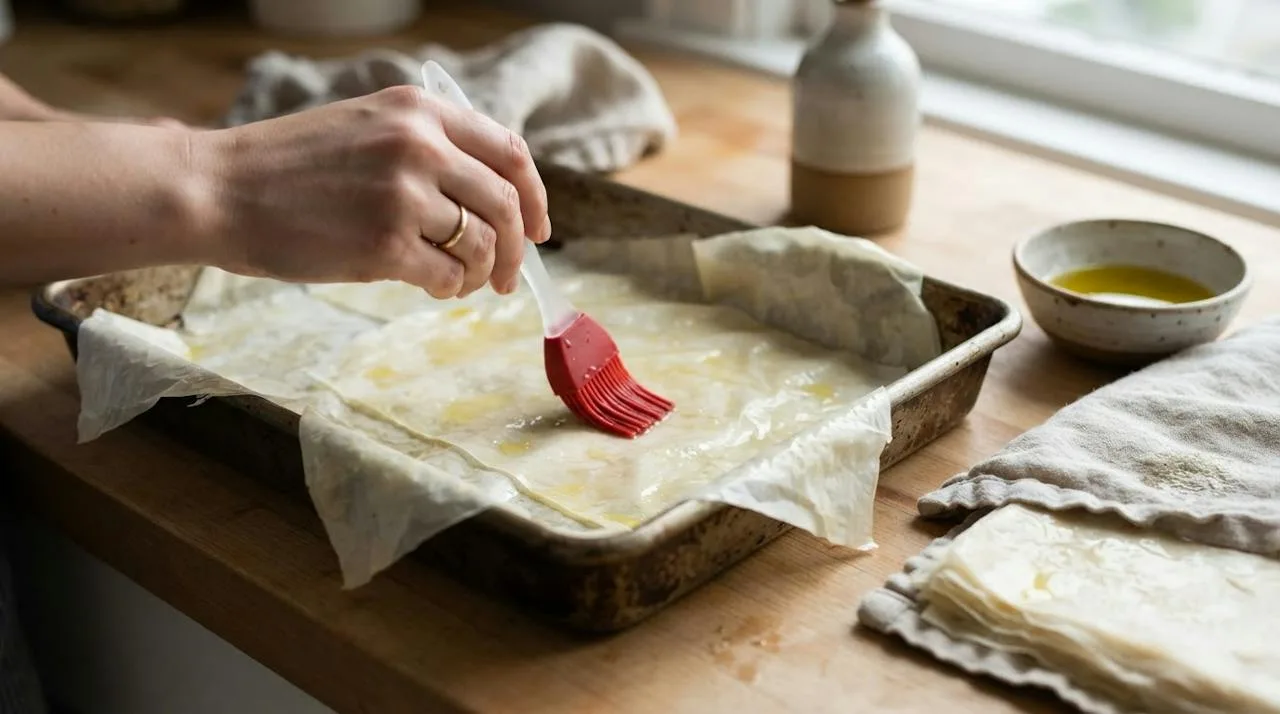
- Build the base. Brush the metal pan lightly with olive oil. Lay in a phyllo sheet with the edges hanging over the sides and brush it lightly with oil. Repeat until you have 8 sheets, brushing each one and rotating them slightly so the corners don’t all overlap in the same place.
- Add the filling. Spread it evenly and press it gently into the corners without compacting it.
- Top the pie. Layer the remaining 8 sheets, brushing each one, and give the last sheet a slightly heavier brushing. Fold the overhanging edges inward around the filling to form a thicker rim and brush the edge with the remaining oil.
- Score it. With a sharp knife, score the top into 12 pieces, cutting through the phyllo but only lightly into the filling. Don’t sprinkle water on top.
- Bake. Bake for 30 minutes, until the top is pale golden, starting to blister and clearly crisp at the edges. Continue for another 18 to 20 minutes, about 49 in total, until the top is deep golden brown with crisp, raised layers. Lift one corner with a spatula: the underside should be golden and dry, not pale or greasy.
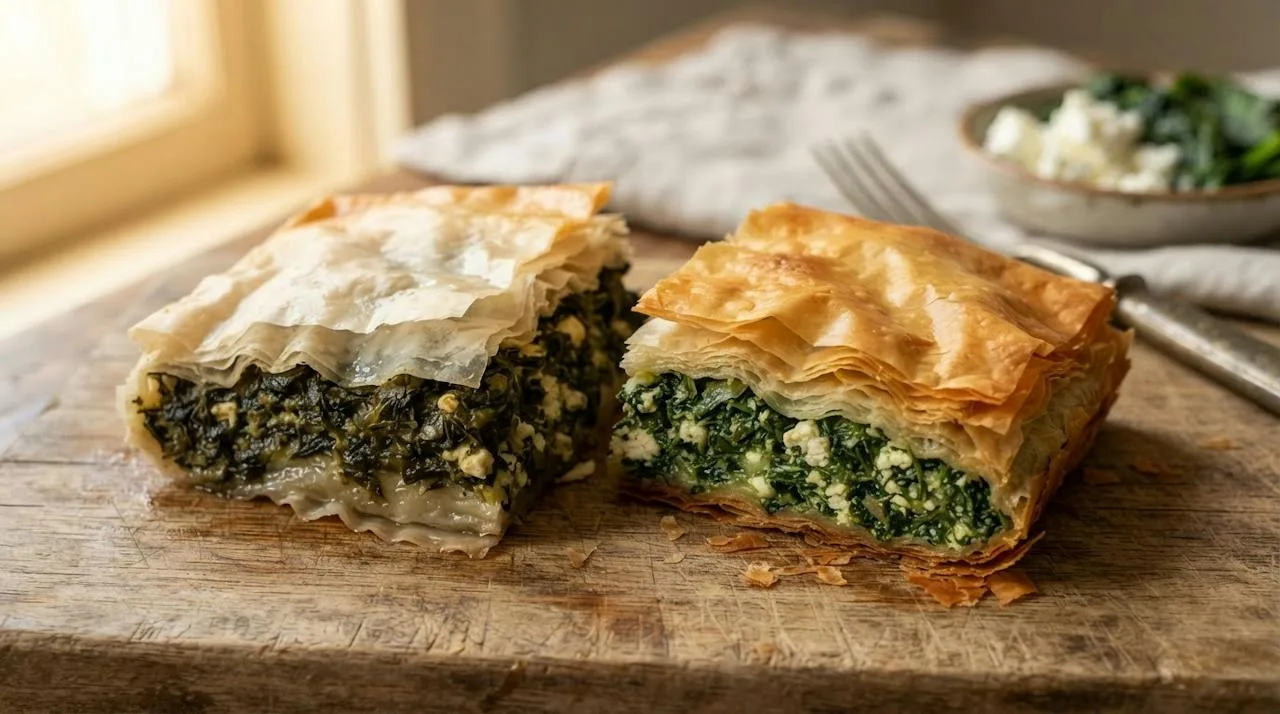
- Rest for 35 minutes. Cutting immediately made the filling look softer and compressed the layers. After 35 minutes, the filling had firmed, the cut edge stayed distinct and the bottom stayed crisp.
- Cut and serve. Cut along the scoring lines into 12 pieces and lift them out.
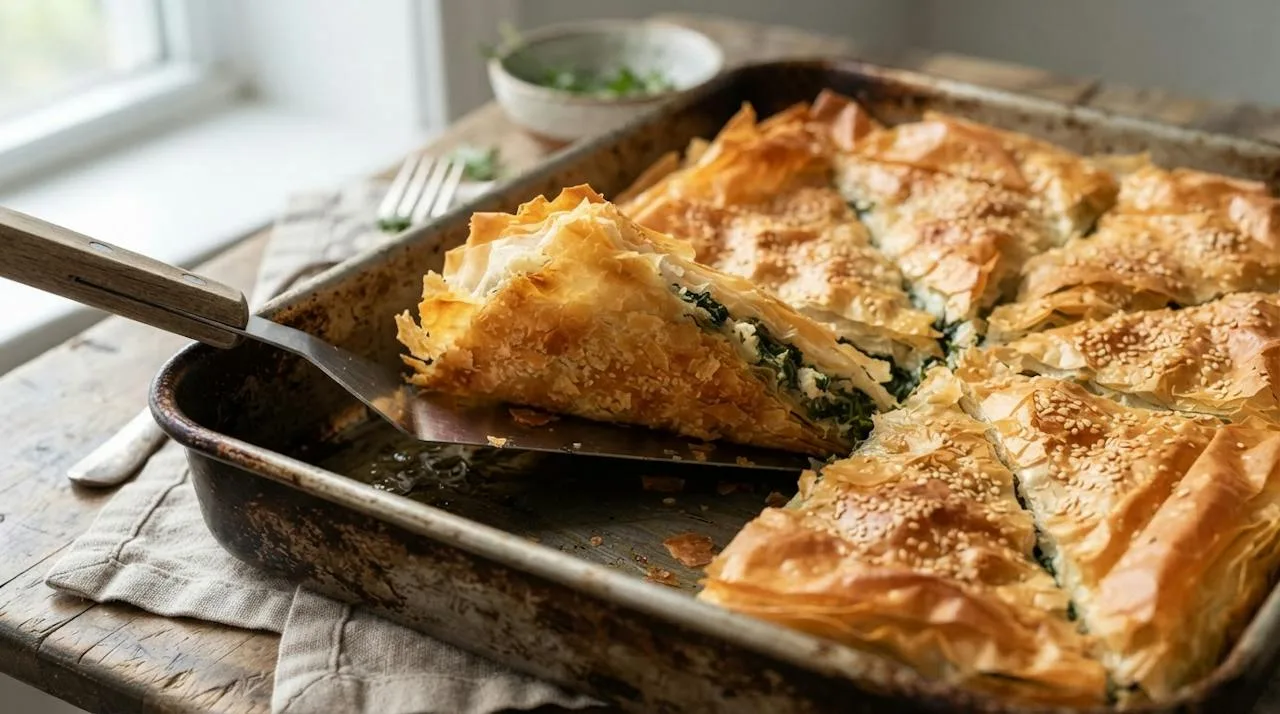
The USDA advises cooking dishes that contain eggs to 160°F (71°C). I judged doneness by the color and the dry, golden bottom and didn’t take the filling’s temperature, so use an instant-read thermometer in the center if you want to confirm.
Timing: the timed prep steps (wilting, cooling, squeezing and the onion) take about 26 minutes, plus mixing and assembly. Then 49 minutes in the oven and a 35-minute rest.
Tested Substitutions
| Original ingredient | Tested substitute | Result |
|---|---|---|
| 1,000 g fresh spinach | 800 g frozen spinach | Convenient, but it held more moisture even after squeezing (380 g, with only about 140 g of liquid removed) and gave a softer bottom. |
| 90 ml olive oil | Butter (half-size comparison) | Darker, more buttery and more dramatic browning, but the top was more brittle and the pie tasted heavier. |
| 150 g ricotta | No ricotta (batch 1, with 300 g feta) | More intensely feta-forward, but looser and saltier. |
| Spinach | Chard or other greens (untested) | I haven’t tried this yet. Let me know in the comments. |
| Spinach filling | With leeks (untested) | I haven’t tried this yet. Let me know in the comments. |
| Feta | Vegan feta (untested) | I haven’t tried this yet. Let me know in the comments. |
| Phyllo | Gluten-free phyllo (untested) | I haven’t tried this yet. Let me know in the comments. |
| Eggs | No eggs (untested) | I haven’t tried this yet. Let me know in the comments. |
| One large pie | Individual triangles (spanakopitakia) (untested) | I haven’t tried this yet. Let me know in the comments. |
Why This Recipe Can Fail (And How to Fix It)
What went wrong?
Tap your problem to see the cause and the fix.
Soggy bottom
Cause: Wet spinach, too few sheets underneath and too little heat.
Fix: Squeeze the spinach until damp but not dripping, use 8 sheets under the filling, and bake in a metal pan at 200°C below the center for about 49 minutes.
Pale bottom
Cause: A glass dish didn't brown the underside as well.
Fix: Use a metal pan and lift a corner with a spatula to check the bottom before taking the pie out.
Wet, weeping filling
Cause: Frozen spinach still felt wet after squeezing.
Fix: Use fresh spinach, or squeeze frozen spinach much harder, and check that no liquid pools in the bowl after mixing.
Too salty
Cause: 300 g feta plus 1 g salt and no ricotta.
Fix: Use 250 g feta, 150 g drained ricotta and no added salt.
Filling slides out when cut
Cause: Cutting too soon after baking.
Fix: Rest the pie for 35 minutes, then cut along the scoring lines.
Sticky, torn phyllo
Cause: A wet towel makes the sheets stick.
Fix: Keep the sheets under a towel that is only slightly damp.
Common Problems
- Soggy bottom: Wet spinach, too few sheets underneath and too little heat. Squeeze the spinach until damp but not dripping, use 8 sheets under the filling, and bake in a metal pan at 200°C below the center for about 49 minutes.
- Pale bottom: A glass dish didn’t brown the underside as well. Use a metal pan, and check the bottom by lifting a corner with a spatula before you take the pie out.
- Wet, weeping filling: Frozen spinach still felt wet after squeezing, and the filling released moisture in the oven. Use fresh spinach, or squeeze frozen spinach much harder, and check that no liquid pools in the bowl after mixing.
- Too salty: 300 g feta plus 1 g salt and no ricotta was too much. Use 250 g feta, 150 g drained ricotta and no added salt.
- Filling slides out when you cut it: Cutting too soon. Rest the pie for 35 minutes, then cut along the scoring lines.
- Sticky, torn phyllo: A wet towel makes the sheets stick. Keep them under a towel that’s only slightly damp.
Serving Suggestions
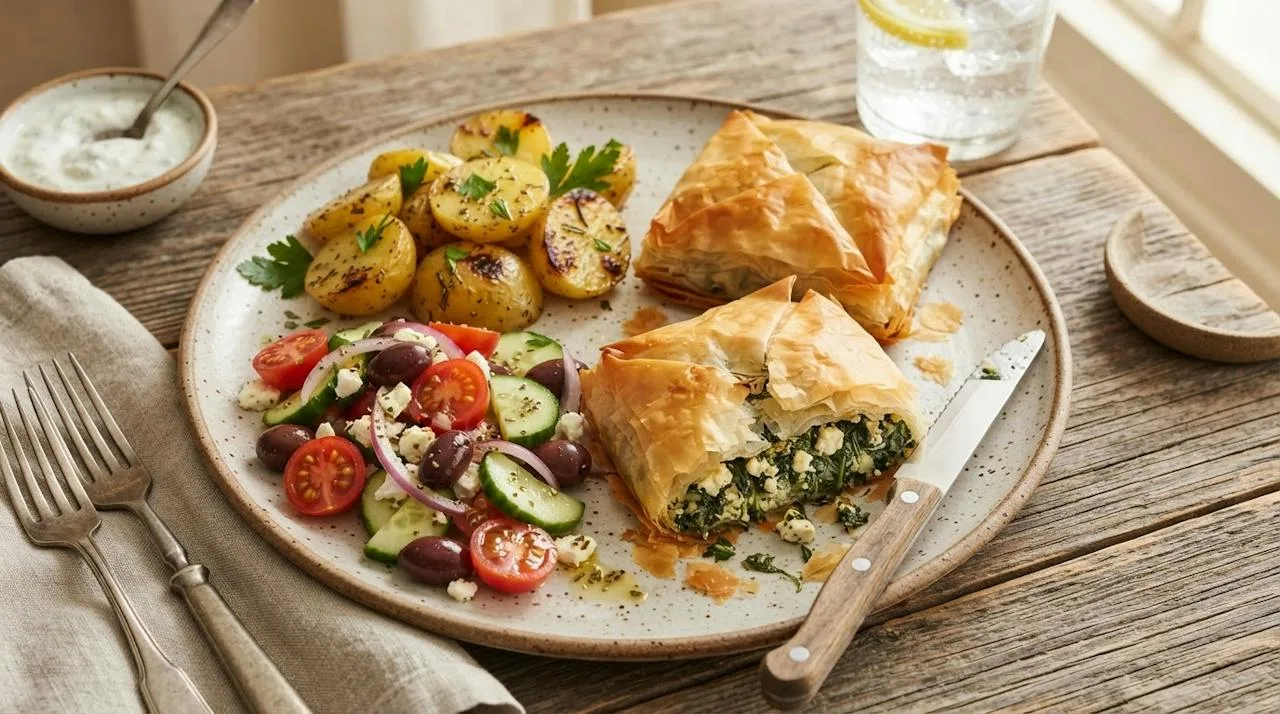
Serve spanakopita warm or at room temperature, two pieces per person as a main or a single piece as part of a Greek spread. I like it with a tray of Greek lemon potatoes and a simple tomato and cucumber salad with olives.
Storage, Reheating and Make-Ahead
I stored the baked pie in a shallow airtight glass container lined with parchment paper, in the refrigerator.
- Day 1: Very crisp top and bottom, filling moist but set. After several hours in the fridge, the top softened slightly but the bottom stayed fairly firm.
- Day 2: The top was noticeably less crisp and the bottom no longer crackly. The filling was slightly firmer and easier to cut, and the feta flavor more pronounced. Reheated at 180°C for 10 to 12 minutes, the top crisped again and the bottom regained most of its texture.
- Day 3: Soft top when cold, firm but not crisp bottom, and the filling still held together. Reheated at 180°C for 12 minutes, it crisped, though not quite as much as on day 1.
- Day 4: Noticeably softer top, slightly leathery edges on the bottom, and a firmer, somewhat drier filling. At 180°C for 13 to 14 minutes the edges crisped, but the center didn’t return to its fresh texture.
The USDA’s leftovers guidance is to eat leftovers within 3 to 4 days, and its egg guidance says to reheat egg dishes to 165°F (74°C), which matches what I found: day 4 is the limit for texture too.
Freezing: Not tested, either baked or unbaked.
What I’d Test Next
- 8 vs. 10 sheets under the filling, with the spinach, feta, oven temperature and bake time kept exactly the same, to see whether a thicker base gives a genuinely crisper bottom or just a heavier pie.
- Freezing, both the baked pie and an assembled, unbaked one.
Mediterranean Secret: Squeeze the spinach until it’s genuinely dry, bake in metal below the center of the oven, and don’t pull the pie until the top is deep golden. Then wait 35 minutes. Patience is the last layer.
With dill on the cutting board and a pie resting on the counter, Nevaeh Hall
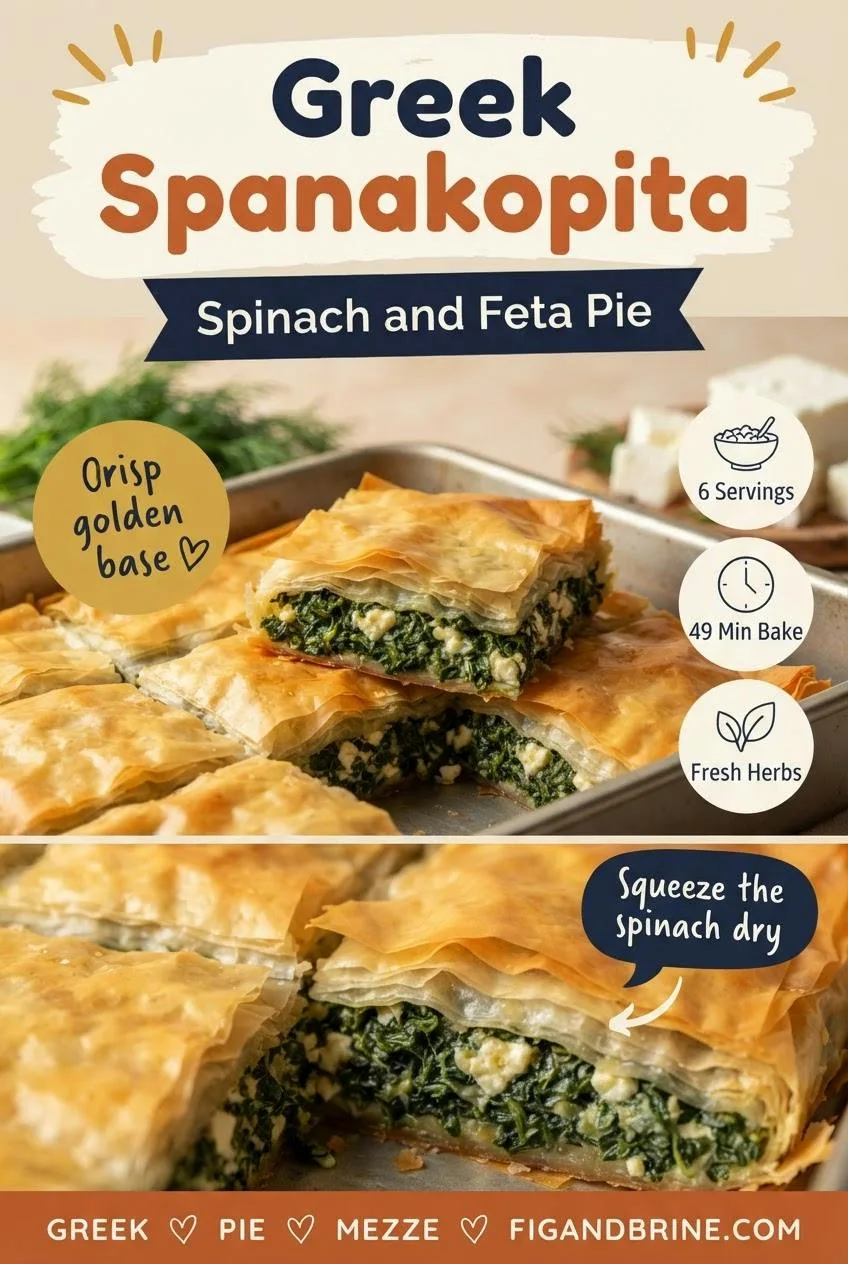

Spanakopita
- Total Time: 1 hour 35 minutes
- Yield: 6 servings
- Diet: Vegetarian
Description
A flaky and savory Greek spinach pie filled with feta, ricotta, and fresh herbs. Perfectly crispy when baked in a metal pan.
Ingredients
- 1,000 g fresh spinach, thick stems trimmed
- 15 ml extra virgin olive oil, for cooking the spinach and onion
- 120 g yellow onion, finely diced
- 8 g garlic (about 2 cloves), finely chopped
- 80 g scallions, thinly sliced
- 250 g Greek sheep’s milk feta, crumbled
- 150 g whole-milk ricotta, drained
- 2 large eggs (about 100 g without shells)
- 25 g fresh dill, chopped
- 12 g fresh parsley, chopped
- 8 g fresh mint, finely chopped
- 2 g black pepper (about ¾ teaspoon)
- 0.5 g freshly grated nutmeg (about ¼ teaspoon)
- 1 package phyllo, 16 sheets (about 450 g), thawed
- 90 ml extra virgin olive oil for brushing
Instructions
- Wilt the spinach: Cook the spinach in a skillet with olive oil over medium-high heat for about 4 minutes, turning often, until wilted.
- Cool it: Transfer the spinach to a colander and let cool for about 8 minutes.
- Squeeze it dry: Gather spinach in a clean towel and squeeze firmly over the sink until about 190 g of liquid is removed.
- Cook the onion: In the same skillet, cook the onion until soft and translucent, then add garlic for the last 45 seconds.
- Make the filling: Combine spinach, onion, garlic, scallions, feta, ricotta, eggs, dill, parsley, mint, pepper, and nutmeg in a large bowl.
- Heat the oven: Preheat to 200°C with a rack one position below the center.
- Build the base: Brush a metal pan lightly with olive oil, layer in 8 sheets of phyllo, brushing each one with oil.
- Add the filling: Spread it evenly and press gently into the corners.
- Top the pie: Layer the remaining 8 sheets, brushing with oil, and fold the edges inward.
- Score it: Cut the top into 12 pieces, cutting through the phyllo but not into the filling.
- Bake: Bake for about 49 minutes until golden brown, then let rest for 35 minutes.
- Cut and serve: Cut along the scoring lines into 12 pieces.
Notes
Ensure the spinach is well-squeezed to prevent a soggy bottom. Use a metal pan for best results.
- Prep Time: 26 minutes
- Cook Time: 49 minutes
- Category: Main Course
- Method: Baking
- Cuisine: Greek


