

Thick Greek Tzatziki (Salted and Squeezed Cucumber, Tested Three Ways)
Good tzatziki is cool, thick and garlicky, the kind of dip that clings to a wedge of warm pita instead of sliding off it. Watery tzatziki, with a thin pool of liquid on top and a loose, runny body, is what you get when the cucumber goes in straight from the grater.
The cucumber is the problem and the solution. According to UMass Amherst, cucumbers are 95% water, and every gram of that water you leave in ends up in your dip. So I tested three ways of preparing the same grated cucumber side by side, and weighed what was left.
My finding: salting the grated cucumber for 10 minutes before squeezing pulled out more water than squeezing alone. From 146 g of grated cucumber, hand-squeezing left 112 g. Salting first and then squeezing left 101 g, 11 g less. That tzatziki also had the least liquid on top after an hour. If you like to strain your own yogurt, my homemade labneh uses the same idea of letting whey drain away. Follow this recipe, and you’ll get a thick, creamy tzatziki with a clean, garlicky tang.

What I Learned From Testing This Recipe
Recipe Testing Note Tested in 6 batches across 3 sessions: September 18, September 26 and October 4, 2026. The final version is batch F. Equipment: box grater (coarse side), a thin clean kitchen cloth for squeezing, a kitchen scale. Key variables tested: cucumber added directly vs. hand-squeezed vs. salted and squeezed (side by side); red wine vinegar vs. lemon juice (side by side). Measured: cucumber weight before and after each treatment, liquid removed, liquid pooled on top after 1 hour, and the finished weight of the final batch (637 g).
The first session was about the cucumber. I grated cucumber and weighed out three equal 146 g portions. Batch A went into the yogurt straight from the grater. Batch B was squeezed by hand in a cloth. Batch C was mixed with 1 g of salt, left for 10 minutes and then squeezed.
Batch A was the problem. Nothing had been removed, so all 146 g of cucumber and its water went into the dip, and after one hour there was 12 ml of liquid sitting on top. Batch B lost 34 g in the cloth and pooled 3 ml. Batch C lost about 45 g and pooled just 1 ml.
The second session compared acids, and the final session put the winners together in a full-size batch.
What I changed after testing: I stopped adding grated cucumber straight to the yogurt and started salting it for 10 minutes and squeezing it in a cloth. In the 146 g test, the cucumber went from 146 g to 101 g, and the liquid on top after 1 hour dropped from 12 ml to 1 ml.
Side-by-Side Results
Each batch started with 146 g of grated cucumber.
| What I measured | A: Added directly | B: Hand-squeezed | C: Salted 10 minutes, then squeezed |
|---|---|---|---|
| Cucumber before | 146 g | 146 g | 146 g |
| Salt used to prepare it | 0 g | 0 g | 1 g |
| Cucumber after | 146 g | 112 g | 101 g |
| Removed | 0 g | 34 g | About 45 g |
| Liquid on top after 1 hour | 12 ml | 3 ml | 1 ml |
| My pick | Too watery | Better | Best: the final recipe |
How this recipe evolved
Tap each session to see what I tested and what I measured.
Session 1 (September 18): three cucumber methods
146 g grated cucumber per batch.
A, added directly: 146 g, 12 ml on top after 1 hour.
B, hand-squeezed: 112 g, 3 ml on top. C, salted 10 minutes then squeezed: 101 g, 1 ml on top.
Session 2 (September 26): vinegar vs. lemon
3 g red wine vinegar: a classic, rounded tang.
3 g lemon juice: brighter and more citrusy. Vinegar won.
Session 3 (October 4): the final recipe
400 g Greek yogurt, 300 g cucumber (salted and squeezed), red wine vinegar.
637 g finished: 6 servings of about 106 g.
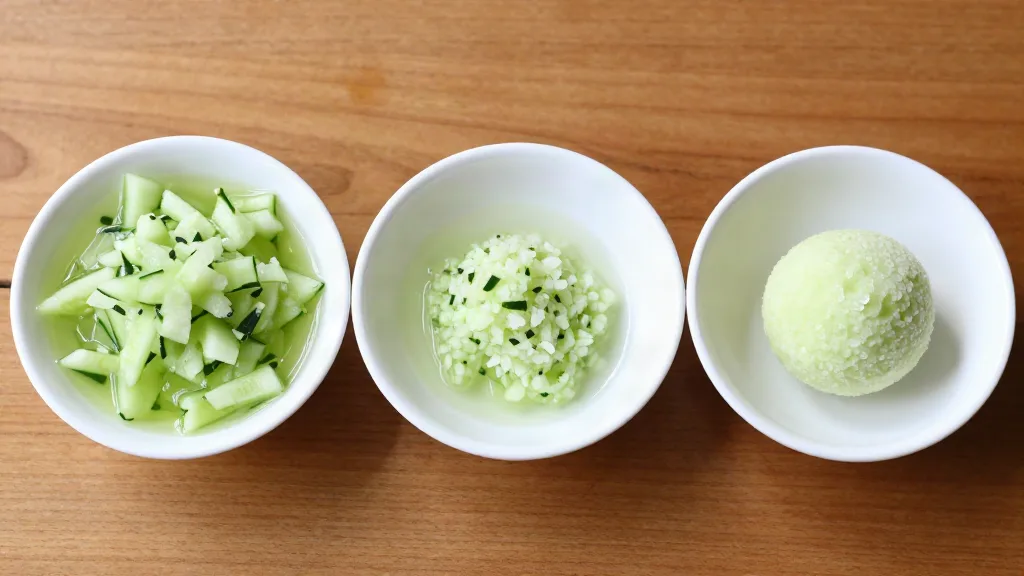
In the second session, I made two small batches with 120 g Greek yogurt, 101 g squeezed cucumber, 1.5 g grated garlic, 4 g olive oil and 1 g dill each, changing only the acid.
| What I compared | D: 3 g red wine vinegar | E: 3 g lemon juice |
|---|---|---|
| Taste | A classic, rounded tang | Brighter and more citrusy |
| Texture | Creamy | Creamy |
| My pick | Red wine vinegar | A good alternative |
Ingredients
Makes about 637 g, or 6 servings of about 106 g
- 400 g thick Greek yogurt (I prefer 10% fat for the thickest result)
- 300 g cucumber, weighed before trimming
- 2 g fine salt for the cucumber (about ⅓ teaspoon)
- 6 g garlic, finely grated (about 2 small cloves)
- 15 g extra-virgin olive oil (about 1 tablespoon), plus a little to finish
- 10 g red wine vinegar (about 2 teaspoons)
- 4 g fresh dill, finely chopped
- Up to 1 g extra fine salt, only if needed after tasting
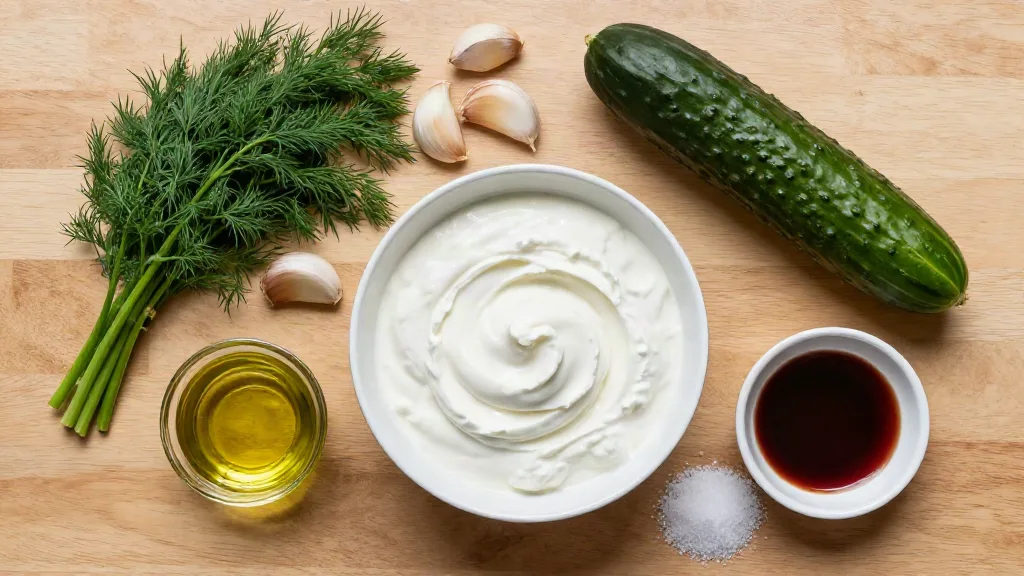
Shopping list
Send the list to yourself via WhatsApp or email.
- 400 g thick Greek yogurt (10% fat preferred)
- 300 g cucumber
- 6 g garlic (about 2 small cloves)
- 4 g fresh dill
- Extra-virgin olive oil (15 g)
- Red wine vinegar (10 g)
- Fine salt (2 g, plus up to 1 g)
- Pita and vegetables to serve
By the Numbers
- Batches: 6, across 3 sessions
- Cucumber, salted and squeezed: 146 g to 101 g (about 45 g removed, roughly 31%)
- Cucumber, squeezed only: 146 g to 112 g (34 g removed)
- Liquid on top after 1 hour: 12 ml unsqueezed, 3 ml squeezed, 1 ml salted and squeezed
- Final batch: 637 g, 6 servings of about 106 g
Before You Start: What to Watch For
- Use thick Greek yogurt. The thicker the yogurt, the more cucumber it can carry without turning loose. I prefer 10% fat.
- Grate on the coarse side. Coarse shreds keep a little texture and are easy to squeeze.
- Salt, wait, then squeeze. Ten minutes with salt draws water to the surface of the cucumber, so the cloth can take more of it out. In my test, that removed 11 g more than squeezing alone.
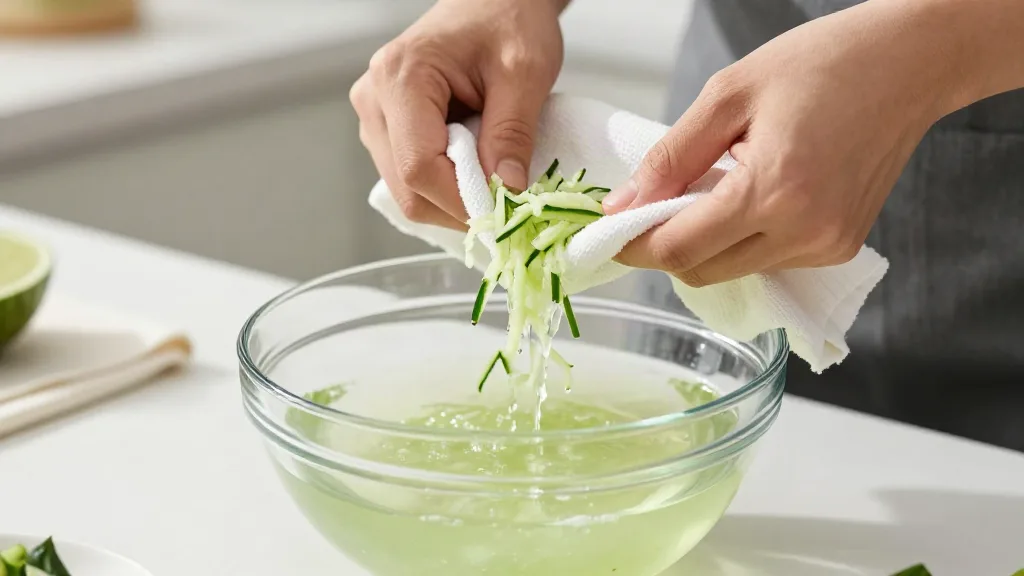
- Squeeze until it stops dripping. Twist the cloth firmly over a bowl until the liquid stops flowing freely. The cucumber should look compact, not wet.
- Taste before you salt again. The cucumber is already salted, so the dip may need very little extra.
- Chill it. At least 1 hour in the fridge gives the flavors time to combine.
- Use a good oil. With so few ingredients, the olive oil really shows. My guide on how to read an olive oil label explains what to look for.
Doneness Cues at a Glance
| Stage | Look | Feel |
|---|---|---|
| Squeezed cucumber | Liquid has stopped flowing from the cloth | Compact, not dripping |
| Finished tzatziki | Thick, holds its shape on a spoon | Creamy, not runny |
| After 1 hour chilled | About 1 ml of liquid on top in my test | Thick and spoonable |
Method
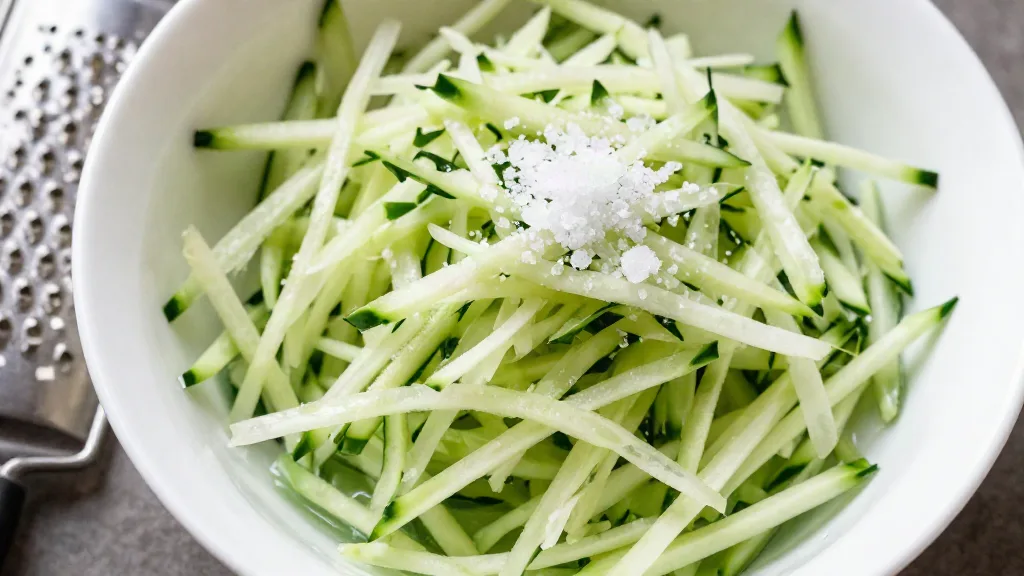
- Grate the cucumber. Wash 300 g cucumber, trim the ends and grate it on the coarse side of a box grater. I left the peel and seeds in.
- Salt it. Mix the grated cucumber with 2 g fine salt and leave it for 10 minutes. The salt starts drawing water out of the shreds.
- Squeeze it hard. Tip the cucumber into a thin, clean kitchen cloth, gather the corners and twist firmly over a bowl until the liquid stops flowing freely. In my 146 g test, salting and squeezing removed about 45 g; at this size, expect roughly 200 g of squeezed cucumber, though it varies with the cucumber.
- Mix the base. Put 400 g thick Greek yogurt in a bowl and stir in 6 g grated garlic, 15 g olive oil, 10 g red wine vinegar and 4 g chopped dill.
- Fold in the cucumber. Add the squeezed cucumber and fold it through until evenly distributed. The tzatziki should hold its shape on a spoon.
- Taste and salt. Taste before adding anything. Add up to 1 g more salt only if it needs it.
- Chill. Cover and refrigerate for at least 1 hour before serving. It can also rest overnight.
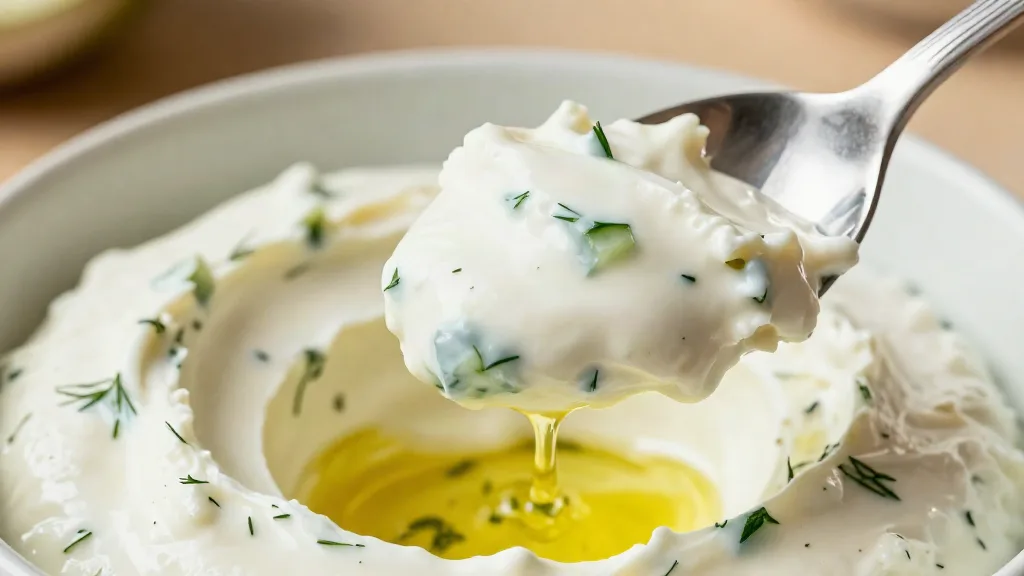
- Serve. Spoon into a bowl, swirl the top with the back of a spoon and finish with a thread of olive oil and a little extra dill.
Tested Substitutions
| Original ingredient | Tested substitute | Result |
|---|---|---|
| Salted and squeezed cucumber | Squeezed only, no salt (tested) | 146 g went to 112 g instead of 101 g; 3 ml on top after 1 hour instead of 1 ml. A good fallback if you’re short on time. |
| Salted and squeezed cucumber | Added straight from the grater (tested) | No water removed; 12 ml pooled on top after 1 hour. Not recommended. |
| Red wine vinegar | Lemon juice, same amount (tested) | Brighter and more citrusy, equally creamy. A good alternative if you prefer lemon. |
| Thick Greek yogurt | Homemade strained yogurt (untested here) | I haven’t tested it in this recipe. |
| Dill | Mint (untested) | I haven’t tried this yet. Let me know in the comments. |
| 6 g garlic | 3 g garlic (untested) | Next on my list to test. |
Why This Recipe Can Fail (And How to Fix It)
Common Problems
- Watery tzatziki: Unsqueezed cucumber carries all its water into the yogurt; in my test, it pooled 12 ml on top within an hour. Salt the grated cucumber for 10 minutes and squeeze it hard in a cloth.
- Still a little loose after squeezing: Squeezing without salt left 11 g more cucumber (112 g vs. 101 g) and pooled 3 ml. Add the 10-minute salting step before you squeeze.
- Too salty: The cucumber is already salted before it goes in. Taste first and add no more than 1 g extra salt.
- Thin from the start: I only tested this recipe with thick Greek yogurt, and that’s what holds the cucumber. Use thick Greek yogurt; I prefer 10% fat.
- Flavors taste separate: The garlic, dill and acid need time to combine. Chill the tzatziki for at least an hour, or overnight, before serving.
- Too sour or too citrusy: Add the acid with a light hand. Red wine vinegar gave a rounded tang; lemon is brighter if you prefer it.
What went wrong?
Tap your problem to see the cause and the fix.
Watery tzatziki
Cause: Unsqueezed cucumber carries all its water in; it pooled 12 ml on top within an hour.
Fix: Salt the grated cucumber for 10 minutes and squeeze it hard in a cloth.
Still a little loose
Cause: Squeezing without salt left 112 g instead of 101 g and pooled 3 ml.
Fix: Add the 10-minute salting step before you squeeze.
Too salty
Cause: The cucumber is already salted before it goes in.
Fix: Taste first and add no more than 1 g extra salt.
Thin from the start
Cause: I only tested thick Greek yogurt, and that's what holds the cucumber.
Fix: Use thick Greek yogurt; I prefer 10% fat.
Flavors taste separate
Cause: The garlic, dill and acid need time to combine.
Fix: Chill for at least an hour, or overnight, before serving.
Too sour or too citrusy
Cause: The acid went in with a heavy hand.
Fix: Red wine vinegar gave a rounded tang; lemon is brighter if you prefer it.
Serving Suggestions
Serve tzatziki cold with warm pita and raw vegetables, or as the cool side to hot, crisp food. It’s especially good with crispy falafel made from dried chickpeas, next to golden Greek lemon potatoes, or alongside a slice of spinach and feta spanakopita.
Storage, Reheating & Make-Ahead
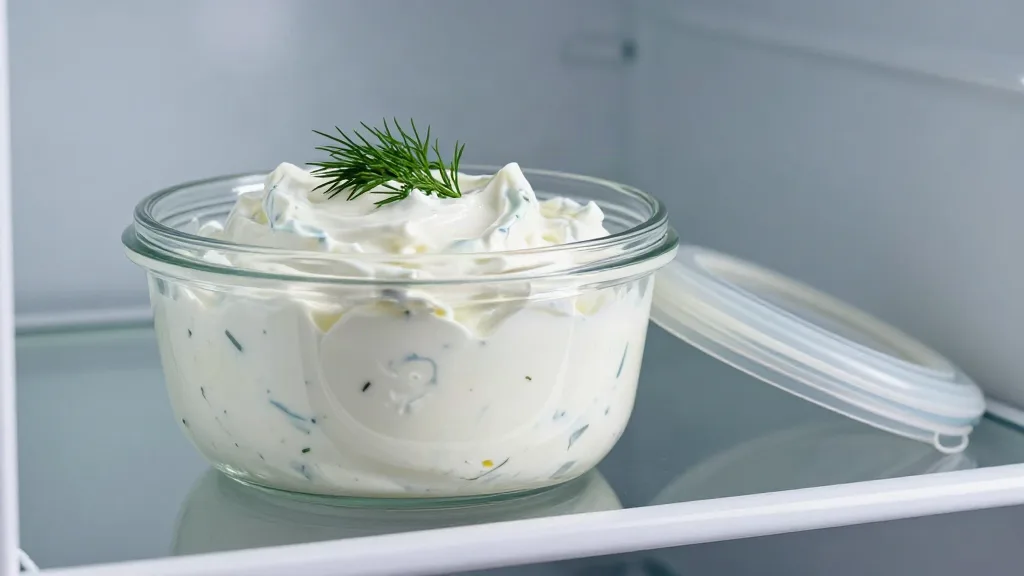
Keep tzatziki covered in the fridge. I didn’t track how it changed over several days, so I won’t give you texture notes I don’t have. The USDA advises refrigerating perishable food within 2 hours and using leftovers within 3 to 4 days.
For make-ahead, the recipe can rest overnight in the fridge before serving. If a little liquid appears on top, stir it back in or pour it off. Don’t reheat or freeze it; freezing wasn’t tested.
The Harvard T.H. Chan School of Public Health describes Greek yogurt as yogurt strained to remove the whey, which is exactly why it makes a thicker tzatziki than regular yogurt.
What I’d Test Next
- 3 g vs. 6 g garlic in two otherwise identical full-size batches, checking flavor at 1 hour and at 24 hours.
- Pooled liquid over several days, measured before stirring, to see how long the salted-and-squeezed version holds.
- Mint instead of dill, for a different herb note.
Continue Cooking
- Horiatiki, Greek village salad with a whole slab of feta
- Greek briam, oven-roasted summer vegetables
- Smoky baba ganoush


Thick Garlic Tzatziki
- Total Time: 75 minutes
- Yield: 6 servings
- Diet: Vegetarian
Description
A thick, creamy homemade tzatziki that’s cool and garlicky, perfect for dipping pita or vegetables.
Ingredients
- 400 g thick Greek yogurt (preferably 10% fat)
- 300 g cucumber, weighed before trimming
- 2 g fine salt for the cucumber (about ⅓ teaspoon)
- 6 g garlic, finely grated (about 2 small cloves)
- 15 g extra-virgin olive oil (about 1 tablespoon), plus a little to finish
- 10 g red wine vinegar (about 2 teaspoons)
- 4 g fresh dill, finely chopped
- Up to 1 g extra fine salt, only if needed after tasting
Instructions
- Grate the cucumber. Wash 300 g cucumber, trim the ends and grate it on the coarse side of a box grater.
- Salt it. Mix the grated cucumber with 2 g fine salt and leave it for 10 minutes.
- Squeeze it hard. Tip the cucumber into a cloth and twist firmly over a bowl until the liquid stops flowing freely.
- Mix the base. Put 400 g thick Greek yogurt in a bowl and stir in 6 g grated garlic, 15 g olive oil, 10 g red wine vinegar, and 4 g chopped dill.
- Fold in the cucumber. Add the squeezed cucumber and fold it through until evenly distributed.
- Taste and salt. Taste before adding anything and add up to 1 g more salt only if needed.
- Chill. Cover and refrigerate for at least 1 hour before serving.
- Serve. Spoon into a bowl, swirl the top with the back of a spoon and finish with a thread of olive oil and extra dill.
Notes
Use high-quality thick Greek yogurt for the best texture. Chill for an hour to let flavors combine.
- Prep Time: 15 minutes
- Cook Time: 0 minutes
- Category: Dip
- Method: No Cook
- Cuisine: Greek


