

Smoky Baba Ganoush (Oven-Charred and Drained)
There’s a moment when a whole eggplant gives up in the oven. The skin blackens and blisters, the whole thing slumps on the tray, and the kitchen fills with a smell that’s half campfire, half sweet roasted vegetable. That’s the moment baba ganoush begins, and it’s the part most recipes rush.
My testing taught me that the eggplant matters more than the tahini. Roast it until it genuinely collapses, drain the flesh for 20 minutes, and mash it by hand instead of blending it smooth. Then add just enough tahini (75 g for about 520 g of drained eggplant, roughly 1 part to 7) to give it a creamy, nutty depth without hiding the smoke. If you want the full background on roasting whole eggplant, my guide on how to cook eggplant so it’s never bitter or soggy covers it.
Vegetables, olive oil, nuts and seeds sit at the base of the traditional Mediterranean diet pyramid from Oldways, and this dip brings eggplant, olive oil and sesame together in one bowl. Follow this recipe, and you’ll have a soft, slightly chunky baba ganoush that tastes clearly of roasted eggplant.
What I Learned From Testing This Recipe
Recipe Testing Note Tested in 2 main rounds, plus side-by-side tests. Last updated: October 2026. Equipment: home oven at 230°C fan with a baking tray on the upper-middle rack, a gas burner for the flame comparison, a fine-mesh sieve, a knife and fork, and a food processor for the texture comparison. Key variables tested: oven vs. gas flame, drained vs. undrained flesh, tahini and lemon amounts, raw vs. roasted garlic, fork-mashed vs. food processor, globe vs. Italian eggplant.
My first batch was close, but not right. The first taste was slightly too smoky, not quite salty enough and a little heavy from the tahini. I’d used 90 g of tahini, 35 ml of lemon juice and about ¾ teaspoon of salt. The garlic was noticeable but not overpowering, so I kept it at one large clove. (A separate test with 2 raw cloves was far too aggressive.)
Two other tests shaped the final recipe. One batch was mixed straight after scooping, without draining. It was noticeably looser, released liquid around the edges after sitting and needed more tahini to reach the texture I wanted. And one eggplant was so heavily blackened that the smoke turned almost bitter, with a bitter note close to the darkest skin.
For round 2, I drained the flesh for 20 minutes, picked out the thick pieces of burnt skin, cut the tahini to 75 g, raised the lemon to 45 ml and brought the salt up to 1 teaspoon. The balance was much better: smoky, bright and creamy, with the eggplant in front.
What I changed after testing: I reduced the tahini from 90 g to 75 g, increased the lemon juice from 35 ml to 45 ml and the salt from about ¾ teaspoon to 1 teaspoon, because the first batch was heavy and under-seasoned. I also drained the flesh for 20 minutes, because the undrained batch turned loose and weepy.
How this recipe evolved
Tap each round to see what went wrong and what changed.
Round 1: the first batch
90 g tahini, 35 ml lemon juice, about 3/4 teaspoon salt, 1 large garlic clove.
Slightly too smoky, not quite salty enough and a little heavy from the tahini.
Side tests
Undrained flesh: looser dip that released liquid around the edges and needed more tahini.
2 raw garlic cloves: far too aggressive.
Heavily blackened eggplant: the smoke turned almost bitter.
Gas flame: noticeably smokier than the oven; food processor: almost a puree if run too long.
Round 2: the final recipe
Tahini 90 g to 75 g, lemon juice 35 ml to 45 ml, salt about 3/4 teaspoon to 1 teaspoon.
Flesh drained for 20 minutes, thick burnt skin removed, mashed by hand.
Smoky, bright and creamy, with the eggplant in front.
Ingredients
Makes about 650 to 680 g (about 2¾ cups): 4 generous mezze servings or 6 to 8 smaller servings as a dip.
For the baba ganoush:
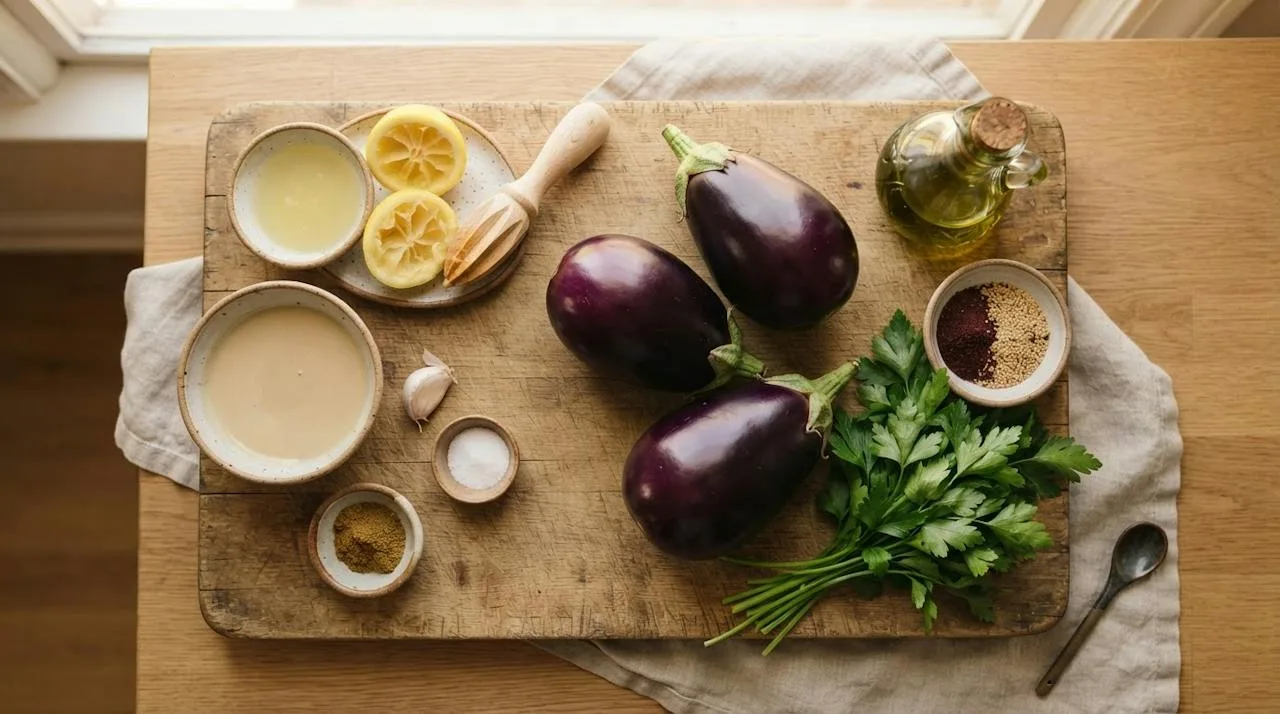
- 3 globe eggplants, about 1.15 kg in total (roughly 350 to 400 g each). This gave me about 520 g of flesh after scooping and draining.
- 75 g runny tahini (a light-colored, pourable tahini; a thicker one made the dip noticeably heavier)
- 45 ml fresh lemon juice
- 1 large garlic clove, about 4 g, grated
- 1 teaspoon fine salt in total: ½ teaspoon mashed with the garlic and ½ teaspoon added during mixing, adjusted to taste
- ½ teaspoon ground cumin
- 1 tablespoon extra virgin olive oil, mixed into the dip
To serve:
- 1 tablespoon extra virgin olive oil
- 2 tablespoons chopped flat-leaf parsley
- Up to ½ teaspoon sumac (optional; I used a small pinch)
- A few sesame seeds
- Warm pita, toasted flatbread and raw vegetables
(Tahini is made from sesame, which the FDA has listed as a major food allergen since 2023, and so are the sesame seeds on top. Keep that in mind if you’re serving guests.)
Shopping list
Send the list to yourself via WhatsApp or email.
- 3 globe eggplants (about 1.15 kg)
- 75 g runny light tahini
- Lemons for 45 ml fresh juice
- 1 large garlic clove
- Fine salt (1 teaspoon)
- Ground cumin (1/2 teaspoon)
- Extra virgin olive oil (2 tablespoons)
- Flat-leaf parsley (2 tablespoons chopped)
- Sumac (optional)
- Sesame seeds
- Pita, flatbread and raw vegetables for serving
Before You Start: What to Watch For
- Roast until it collapses, not just until it’s soft. The eggplant is ready when the skin is heavily blackened and blistered, the whole eggplant has visibly slumped, and a thin knife slides through the center with no resistance. Flesh that still feels springy will taste raw and spongy.
- Pierce the eggplants first. A few knife pokes let steam escape as they roast.
- Expect the tahini to seize. When you whisk tahini into lemon juice, it thickens dramatically and looks almost broken for a moment. Keep going: once you add the eggplant and its moisture, it loosens again. I didn’t need to add any water.
- Don’t squeeze the flesh. Let it drain on its own in the sieve. Pressing it removed some of the roasted texture.
- Remove the thick burnt skin, not every fleck. Thick blackened pieces made the dip bitter, but tiny charred flecks added a pleasant smokiness.
- Want more smoke? A gas flame gave a noticeably smokier eggplant than the oven. It’s the same blistering approach I use in my guide on how to roast and peel peppers.
What time do you want to eat?
Pick the column with your serving time to see when to start each step.
| Step | Eat at 18:00 | Eat at 18:30 | Eat at 19:00 |
|---|---|---|---|
| Heat the oven and pierce the eggplants | 16:10 | 16:40 | 17:10 |
| Roast, turning every 12 to 15 minutes | 16:15 | 16:45 | 17:15 |
| Cool until you can handle them | 17:05 | 17:35 | 18:05 |
| Scoop the flesh and remove thick burnt skin | 17:25 | 17:55 | 18:25 |
| Drain in a fine-mesh sieve | 17:30 | 18:00 | 18:30 |
| Mash the garlic with salt (while it drains) | 17:45 | 18:15 | 18:45 |
| Chop and mash the eggplant | 17:50 | 18:20 | 18:50 |
| Mix with lemon, tahini, cumin and oil | 17:55 | 18:25 | 18:55 |
| Top and serve | 18:00 | 18:30 | 19:00 |
Method
- Heat the oven. Preheat to 230°C fan (about 445°F) with a rack in the upper-middle position.
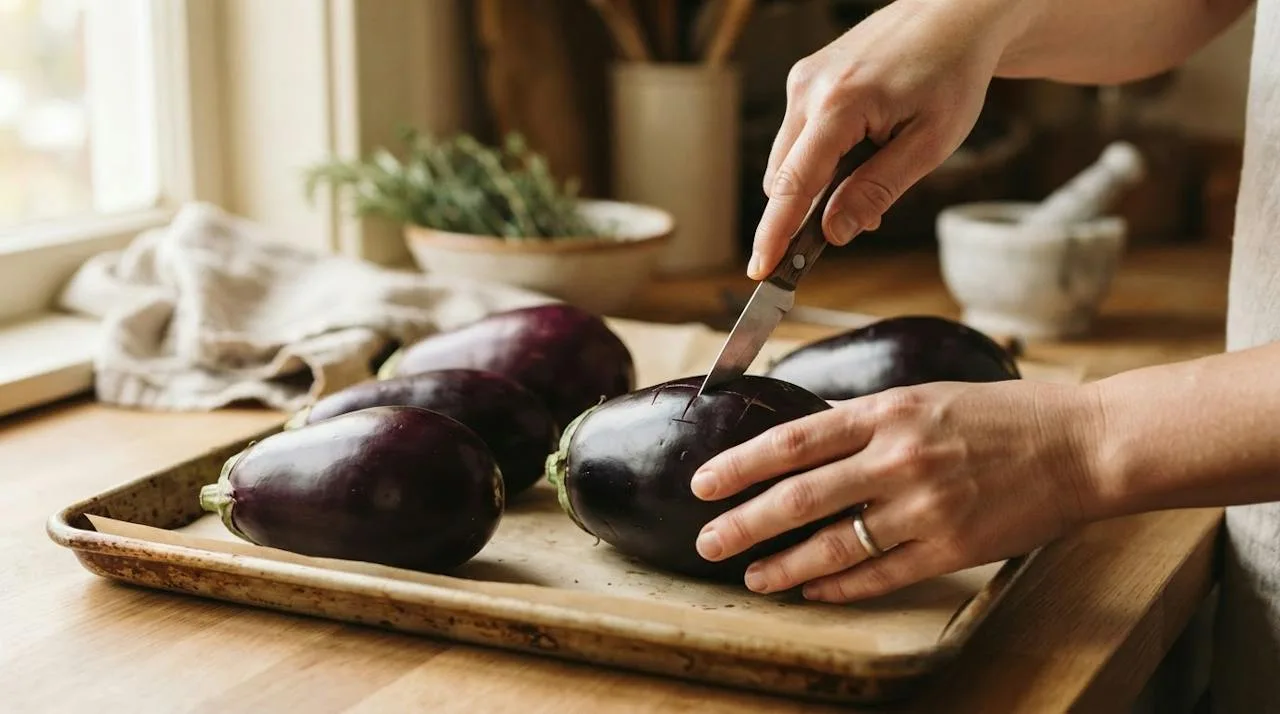
- Pierce the eggplants. Pierce each eggplant in a few places with a small knife and place them whole directly on a baking tray. This takes about 5 minutes.
- Roast and turn. Roast for about 40 to 50 minutes, turning every 12 to 15 minutes, until the skin is heavily blackened and blistered and the eggplants have collapsed. A thin knife should slide easily through the center, and the flesh should feel completely soft rather than springy. My largest eggplant took the full 50 minutes, so check each one separately.
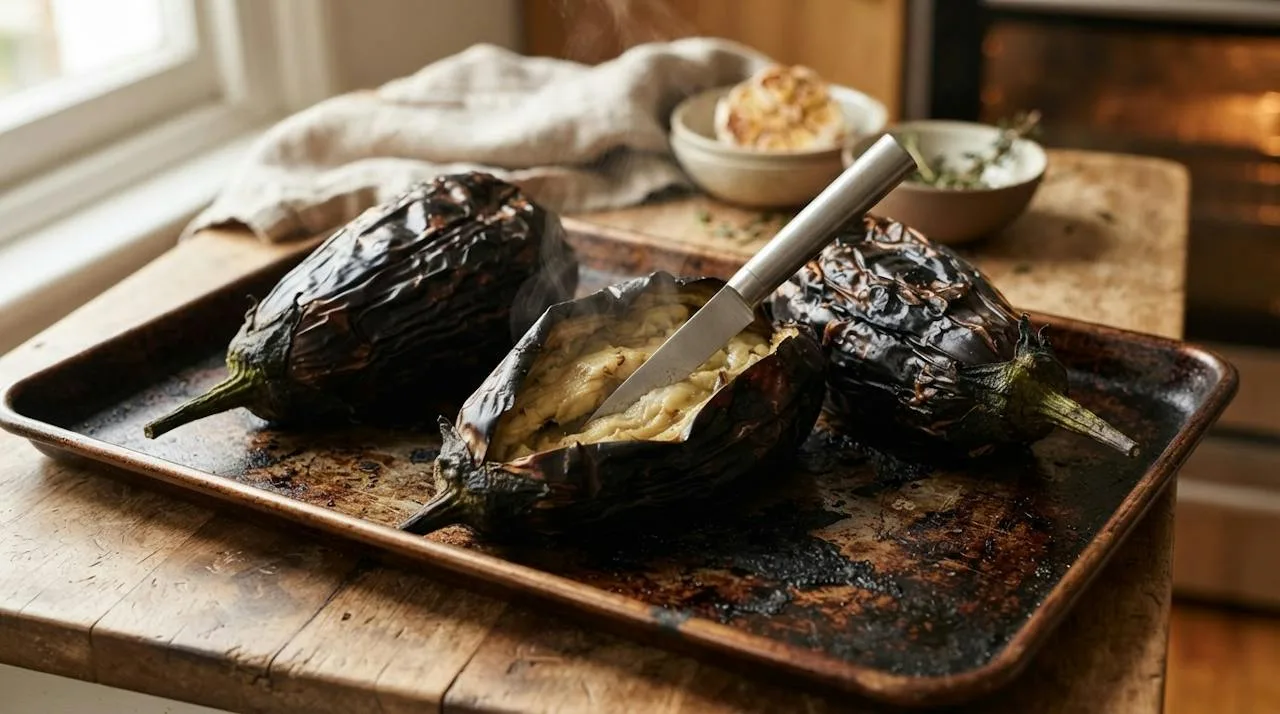
- Cool. Let the eggplants cool for 15 to 20 minutes, until you can handle them comfortably.
- Scoop the flesh. Split each eggplant open and scoop the flesh away from the skin, about 5 minutes. Pick out any thick pieces of blackened skin; leave the tiny charred flecks.
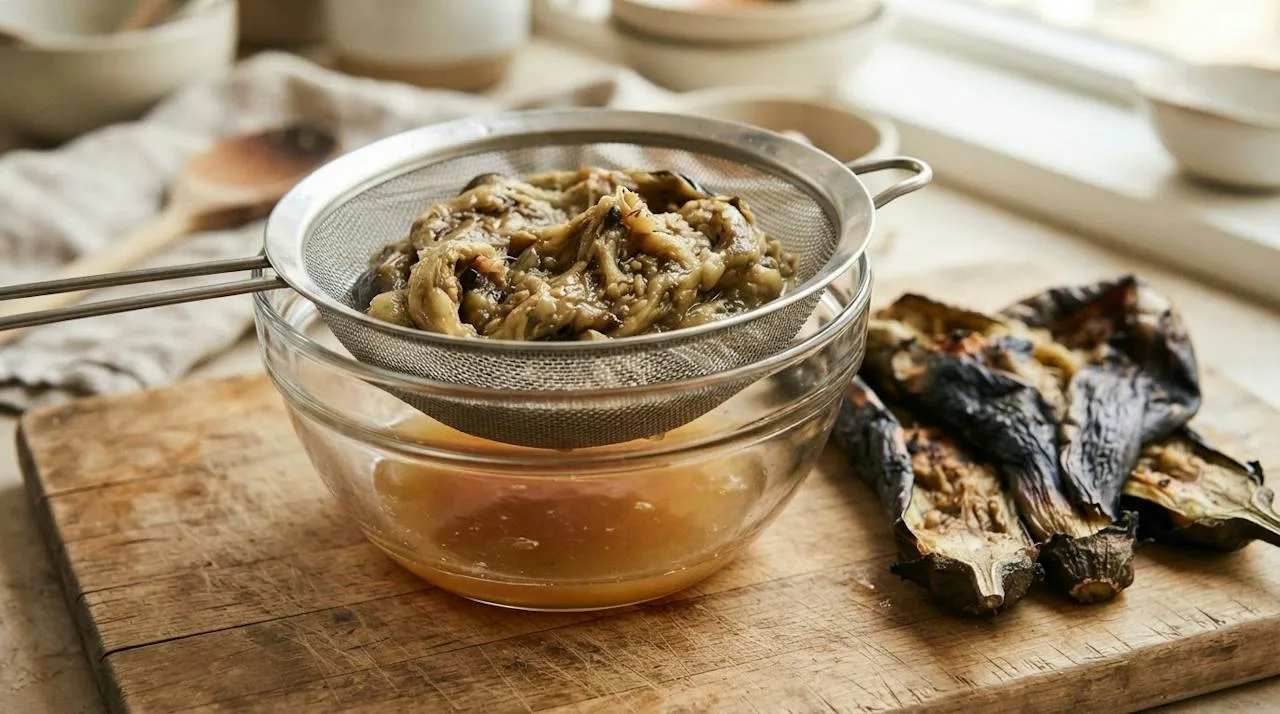
- Drain for 20 minutes. Put the flesh in a fine-mesh sieve set over a bowl and leave it for about 20 minutes, without pressing. From my 3 eggplants, roughly 70 to 90 ml of liquid collected, and the amount varied from eggplant to eggplant. Watery eggplants benefit most.
- Mash the garlic. While the eggplant drains, grate the garlic clove and mash it with ½ teaspoon of the salt into a smooth paste.
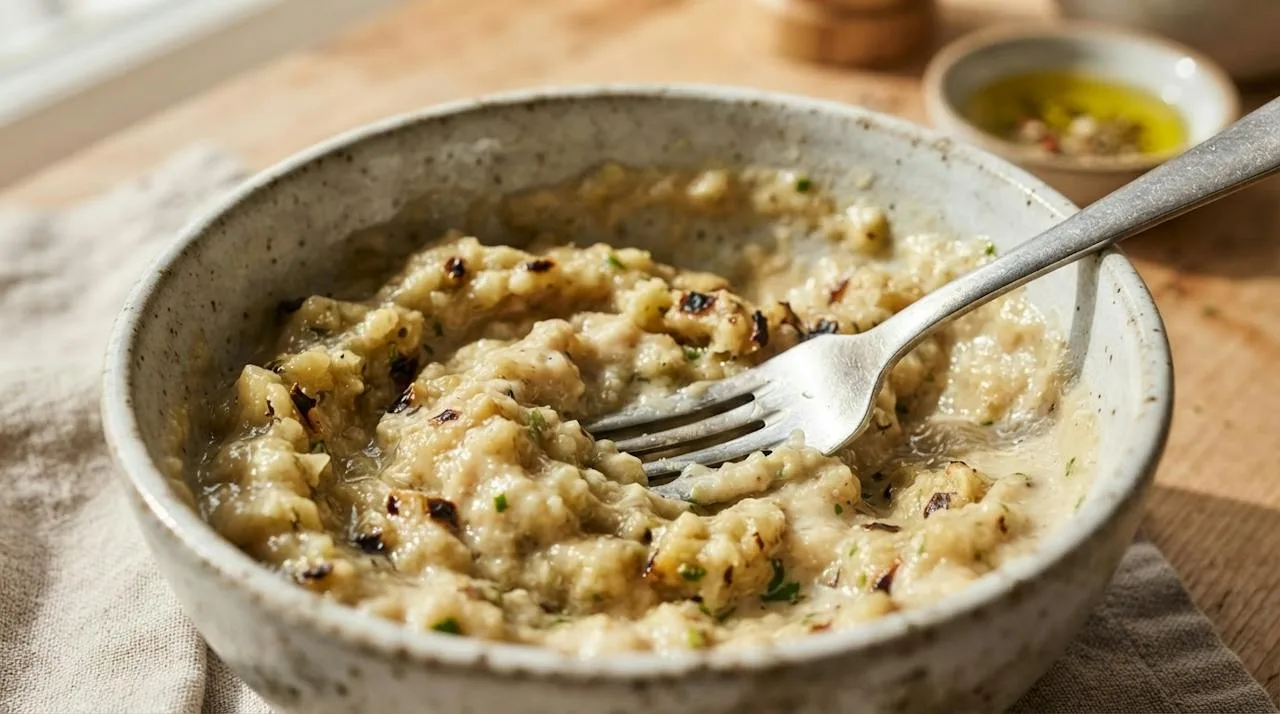
- Chop and mash the eggplant. Roughly chop the drained flesh with a knife, then mash it with a fork, about 5 minutes. You’re aiming for a soft, slightly chunky texture with small pieces of eggplant still visible. (A food processor works if you want it smooth, but stop early; processed too long, mine turned almost into a purée.)
- Build the base. In a mixing bowl, combine the lemon juice and the garlic paste, then whisk in the tahini. It will thicken and look almost seized. That’s normal.
- Fold in the eggplant. Add the mashed eggplant and stir until the tahini mixture loosens and the dip turns creamy and pale.
- Season and finish. Stir in the cumin, the remaining ½ teaspoon of salt and 1 tablespoon of olive oil, about 5 minutes for mixing and seasoning. Taste: it should be smoky, bright with lemon and lightly nutty, with the garlic noticeable but not sharp. Adjust the salt slightly if your tahini or eggplant needs it.
- Serve. Spread the baba ganoush into a shallow bowl, drizzle with 1 tablespoon of olive oil and finish with the parsley, a small pinch of sumac and a few sesame seeds. Serve at cool room temperature.
Gas flame option (for the smokiest version): Instead of the oven, set a whole eggplant directly over a gas flame and turn it every 1 to 2 minutes for about 12 to 15 minutes, until the skin is blackened all over and the flesh is completely soft (the same doneness cues as the oven). I tested this with one eggplant: it had noticeably more smoke flavor, while the oven was easier and more consistent. Never leave an open flame unattended; the U.S. Fire Administration advises staying in the kitchen whenever you cook on the stovetop.
Total time: about 1½ hours, depending on eggplant size (up to about 1 hour 50 minutes if every step runs long). Active hands-on time is only about 20 to 25 minutes.
Tested Substitutions
| Original ingredient | Tested substitute | Result |
|---|---|---|
| Globe eggplant | Italian eggplant | Worked, but gave less flesh and a slightly firmer texture. I prefer globe. |
| Raw garlic | 1 garlic clove roasted alongside the eggplant | Sweeter and much milder. I preferred raw garlic for its freshness. |
| 75 g tahini | 50 g tahini plus 40 g plain unsweetened plant yogurt | Lighter and tangier, but lost some of the characteristic tahini flavor. |
| Tahini | No tahini at all | Tasted strongly of roasted eggplant and lemon, but lacked the creamy, nutty depth of baba ganoush. |
| Runny light tahini | Thicker tahini | Made the dip noticeably heavier. |
| Fork-mashed | Food processor | Smoother and more uniform; easy to over-process into a purée. |
| Tahini | Almond, cashew or peanut butter (untested) | I haven’t tried these yet. Let me know in the comments. |
| Charring the eggplant | Smoked paprika (untested) | I haven’t tried this yet. Let me know in the comments. |
| Oven or gas flame | Air fryer or barbecue grill (untested) | I haven’t tried these yet. Let me know in the comments. |
| No additions | Pomegranate molasses in the dip (untested) | I haven’t tried this yet. Let me know in the comments. |
Why This Recipe Can Fail (And How to Fix It)
Every problem below happened in my testing, and each fix is what solved it.
Common Problems
- Too watery: The eggplant wasn’t drained, so its liquid loosened the dip and seeped out around the edges after sitting. Drain the scooped flesh in a fine-mesh sieve for about 20 minutes; that fixed it without adding more tahini.
- Too smoky or bitter: Heavily blackened skin was mixed into the dip, and the smoke turned almost bitter. Remove the thick pieces of burnt skin before mashing, but keep the small charred flecks for flavor.
- Too garlicky: Two raw cloves were far too aggressive. Use 1 large clove (about 4 g), grated and mashed with salt. For a much milder dip, roast the clove alongside the eggplant instead.
- Too thick and heavy: Too much tahini, or a thick tahini. Reduce it to 75 g of runny, light tahini for about 520 g of drained eggplant, so the eggplant comes forward.
- Flat or bland: Not enough salt or lemon. My first batch needed lemon raised from 35 to 45 ml and salt from about ¾ to 1 teaspoon. Taste after mixing and adjust slightly.
- Pasty, like a generic spread: Over-blending. Chop and mash by hand, or pulse the food processor briefly and stop while it still has some texture.
- Spongy or raw-tasting: The eggplant wasn’t roasted long enough. It should be completely collapsed, and a thin knife should slide through the center with no resistance. Larger eggplants can take the full 50 minutes.
What went wrong?
Tap your problem to see the cause and the fix.
Too watery
Cause: The eggplant wasn't drained, so its liquid loosened the dip and seeped out after sitting.
Fix: Drain the scooped flesh in a fine-mesh sieve for about 20 minutes, without pressing.
Too smoky or bitter
Cause: Heavily blackened skin was mixed into the dip.
Fix: Remove the thick pieces of burnt skin before mashing, but keep the small charred flecks for flavor.
Too garlicky
Cause: Two raw cloves were far too aggressive.
Fix: Use 1 large clove (about 4 g), grated and mashed with salt, or roast it with the eggplant for a much milder dip.
Too thick and heavy
Cause: Too much tahini, or a thick tahini.
Fix: Use 75 g of runny, light tahini for about 520 g of drained eggplant.
Flat or bland
Cause: Not enough salt or lemon.
Fix: The first batch needed lemon raised from 35 to 45 ml and salt from about 3/4 to 1 teaspoon. Taste and adjust slightly.
Pasty, like a generic spread
Cause: Over-blending in the food processor.
Fix: Chop and mash by hand, or pulse briefly and stop while it still has some texture.
Spongy or raw-tasting
Cause: The eggplant wasn't roasted long enough.
Fix: Roast until fully collapsed and a thin knife slides through the center with no resistance; large eggplants can take the full 50 minutes.
Serving Suggestions
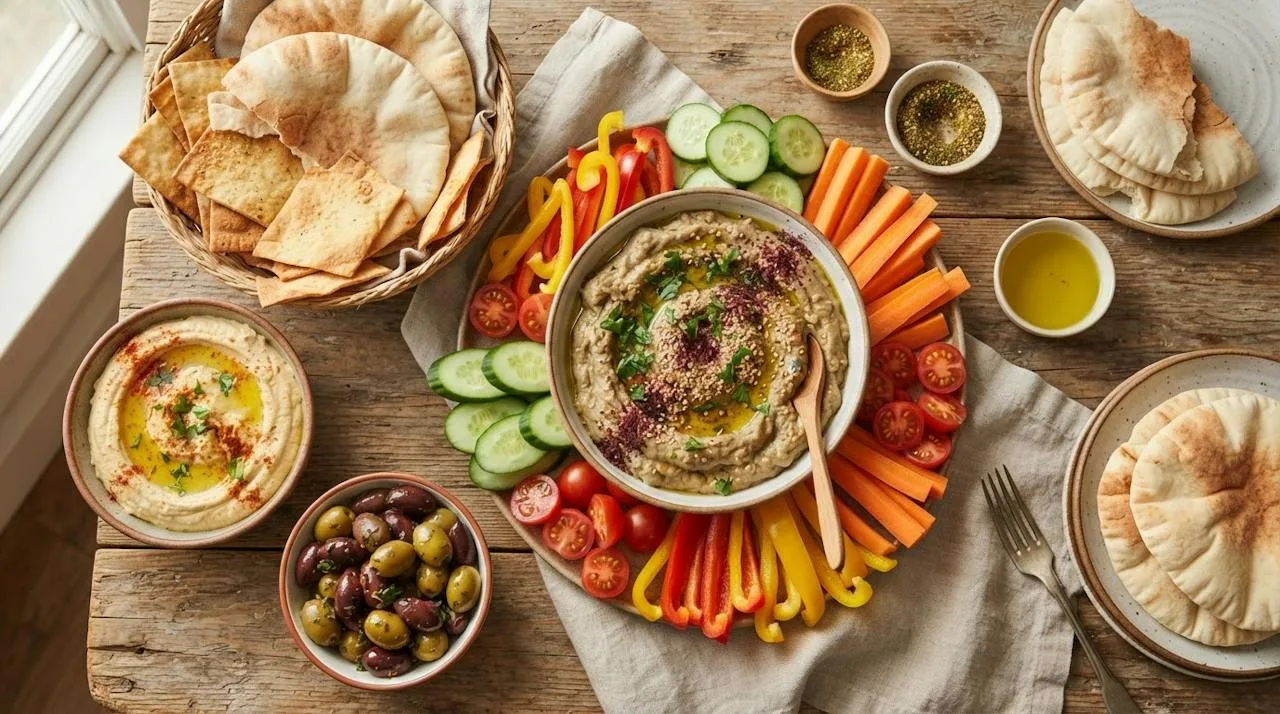
I like baba ganoush at cool room temperature, not straight from the fridge, so the smoke and lemon come through. Keep the toppings simple: a tablespoon of olive oil, parsley, a pinch of sumac and a few sesame seeds.
- Scoop it up with warm pita, toasted flatbread, cucumber, carrot sticks, bell pepper and cherry tomatoes, with a bowl of olives on the side.
- Make it part of a mezze spread with my extra-smooth hummus from dried chickpeas, roasted vegetables and a simple salad.
Storage, Reheating and Make-Ahead
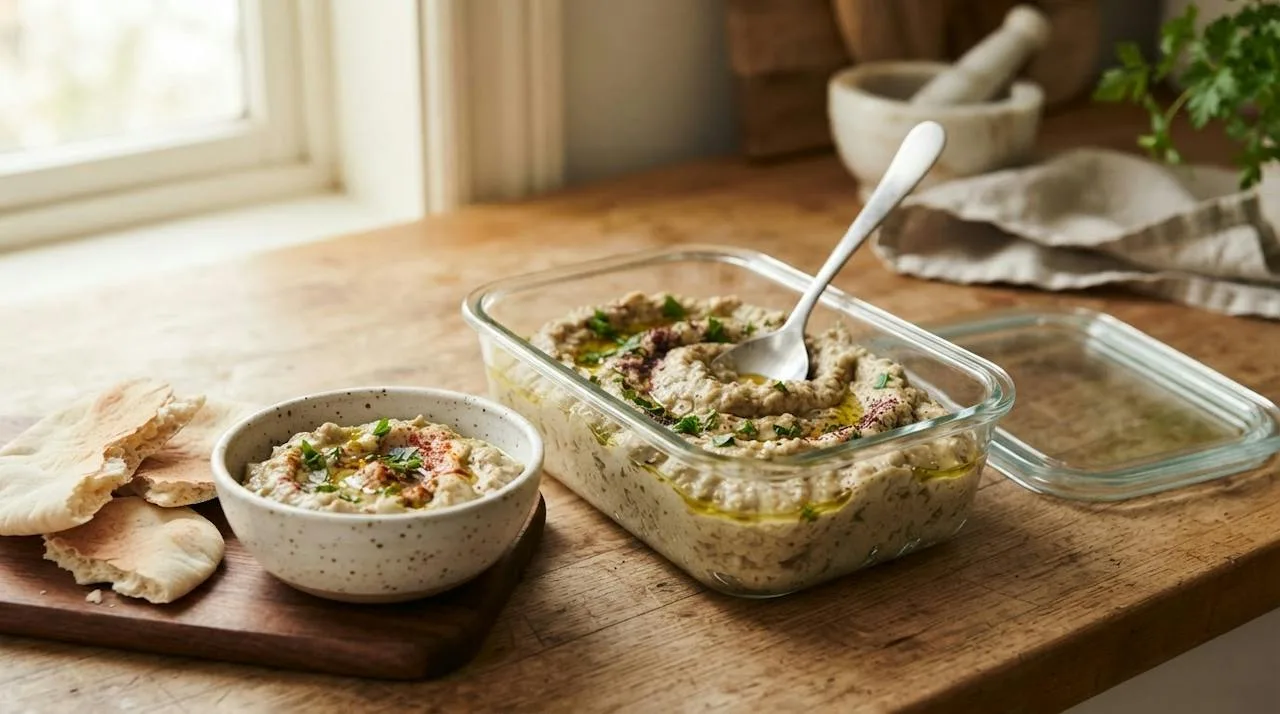
Keep baba ganoush refrigerated in a covered glass container. Here’s how mine changed:
- Day 1: The best texture: very smoky, creamy and fresh, with the lemon and garlic clear but balanced.
- Day 2: The flavors deepened a little, and the garlic was more noticeable but not unpleasant. The texture stayed creamy, with small pieces of eggplant still visible.
- Day 3: Still good. A little liquid appeared around the edges, and the color was slightly darker. Stirring the liquid back in restored the texture.
- Day 4: Still usable, but less fresh, and the eggplant had become softer.
Eat it within 3 to 4 days, in line with the USDA’s leftovers and food safety guidance.
No reheating needed: after chilling, let it sit out for about 20 to 30 minutes before serving so it comes to cool room temperature, stir, and add fresh oil and toppings.
Make-ahead: It’s a good dip to make a day ahead, since the flavor deepens on day 2. Add the toppings just before serving.
Freezing: I haven’t tested freezing baba ganoush, so I can’t recommend it yet.
Mediterranean Secret: Roast the eggplant until it genuinely collapses, drain it and mash it by hand. Add the tahini gradually. The smoke and the eggplant should lead; the tahini is there to carry them.
Continue Cooking
- Tabbouleh, the parsley-forward Lebanese salad
- Muhammara, a roasted red pepper and walnut dip
- Roasting vegetables the Mediterranean way: the complete guide
With smoke on my fingers and a bowl of baba ganoush, Nevaeh Hall

Baba Ganoush
- Total Time: 70 minutes
- Yield: 4 servings
- Diet: Vegan
Description
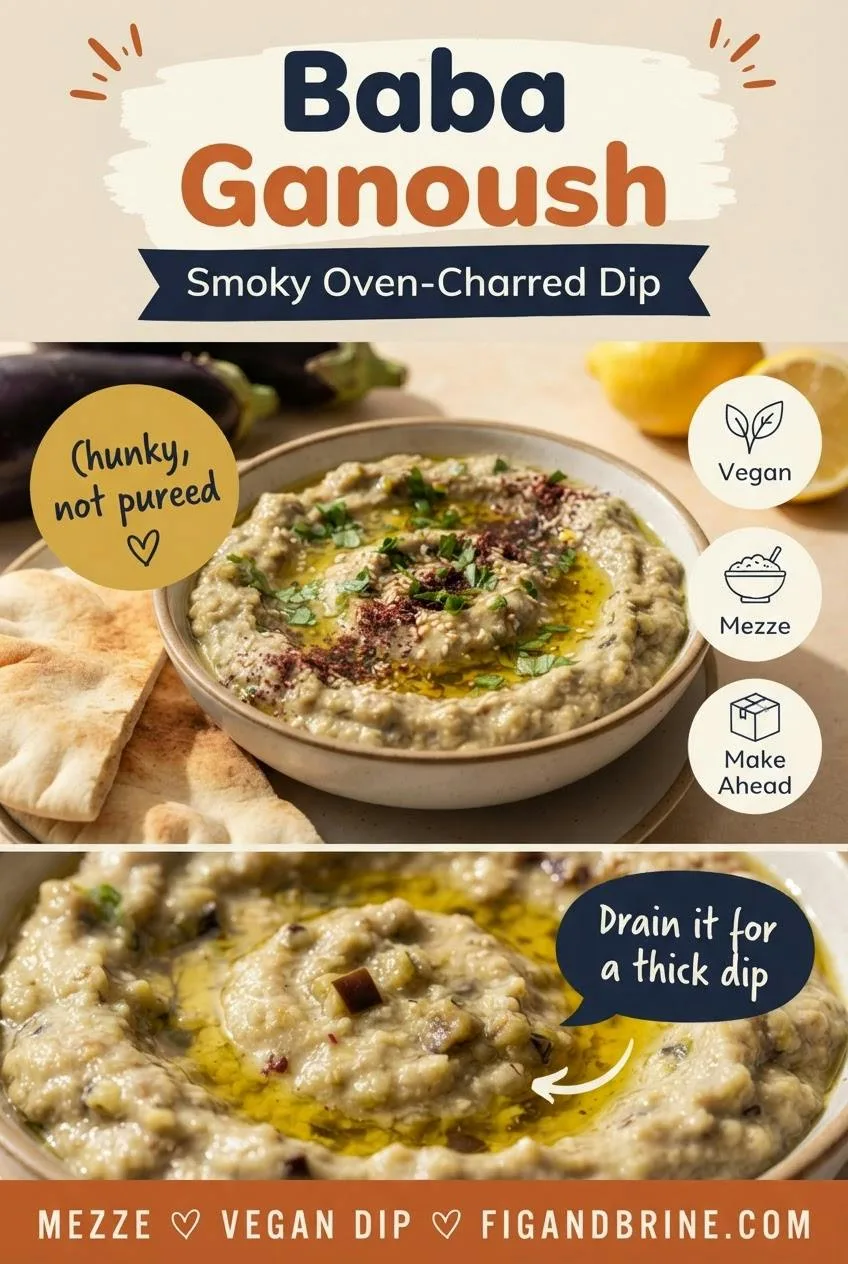
A creamy and smoky baba ganoush made from roasted eggplants, tahini, lemon, and garlic. Perfect for dipping with pita or veggies.
Ingredients
- 3 globe eggplants, about 1.15 kg in total
- 75 g runny tahini
- 45 ml fresh lemon juice
- 1 large garlic clove, grated
- 1 teaspoon fine salt
- ½ teaspoon ground cumin
- 1 tablespoon extra virgin olive oil (mixed into the dip)
- 1 tablespoon extra virgin olive oil (to serve)
- 2 tablespoons chopped flat-leaf parsley
- Up to ½ teaspoon sumac (optional)
- A few sesame seeds
- Warm pita, toasted flatbread, and raw vegetables for serving
Instructions
- Preheat the oven to 230°C (about 445°F).
- Pierce each eggplant with a small knife and place them whole on a baking tray.
- Roast for 40 to 50 minutes, turning every 12 to 15 minutes, until the skin is blackened and blistered.
- Cool the eggplants for 15 to 20 minutes until you can handle them comfortably.
- Scoop the flesh from each eggplant, removing thick burnt skin.
- Drain the flesh in a fine-mesh sieve for about 20 minutes without pressing.
- Mash the garlic with ½ teaspoon of salt into a smooth paste.
- Chop the drained flesh and mash it lightly.
- Combine lemon juice and garlic paste, then whisk in tahini until creamy.
- Fold in the eggplant, cumin, remaining salt, and olive oil.
- Serve in a shallow bowl drizzled with olive oil, garnished with parsley, sumac, and sesame seeds.
Notes
Let the baba ganoush sit at room temperature for 20 to 30 minutes before serving for optimal flavor.
- Prep Time: 20 minutes
- Cook Time: 50 minutes
- Category: Appetizer
- Method: Roasting
- Cuisine: Mediterranean


