

Crispy Falafel From Dried Chickpeas (Soaked, Never Cooked)
A good falafel shatters at the edges and stays soft and green inside, with tiny flecks of chickpea and herbs you can actually see. A bad one is either a crumbly mess in the oil or a dense, pasty ball. I made both before I made the good one.
Four batches taught me one thing above everything else: use dried chickpeas that are soaked but never cooked. In my side-by-side test, raw soaked chickpeas beat cooked and canned chickpeas by a much bigger margin than any spice change. The second key is moisture: squeezing about 25 g of liquid out of the onion made the mixture far easier to shape.
Chickpeas are pulses, which the Harvard T.H. Chan School of Public Health describes as an inexpensive source of protein and fiber. If you’ve only cooked them before, my guide on how to cook dried chickpeas shows the other half of what a bag of dried chickpeas can do. Follow this recipe, and you’ll get falafel that hold together in the oil, with a crisp crust and a light, coarse center.
What I Learned From Testing This Recipe
Recipe Testing Note Tested 4 times: September 7, 15 and 24, and October 3, 2026. The final version is batch 4. Equipment: 1.5-liter food processor, 20 cm heavy stainless-steel pot with about 6 cm of oil, digital instant-read thermometer, small falafel scoop, induction stove, wire rack. For comparisons: a conventional oven at 200°C and an air fryer at 190°C. Key variables tested: raw soaked vs. cooked vs. canned chickpeas, soak time, onion moisture, grind, baking soda, resting, falafel size, oil temperature, fried vs. baked vs. air-fried. Measured: 500 g dried chickpeas to 1,075 g soaked; about 25 g liquid squeezed from the onion; about 1,410 g mixture; oil temperature through every batch; about 160 ml of oil lost.
Batch 1 exposed the binding problem. I soaked 500 g chickpeas for 12 hours (980 g soaked), used 200 g onion without squeezing it, 40 g each of parsley and cilantro, 10 g cumin, no baking soda, and fried 35 g pieces at 170°C for 4½ minutes. The first three falafel lost small pieces as soon as they hit the oil, and one broke in two. The centers were cooked but slightly pasty. Because the 35 g pieces needed so long, the crust turned dark before the inside was right. And the mixture tasted onion-heavy and less aromatic than I wanted.
Batch 2 changed the soak, the onion moisture, the grind and the size. Batch 3 compared chickpea types and cooking methods. Batch 4 confirmed the formula and the oil temperature.
What I changed after testing: Soak from 12 to 18 hours (980 g to 1,075 g soaked), onion from 200 g to 180 g with about 25 g of liquid squeezed out, parsley and cilantro from 40 g to 50 g each, cumin from 10 g to 8 g, 4 g baking soda added, a coarser grind (35 to 40 one-second pulses instead of 55 seconds), falafel from 35 g to 30 g, and oil from 170°C to 178°C with 6 cm depth instead of 5. Batch 1 fell apart, tasted pasty and browned too fast.
How this recipe evolved
Tap each batch to see what went wrong and what changed.
Batch 1 (September 7): the binding problem
12-hour soak (980 g), 200 g unsqueezed onion, no baking soda, 35 g pieces at 170°C for 4 1/2 minutes.
The first three lost pieces in the oil and one broke in two; centers slightly pasty.
Crust too dark before the inside was right; onion-heavy flavor.
Batch 2 (September 15): soak, onion, grind, size
18-hour soak, 180 g onion with 20 g liquid squeezed out, 50 g each parsley and cilantro, 8 g cumin, 4 g baking soda.
Coarser grind, 30 g pieces, oil 175°C, 6 cm deep.
Batch 3 (September 24): comparisons
Raw soaked chickpeas beat cooked and canned by a large margin.
Deep-fried beat baked and air-fried; rested mixture and coarse grind won.
Oil raised to 178°C.
Batch 4 (October 3): the final recipe
500 g dried chickpeas to 1,075 g soaked, 25 g onion liquid out, 35 to 40 one-second pulses, 45-minute rest.
47 falafel of 30 g, fried in batches of 12 at 178°C for 3 1/2 to 4 minutes: crisp crust, light coarse center.
Side-by-Side Results
| What I compared | Version A | Version B | What happened | My pick |
|---|---|---|---|---|
| Chickpeas | Dried, soaked 18 hours, raw | 500 g cooked or 500 g canned, drained | Raw soaked: crisp irregular crust, light, coarse greenish-beige inside. Cooked: soft, paste-like mix, thinner crust, heavier center, some pieces flattened. Canned: the weakest; still wet after longer chilling, softer crust, dense center, and one cracked in the oil | Raw soaked, by a large margin |
| Cooking method | Deep-fried | Baked (200°C, about 24 minutes, about 20 ml oil) or air-fried (190°C, 14 minutes, turned at 8) | Fried had the deepest golden crust and strongest crunch. Baked browned but had a thinner crust and a slightly drier inside. Air-fried browned well with much less oil, but the crust stayed lighter and less blistered | Deep-fried |
| Resting | Shaped and fried straight away | Rested 45 minutes in the fridge | Unrested mixture was softer to handle and 3 of 12 developed small surface cracks. Rested mixture scooped cleanly and crisped more evenly | Rested |
| Baking soda | None | 4 g in the mixture | Without: denser, slightly darker green-brown center. With: a lighter, slightly more open crumb that stayed tender without turning fluffy | 4 g |
| Grind | Fine, almost a paste | Coarse, like sand | Fine gave a smooth, denser inside. Coarse showed tiny chickpea and herb pieces and a crust with more cracks and ridges | Coarse |
By the Numbers (Batch 4)
- Chickpeas: 500 g dried, 1,075 g after an 18-hour soak
- Onion: 180 g chopped, 155 g after squeezing (about 25 g of liquid out)
- Mixture: about 1,410 g, shaped into 47 falafel of 30 g each, about 4.5 cm wide and 2 cm thick
- Batches: 12 falafel at a time, 3½ to 4 minutes each
- Oil: 2 liters of peanut oil; about 1,840 ml left after frying and cooling, so about 160 ml was absorbed or lost
| Batch | Oil at start | Lowest after adding 12 falafel | Oil at the end |
|---|---|---|---|
| 1 | 178°C | 156°C | 172°C |
| 2 | 177°C | 158°C | 173°C |
| 3 | 178°C | 157°C | 173°C |
| 4 | 178°C | 156°C | 174°C |
Taster Notes
Three family members tasted the final batch. One liked the darker, extra-crisp edges and the cumin and coriander aroma; another preferred the flatter 30 g shape for its better crust-to-center ratio; the third liked the milder chili level and ate hers with hummus and pita. All three preferred the fried falafel over the baked comparison.
Ingredients
Makes 47 falafel (30 g each), about 6 servings of 7 to 8.
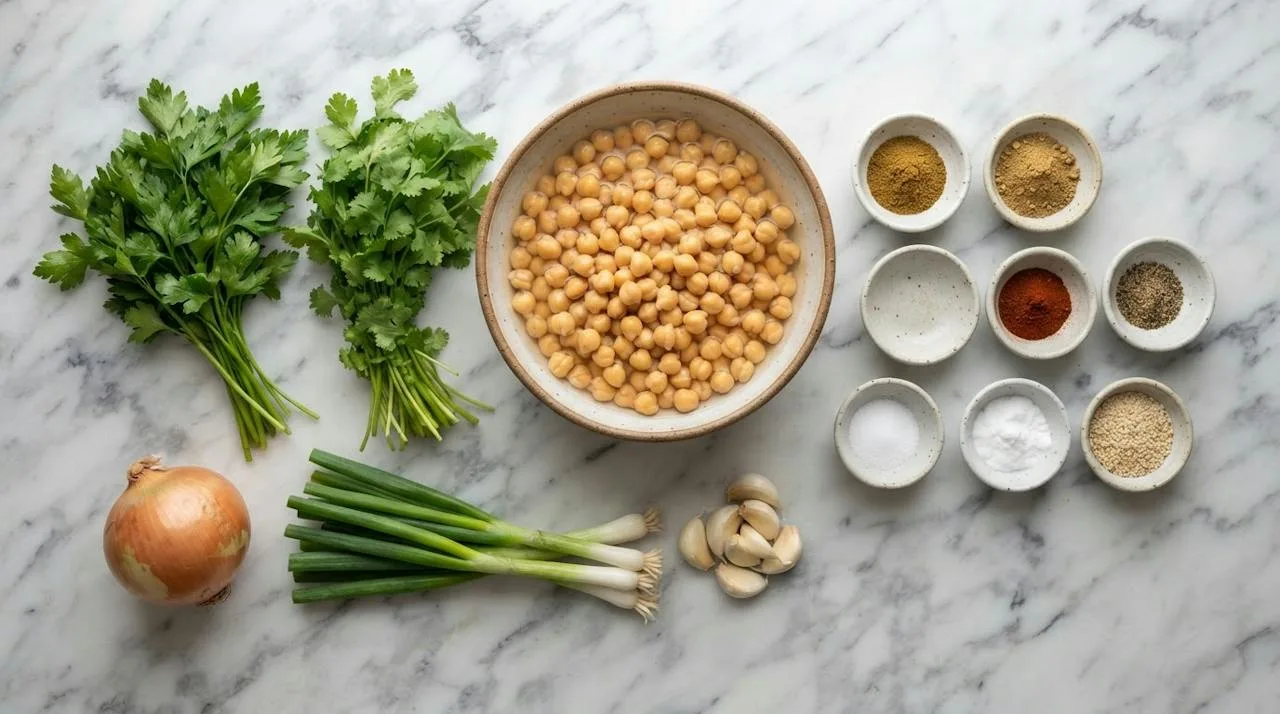
- 500 g dried chickpeas (medium kabuli), soaked 18 hours in 2 liters cold water, no baking soda
- 50 g flat-leaf parsley, tender stems included (thick lower stems removed)
- 50 g cilantro, stems included
- 180 g yellow onion, roughly chopped and squeezed in a towel
- 60 g scallions
- 20 g garlic (about 5 large cloves)
- 8 g ground cumin (about 2½ teaspoons)
- 7 g ground coriander (about 2½ teaspoons)
- 2 g chili powder (about ¾ teaspoon)
- 2 g black pepper (about ¾ teaspoon)
- 12 g fine salt (about 2 teaspoons)
- 4 g baking soda
- 20 g sesame seeds
- 2 liters peanut oil for frying, about 6 cm deep in the pot
No flour or chickpea flour. Note that this recipe contains sesame, which the FDA lists as a major food allergen, and is fried in peanut oil.
Shopping list
Send the list to yourself via WhatsApp or email.
- 500 g dried chickpeas (medium kabuli)
- 50 g flat-leaf parsley
- 50 g cilantro
- 180 g yellow onion
- 60 g scallions
- 20 g garlic (about 5 large cloves)
- Ground cumin (8 g)
- Ground coriander (7 g)
- Chili powder (2 g)
- Black pepper (2 g)
- Fine salt (12 g)
- Baking soda (4 g)
- Sesame seeds (20 g)
- 2 liters peanut oil for frying
- To serve: pita, tahini, lemon, tomato, cucumber, pickled turnips
Cost check: my receipt came to $24.67 at a Walmart supermarket in October 2026, about $4.11 per serving. That total covers the whole meal (pita, tahini, pickles and salad) and the full 2-liter bottle of oil, most of which was left over.
Before You Start: What to Watch For
- Never cook the chickpeas. Soak them until swollen; they should split with a fingernail but still feel firm. Cooked or canned chickpeas made a soft paste that fried up dense.
- Squeeze the onion. About 25 g of liquid came out of 180 g, and it made a noticeable difference to how firm the mixture was.
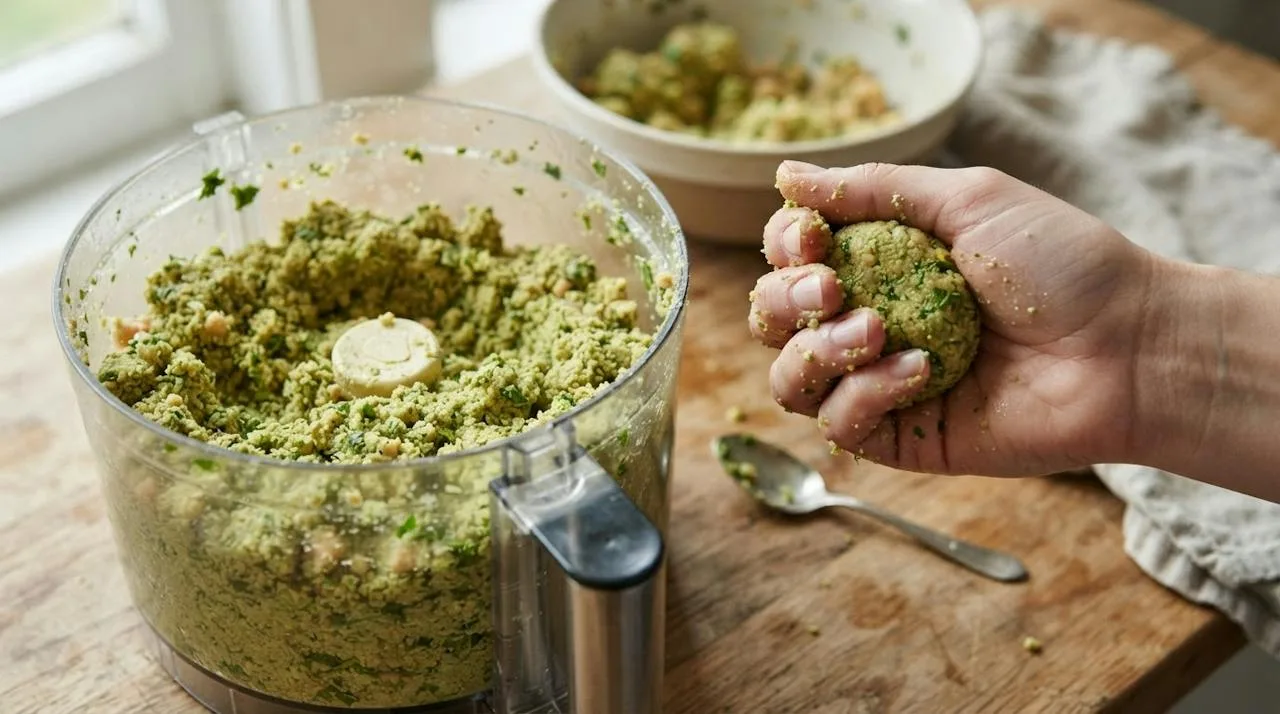
- Pulse, don’t blend. Stop while the mixture looks like coarse sand with tiny chickpea pieces, not a smooth hummus-like paste.
- Use the press test. Squeeze about 30 g in your hand: it should hold together without releasing liquid, and break only when you deliberately crumble it.
- Use a thermometer. Start the oil at about 178°C. It dropped to about 156°C when 12 falafel went in and recovered to 172 to 174°C by the end of each batch.
- Stand by the pot. The U.S. Fire Administration advises never leaving hot oil unattended. For more on choosing a frying oil, see my guide to frying with extra virgin olive oil (I used peanut oil for this recipe and haven’t tested olive oil with it).
Doneness Cues at a Glance
| Stage | Look | Feel or sound | Smell or taste |
|---|---|---|---|
| Soaked chickpeas | Noticeably swollen | Split with a fingernail, still firm | |
| Ground mixture | Coarse sand with tiny chickpea and herb pieces | Holds together when squeezed, no liquid | |
| Rested mixture | Firm and easy to scoop | ||
| Fried falafel | Deep golden brown with small irregular cracks | Sounds crisp when tapped with tongs | |
| Inside | Greenish-beige, moist, not pasty |
Method
- Soak the chickpeas. Cover 500 g dried chickpeas with 2 liters cold water and soak for 18 hours, until swollen enough to split with a fingernail but still firm. Mine went from 500 g to 1,075 g.
- Drain thoroughly. Drain and rinse, then let them sit in a colander for about 10 minutes. Excess water makes the mixture loose.
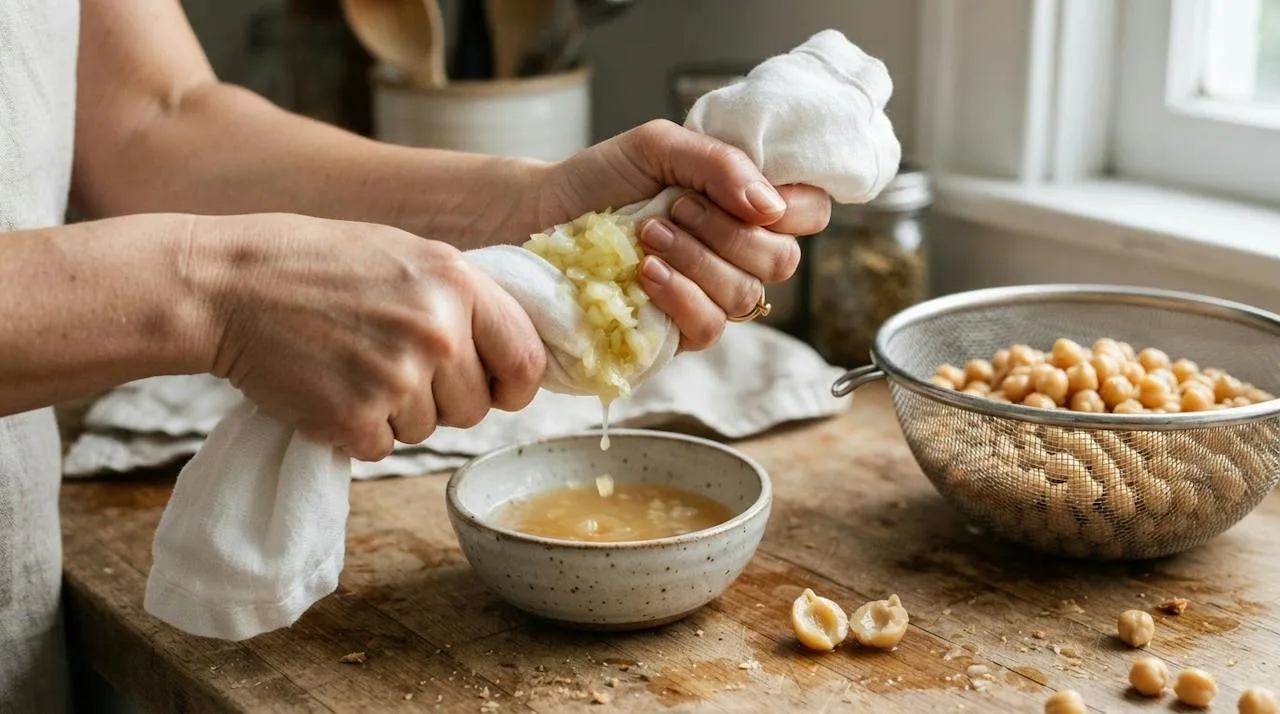
- Squeeze the onion. Chop the onion, wrap it in a clean towel and squeeze firmly. 180 g gave up about 25 g of liquid.
- Pulse the base. Put the chickpeas, onion, scallions, garlic, parsley and cilantro in the food processor. Pulse 35 to 40 times, about 1 second each, stopping twice to scrape down the sides. Stop when it looks like coarse sand.
- Do the press test. Squeeze about 30 g firmly in one hand. It should form a compact mass with no visible liquid and break apart only when you deliberately crumble it.
- Season. Add the cumin, coriander, chili, pepper, salt, baking soda and sesame seeds and pulse another 6 to 8 times. Don’t over-process.
- Rest it. Cover and refrigerate for 45 minutes, until firm and easy to scoop.
- Shape. Scoop 30 g portions (I weighed a few) and press them lightly into slightly flattened rounds, about 4.5 cm wide and 2 cm thick. The flatter shape cooked more evenly and gave more crisp surface.
- Heat the oil. Heat 2 liters of peanut oil, about 6 cm deep in a heavy 20 cm pot, to 178°C.
- Fry a test falafel. If you’re unsure about the mixture, fry one and cut it open before frying the rest.
- Fry in batches of 12. Add 12 falafel; the oil will drop to about 156°C and climb back to 172 to 174°C. Turn once at about 2 minutes and fry 3½ to 4 minutes in total, until deep golden brown with small cracks and a crisp sound when tapped. My first batch took closer to 4 minutes; later batches about 3½. Let the oil return to about 176 to 178°C before the next batch.
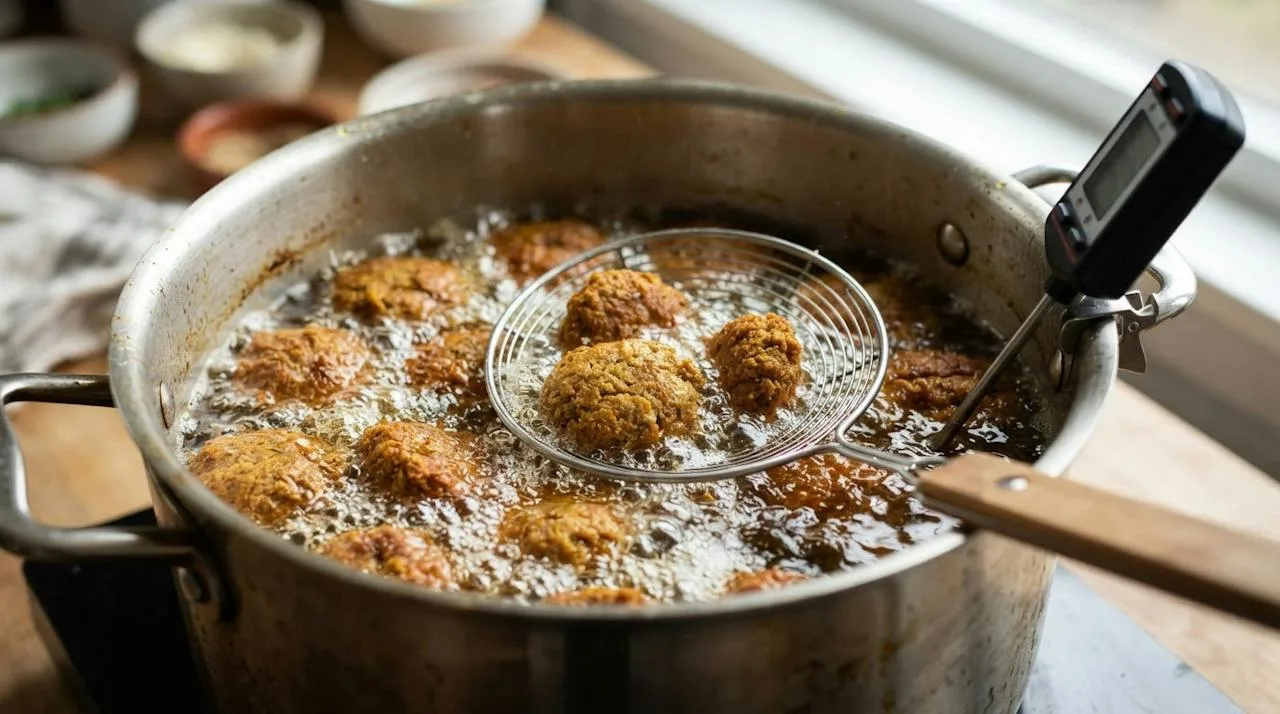
- Drain on a rack. Drain on a wire rack set over a tray for about 2 minutes. Paper towels trapped steam underneath and softened the bottoms.
- Check one. Break one open: it should be greenish-beige and moist inside, with visible chickpea and herb pieces, not pasty.
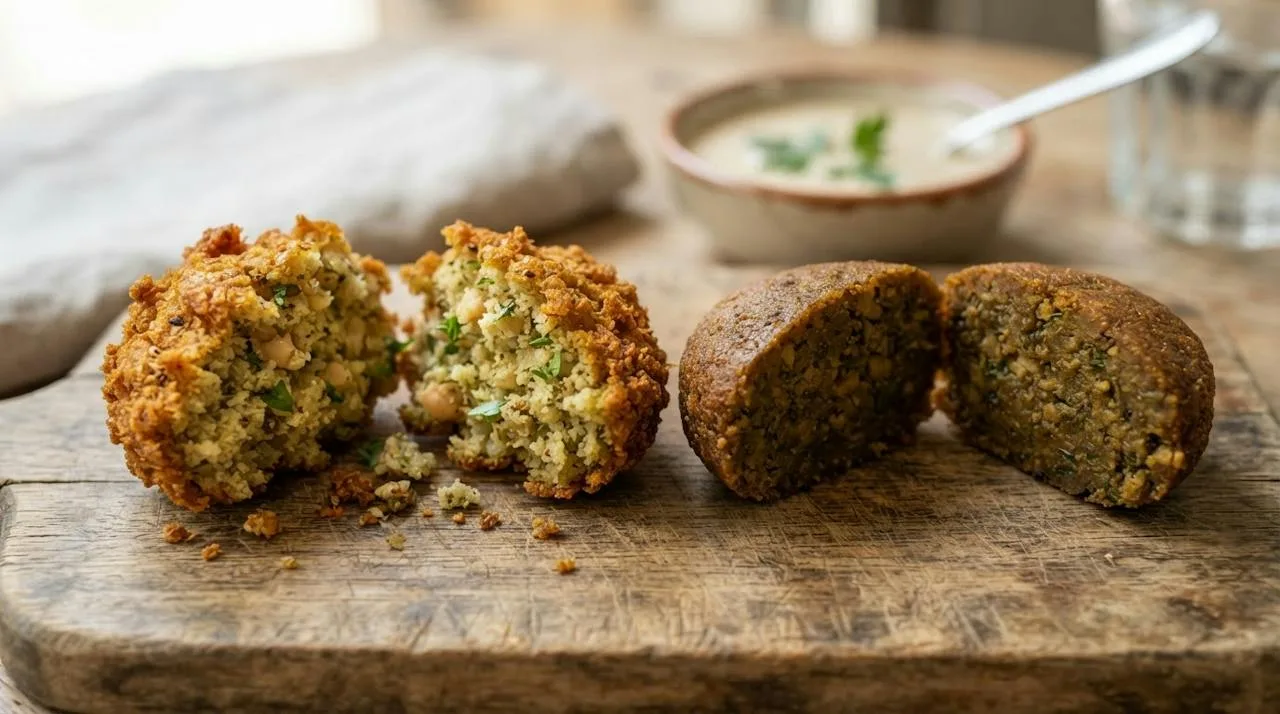
Timing: soak 18 hours ahead. On the day, drain for 10 minutes, rest the mixture for 45 minutes, then fry four batches of 3½ to 4 minutes each, plus the time to squeeze, pulse and shape.
Tested Substitutions
| Original ingredient | Tested substitute | Result |
|---|---|---|
| Raw soaked chickpeas | 500 g cooked chickpeas | Softer, denser and harder to shape; thinner crust, heavier center. |
| Raw soaked chickpeas | 500 g canned chickpeas | Too wet and pasty even after longer chilling; one cracked in the oil. |
| 50 g parsley, 50 g cilantro | 70 g parsley, 30 g cilantro | Milder and more familiar, but the 50/50 balance had more character. |
| Deep-frying | Baking at 200°C, about 24 minutes, about 20 ml oil | Browned, but a thinner crust and a slightly drier inside. |
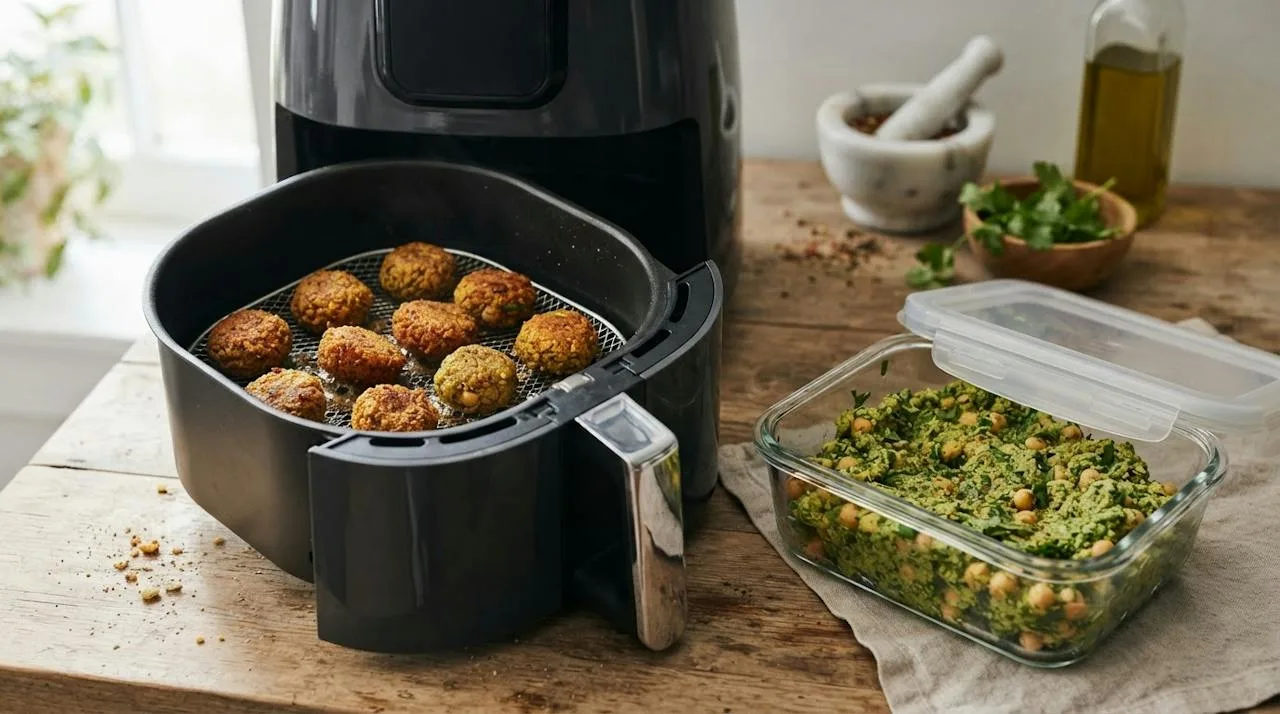
| Deep-frying | Air fryer at 190°C, 14 minutes | A good, lower-oil option, but lighter and less blistered. |
| Chickpeas | Fava beans, or a 50/50 chickpea and fava mix (untested) | I haven’t tried this yet. Let me know in the comments. |
| Plain falafel | Stuffed falafel (untested) | I haven’t tried this yet. Let me know in the comments. |
| Peanut oil | Olive oil for frying (untested in this recipe) | I haven’t tried this yet. Let me know in the comments. |
Why This Recipe Can Fail (And How to Fix It)
Common Problems
- Falls apart in the oil: A wet mixture: a 12-hour soak, unsqueezed onion and too fine a grind. Soak for 18 hours, drain for 10 minutes, squeeze the onion, pulse to coarse sand, and rest the mixture for 45 minutes.
- Pasty or dense inside: Cooked or canned chickpeas, a fine grind or no baking soda. Use raw soaked chickpeas, stop pulsing at coarse sand, and add 4 g baking soda.
- Too dark outside, underdone inside: 35 g pieces at 170°C needed 4½ minutes. Make 30 g slightly flattened rounds and start the oil at 178°C, for 3½ to 4 minutes.
- Cracks on the surface: Shaping and frying straight away. Rest the mixture for 45 minutes so it scoops cleanly.
- Soggy bottoms: Paper towels trap steam. Drain on a wire rack.
- Onion-heavy or flat taste: 200 g onion and 10 g cumin overpowered the herbs. Use 180 g squeezed onion, 50 g each of parsley and cilantro, and 8 g cumin.
What went wrong?
Tap your problem to see the cause and the fix.
Falls apart in the oil
Cause: A wet mixture: a 12-hour soak, unsqueezed onion and too fine a grind.
Fix: Soak 18 hours, drain 10 minutes, squeeze the onion, pulse to coarse sand and rest the mixture 45 minutes.
Pasty or dense inside
Cause: Cooked or canned chickpeas, a fine grind or no baking soda.
Fix: Use raw soaked chickpeas, stop pulsing at coarse sand and add 4 g baking soda.
Too dark outside, underdone inside
Cause: 35 g pieces at 170°C needed 4 1/2 minutes.
Fix: Make 30 g slightly flattened rounds and start the oil at 178°C, for 3 1/2 to 4 minutes.
Cracks on the surface
Cause: Shaping and frying straight away.
Fix: Rest the mixture for 45 minutes so it scoops cleanly.
Soggy bottoms
Cause: Paper towels trap steam.
Fix: Drain on a wire rack.
Onion-heavy or flat taste
Cause: 200 g onion and 10 g cumin overpowered the herbs.
Fix: Use 180 g squeezed onion, 50 g each of parsley and cilantro, and 8 g cumin.
Serving Suggestions
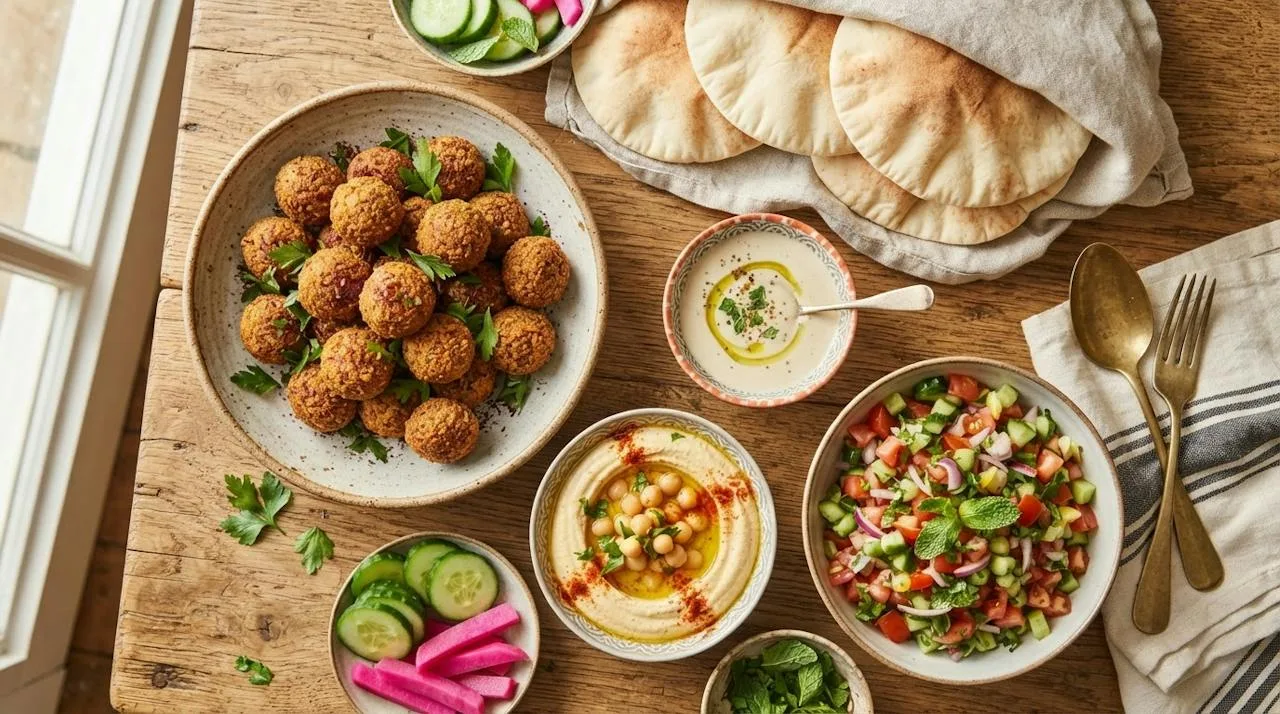
Serve falafel hot from the rack with warm pita, a cool tahini-lemon sauce, chopped tomato and cucumber salad, pickled turnips, sliced cucumber and fresh parsley. My favorite combination is hot falafel, cool tahini and crunchy pickles. For a mezze table, add a bowl of my extra-smooth hummus from dried chickpeas alongside.
Storage, Reheating and Make-Ahead
Uncooked mixture (covered glass container, refrigerated):
- 12 hours: Still firm and easy to scoop, no liquid separating.
- 24 hours: Slightly darker green, still held together, herbs still smelled fresh.
- 48 hours: A little wetter, with a less fresh herb aroma, but it still shaped and fried successfully.
For the best texture, fry the mixture within 24 hours.
Cooked falafel:
- Day 1: Very crisp crust, moist center, strongest herb aroma.
- Day 2: Soft crust after refrigeration, inside still good, flavors slightly deeper. In the air fryer at 180°C for 5 minutes, the crust crisped again and the center stayed moist.
- Day 3: Firmer and slightly drier. At 180°C for 6 minutes, the crust crisped nicely, but the center was less tender than on day 1.
Refrigerate cooked falafel promptly and eat within 3 to 4 days, in line with the USDA’s leftovers and food safety guidance.
Freezing: Not tested, either for shaped raw falafel or cooked ones.
What I’d Test Next
- A 50/50 chickpea and fava bean version, keeping the same total soaked weight, herbs, 30 g size and 178°C oil, to see how the fava beans change the color, tenderness and crust.
- Freezing, both shaped raw falafel and cooked ones.
Mediterranean Secret: Soak, don’t cook. Raw soaked chickpeas, a squeezed onion and a coarse grind do more for falafel than any spice blend. Do the press test, fry one first, and trust the thermometer.
With a thermometer in the pot and a bowl of tahini on the side, Nevaeh Hall
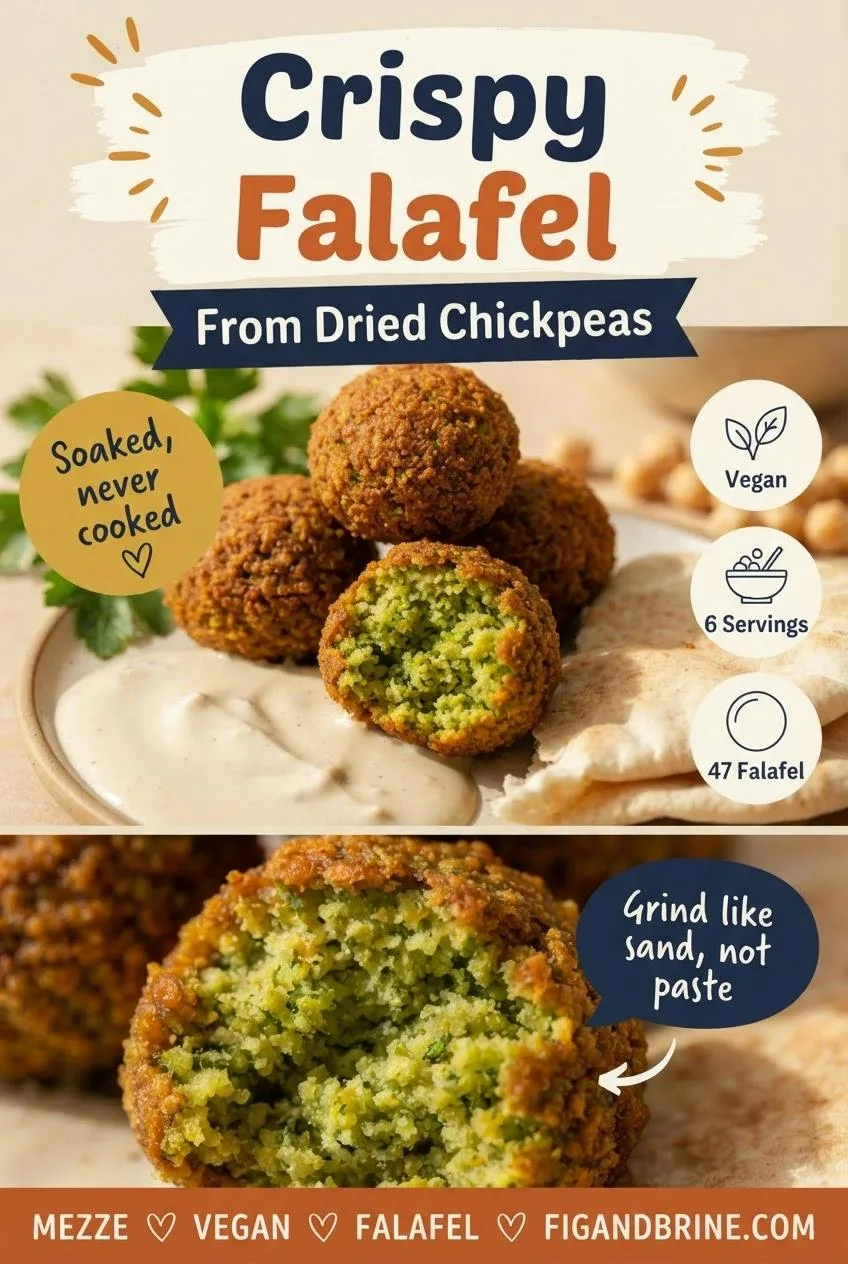

Crispy Falafel
- Total Time: 18 hours 30 minutes
- Yield: 6 servings
- Diet: Vegan
Description
A perfect falafel recipe that results in a crisp exterior and soft, flavorful interior made from raw soaked chickpeas.
Ingredients
- 500 g dried chickpeas, soaked for 18 hours
- 50 g flat-leaf parsley, tender stems included
- 50 g cilantro, stems included
- 180 g yellow onion, roughly chopped and squeezed
- 60 g scallions
- 20 g garlic (about 5 large cloves)
- 8 g ground cumin
- 7 g ground coriander
- 2 g chili powder
- 2 g black pepper
- 12 g fine salt
- 4 g baking soda
- 20 g sesame seeds
- 2 liters peanut oil for frying
- To serve: pita, tahini, lemon, tomato, cucumber, pickled turnips
Instructions
- Soak the chickpeas in cold water for 18 hours.
- Drain and rinse the chickpeas, then let them sit in a colander for about 10 minutes.
- Squeeze the onion to remove excess liquid.
- Pulse the chickpeas, onion, scallions, garlic, parsley, and cilantro in a food processor until they resemble coarse sand.
- Season the mixture with cumin, coriander, chili, pepper, salt, baking soda, and sesame seeds and pulse a few more times.
- Rest the mixture in the fridge for 45 minutes.
- Shape the mixture into 30 g portions, lightly flattened.
- Heat peanut oil in a pot to 178°C.
- Fry in batches, 12 falafel at a time, for 3.5 to 4 minutes until deep golden brown.
- Drain on a wire rack before serving.
Notes
Ensure to use raw soaked chickpeas, squeeze the onion well, and pulse the mixture to a coarse consistency for the best texture.
- Prep Time: 18 hours
- Cook Time: 30 minutes
- Category: Main Course
- Method: Frying
- Cuisine: Mediterranean


