
The Complete Mediterranean Diet Guide for Beginners: How to Eat, Shop, and Cook the Mediterranean Way
The morning everything changed, I was standing at a farmers market stall with a paper bag of warm, split-open figs in one hand and a tiny cup of brine-cured olives in the other, and I realized I had been doing the Mediterranean diet completely wrong. The farmer who handed me those olives didn’t count a single calorie. She ate bread, cheese, and fish, and she poured olive oil like it was water, and she looked healthier than anyone I knew.
I’m not the only one drawn to this way of eating. According to ABC News coverage of the U.S. News & World Report rankings, the Mediterranean diet was named the best diet overall for the eighth year in a row in 2025. Yet the CDC reports that only about 1 in 10 American adults eats enough fruits and vegetables, the very foundation this diet is built on.
Before that morning, I had “started” the Mediterranean diet three separate times. I spent roughly $240 on imported specialty oils, fancy jarred pestos, and “Mediterranean-style” frozen meals, then quit within two weeks every single time because it felt expensive, fussy, and nothing like the food I actually craved.
If you’re treating the Mediterranean diet like another list of rules and forbidden foods, you’re setting yourself up for the same frustrating cycle. It was never meant to be a diet in the American sense of the word.
Here’s the truth that farmer taught me: the Mediterranean diet is a pattern, not a plan. It’s built on cheap, humble ingredients (beans, grains, vegetables, olive oil, a little fish) cooked slowly and eaten with people you love. Once you understand the pattern, every meal gets easier. In this guide, I’ll walk you through the science, the pantry, the plate, the shopping list, a 7-day meal plan, and a 30-day roadmap, so you can finally make this way of eating stick.
Note: This guide is for general educational purposes and isn’t medical advice. If you have a health condition, take medication, or are pregnant, talk with your doctor or a registered dietitian before changing how you eat.
What Is the Mediterranean Diet, Really?
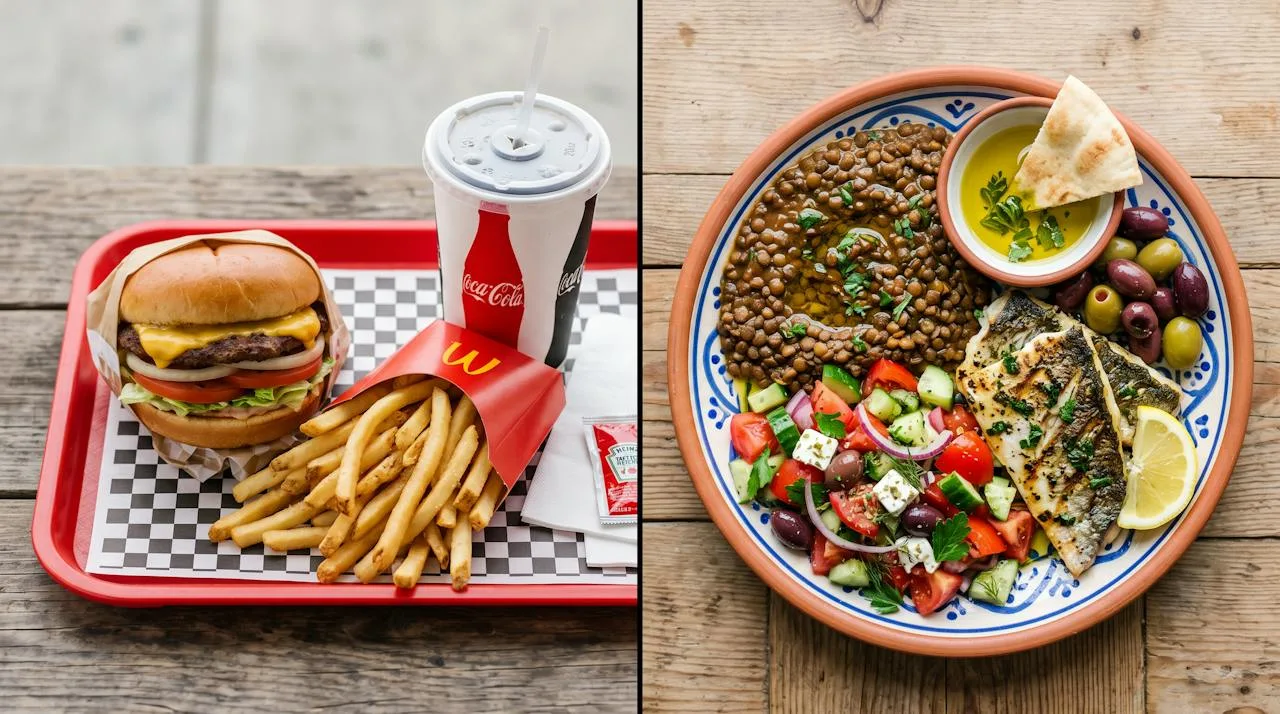
The word “diet” is the first thing that trips most beginners up, and it’s the first thing we need to throw out.
A Way of Eating Born From Place, Not a Plan
The Mediterranean diet describes the traditional eating patterns of the countries that surround the Mediterranean Sea: Greece, southern Italy, Spain, southern France, Morocco, Lebanon, Turkey, and their neighbors. These regions don’t share one cuisine, but they share a rhythm. Meals are built around plants, olive oil is the main fat, fish shows up more often than red meat, and food is eaten slowly and socially.
That shared rhythm is so central to life in the region that UNESCO inscribed the Mediterranean diet on its list of the Intangible Cultural Heritage of Humanity. Notice what UNESCO emphasizes: not just ingredients, but the skills, rituals, and traditions around harvesting, fishing, preserving, cooking, and, above all, sharing food at the table.
That’s the heart of it. When I say “Mediterranean diet” in this guide, I mean a set of habits:
- Eat mostly vegetables, fruits, whole grains, beans, nuts, and seeds
- Use extra virgin olive oil as your main cooking and finishing fat
- Eat fish and seafood a couple of times a week
- Enjoy moderate amounts of cheese, yogurt, eggs, and poultry
- Keep red meat and sweets for occasional meals
- Cook with herbs, spices, garlic, and lemon instead of heavy salt and sauces
- Share meals, slow down, and move your body every day
MEDITERRANEAN SECRET: There’s no single “correct” Mediterranean menu. A Greek grandmother, a Moroccan home cook, and a Sicilian fisherman eat very differently, but all three follow the same pattern. Once you learn the pattern, you can cook from any of those kitchens.
Where the Science Started: The Seven Countries Study
In the 1950s, American physiologist Ancel Keys began what became the Seven Countries Study, comparing diet, lifestyle, and heart disease rates across the United States, Finland, the Netherlands, Italy, the former Yugoslavia, Greece, and Japan. One of the most striking findings was how low heart disease rates were in rural Crete and parts of southern Italy, despite diets that were far from “low fat.” Much of that fat came from olive oil.
That observation launched decades of research. The early work was observational (it showed patterns, not proof), but it gave scientists a question worth testing: was something about the traditional Mediterranean way of eating actually protective?
The Evidence Today
Randomized trials eventually put the pattern to the test. The largest is PREDIMED, published in the New England Journal of Medicine. The study followed about 7,400 Spanish adults at high cardiovascular risk. People assigned to a Mediterranean diet supplemented with extra virgin olive oil or mixed nuts had roughly a 30% lower rate of major cardiovascular events than people told to follow a reduced-fat diet.
Earlier, the Lyon Diet Heart Study, published in the journal Circulation, found that heart attack survivors who followed a Mediterranean-style diet had markedly fewer repeat cardiac events than those on a standard prudent diet.
Large observational studies tell a similar story. A Women’s Health Study analysis in JAMA Network Open followed nearly 26,000 women for about 12 years and found that those with the highest adherence to a Mediterranean diet had about a 25% lower risk of cardiovascular disease.
This is why organizations like the American Heart Association and the Mayo Clinic point to the Mediterranean pattern as a heart-healthy way of eating.
COMMON MISTAKE: Don’t treat the research as a promise that one ingredient will fix everything. The benefits in these studies came from the whole pattern eaten over years, not from adding a spoonful of olive oil to an otherwise unchanged diet.
The Mediterranean Diet Pyramid: Your Beginner’s Map
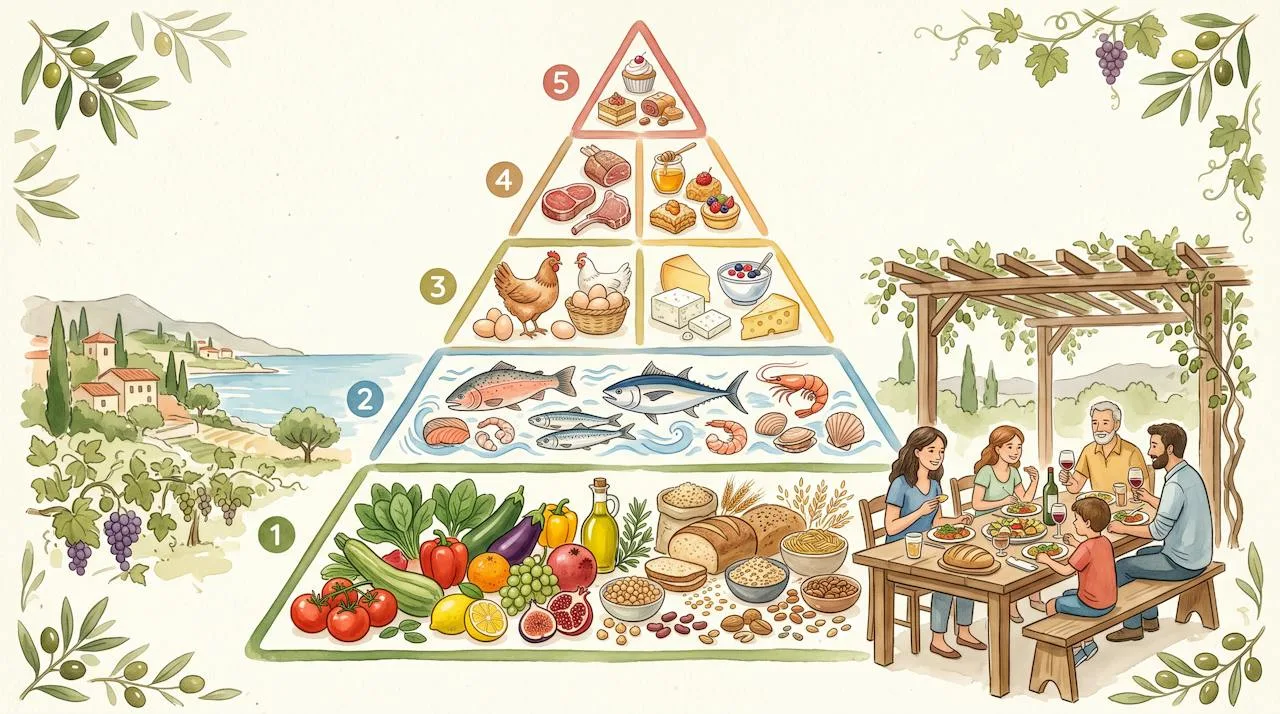
If the Mediterranean diet had a blueprint, this would be it, and it looks nothing like the food pyramid most of us grew up with.
How the Pyramid Works
In 1993, the nonprofit Oldways worked with the Harvard School of Public Health and the World Health Organization to create the Oldways Mediterranean Diet Pyramid. It remains the clearest visual guide for beginners. Here’s how it breaks down, from bottom to top:
- The foundation: daily physical activity and shared meals. Before a single food appears, the pyramid puts movement and eating together at its base.
- Every meal: vegetables, fruits, whole grains, beans and lentils, nuts and seeds, herbs and spices, and olive oil.
- At least twice a week: fish and seafood.
- In moderate portions, daily to weekly: poultry, eggs, cheese, and yogurt.
- Less often: red meat and sweets.
Water is the everyday drink. Wine, if you already drink it, is taken in moderation and usually with meals.
Why the Base Matters More Than the Top
Most beginners obsess over the top of the pyramid (“Can I still eat steak? Can I have dessert?”). But the magic happens at the base. When your plate is mostly vegetables, beans, grains, and olive oil, there simply isn’t much room left for the foods you want to eat less of.
The Harvard T.H. Chan School of Public Health’s Nutrition Source describes the pattern the same way: it emphasizes plant foods and healthy fats rather than strict limits or calorie targets.
How It Compares to U.S. Guidelines
You don’t have to choose between the Mediterranean diet and official American advice. The 2020–2025 Dietary Guidelines for Americans included a “Healthy Mediterranean-Style Dietary Pattern” as one of its example eating patterns. It’s fully compatible with mainstream nutrition advice. It just gets there with more flavor.
🫒 MEDITERRANEAN SECRET: Think of the pyramid as “how often,” not “how much.” Nothing is banned. Red meat and honey-soaked pastries still have a place; they just show up at celebrations instead of every Tuesday.
Essential Mediterranean Ingredients: Building Your Pantry
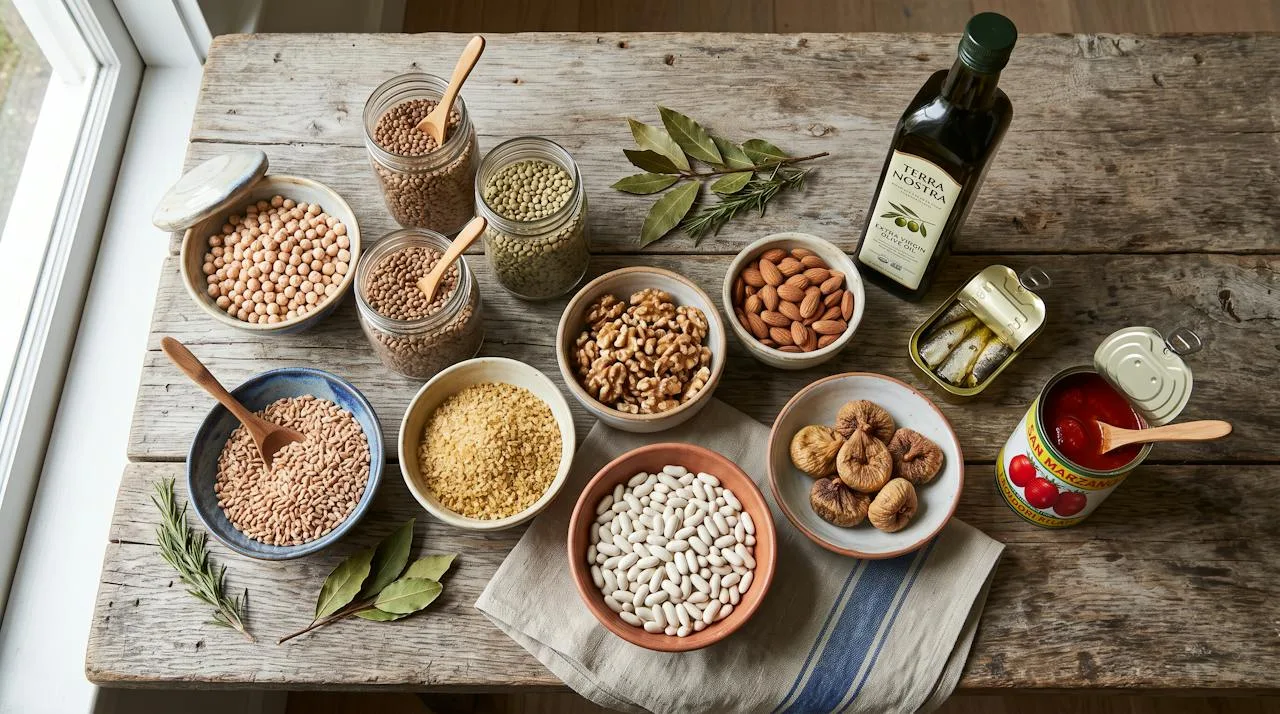
Every great Mediterranean cook I know has a secret weapon, and it isn’t a recipe. It’s a well-stocked pantry.
Extra Virgin Olive Oil: The Golden Foundation
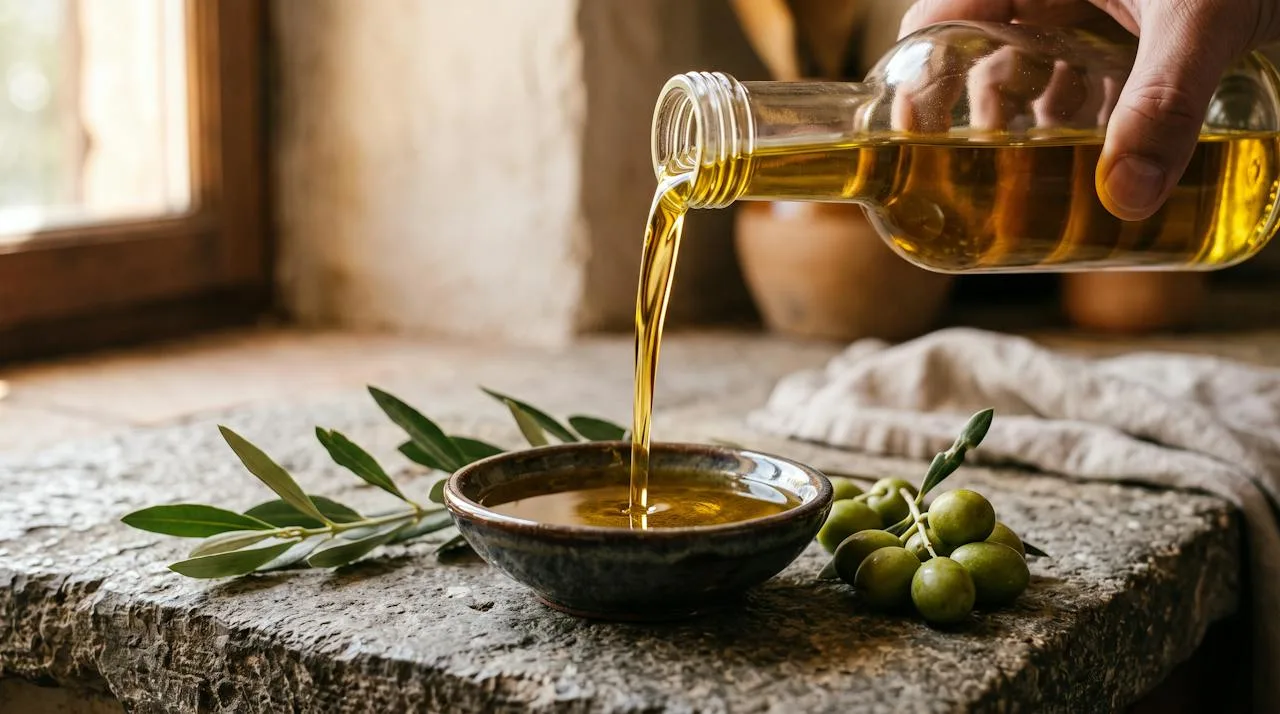
If you change only one thing this month, make it this: switch your main cooking fat to extra virgin olive oil.
Extra virgin olive oil (EVOO) is made by mechanically pressing olives without chemical refining. That gentle process keeps its peppery, grassy flavor and preserves naturally occurring polyphenols. Olive oil is rich in monounsaturated fat, which Harvard’s Nutrition Source on fats identifies as one of the “good” fats when it replaces saturated and trans fats.
The FDA first allowed a qualified health claim for olive oil and heart disease back in 2004. In 2018, it completed a review of oleic acid, the main monounsaturated fat in olive oil, and allowed a claim that supportive but not conclusive evidence suggests about 1½ tablespoons (20 grams) a day of oils high in oleic acid may reduce the risk of coronary heart disease. The key condition in both cases: the oil has to replace saturated fat without adding extra calories. Olive oil works as a swap, not an add-on.
What to look for when buying:
- “Extra virgin” on the label (not “pure,” “light,” or “olive pomace oil”)
- A harvest date, ideally within the last 12–18 months
- Dark glass or tin, which protects the oil from light
- A specific origin rather than a vague blend of “oils from several countries”
Researchers at the UC Davis Olive Center have long studied olive oil quality and labeling, and their work is a big reason American shoppers now pay more attention to freshness and harvest dates. For everyday cooking, a reasonably priced, fresh supermarket EVOO is perfectly fine. Save the pricey bottle for drizzling.
COMMON MISTAKE: Keeping olive oil next to the stove. Heat and light make it go stale fast. Store it in a cool, dark cupboard and use it within a couple of months of opening.
Beans, Lentils, and Chickpeas: The Humble Heroes
Legumes are the most underrated part of the Mediterranean pantry and the most budget-friendly. Chickpeas become hummus and stews. Lentils turn into soups in 30 minutes. White beans slow-simmer with tomatoes and herbs into something that tastes like it took all day.
According to the Harvard Nutrition Source on legumes, beans and lentils are rich in fiber, plant protein, B vitamins, iron, and potassium. They’re also one of the cheapest sources of protein in any grocery store.
Stock these:
- Canned chickpeas and white beans (rinse to cut the sodium)
- Dried green or brown lentils (no soaking needed)
- Dried red lentils (they melt into soups)
- Dried chickpeas for weekend cooking
Whole Grains: Farro, Bulgur, and Friends
Mediterranean grains are nutty, chewy, and satisfying. The Whole Grains Council explains that whole grains keep all three parts of the kernel (bran, germ, and endosperm), which is where most of the fiber, vitamins, and minerals live.
Great beginner grains include:
- Bulgur: cracked wheat that cooks in about 10–15 minutes, the base of tabbouleh
- Farro: chewy ancient wheat, perfect for grain bowls and salads
- Whole-wheat couscous: ready in 5 minutes
- Brown rice and barley: hearty, familiar, affordable
- Whole-grain bread: yes, bread belongs on the Mediterranean table
Nuts, Seeds, and Fruit
A small handful of walnuts, almonds, or pistachios is the classic Mediterranean snack. Fresh fruit (figs, oranges, grapes, pomegranates, apricots) is the classic dessert. Dried figs and dates satisfy a sweet tooth with fiber attached.
MEDITERRANEAN SECRET: Toast your nuts. Two to three minutes in a dry skillet, until fragrant and just golden at the edges, turns a boring handful into something that tastes like a treat.
Herbs, Spices, and Aromatics
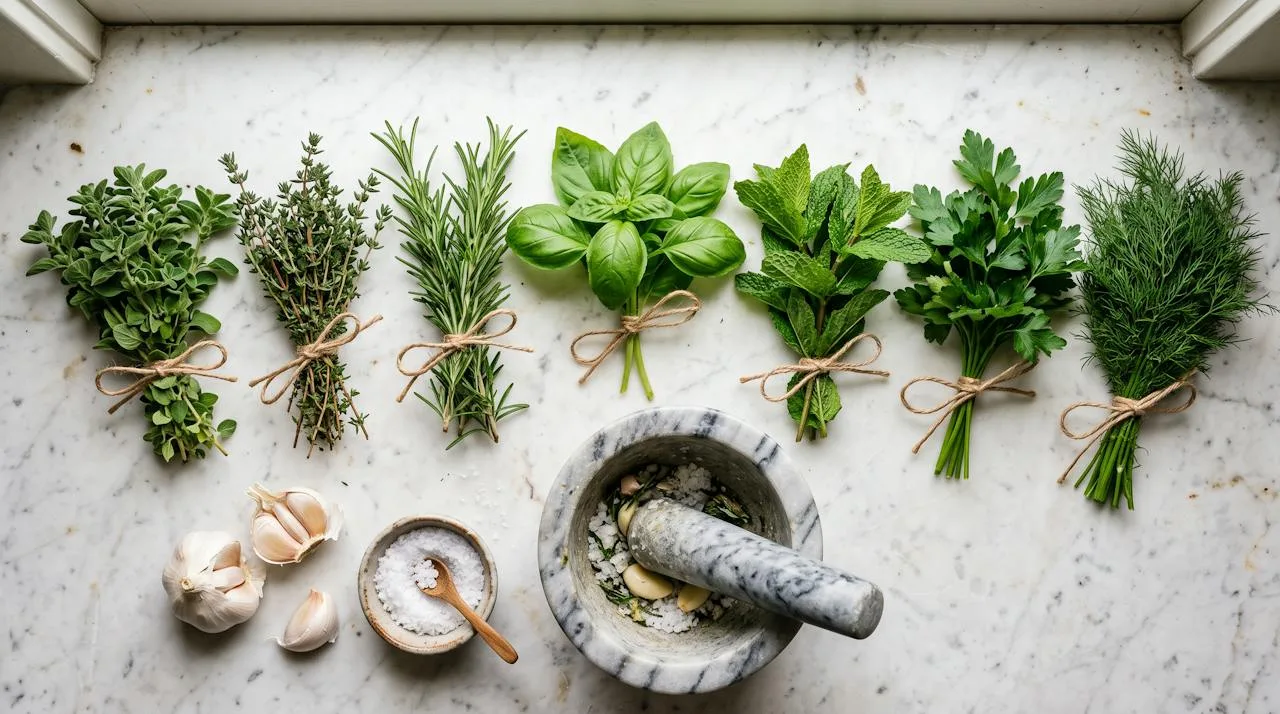
Here’s where the Mediterranean kitchen gets its soul. Instead of relying on heavy sauces and lots of salt, Mediterranean cooks build flavor with:
- Fresh herbs: parsley, mint, dill, basil, cilantro
- Woody herbs: oregano, thyme, rosemary, bay leaf
- Spices: cumin, paprika, cinnamon, sumac, za’atar, red pepper flakes
- Aromatics: garlic, onion, shallots, lemon zest and juice
- Briny accents: olives, capers, anchovies, preserved lemon
That last group is close to my heart (it’s half the reason this blog is called Fig & Brine). A few chopped olives or a spoonful of capers adds enough savory depth that you barely need extra salt. That matters, because the American Heart Association recommends no more than 2,300 mg of sodium a day for most adults, moving toward an ideal limit of 1,500 mg.
Fish, Dairy, Eggs, and Poultry
Fish, especially oily fish like sardines, salmon, mackerel, and anchovies, provides omega-3 fatty acids. The NIH Office of Dietary Supplements notes that fatty fish are among the best food sources of the omega-3s EPA and DHA. The American Heart Association recommends about two servings of fish per week, especially fatty fish.
Dairy in the Mediterranean is mostly fermented: thick yogurt and cheeses like feta, halloumi, and Parmigiano, eaten in modest portions. Eggs and chicken appear a few times a week. Red meat shows up occasionally, often as a flavoring in a bean or vegetable dish rather than as a huge slab on the plate.
How to Build a Mediterranean Plate
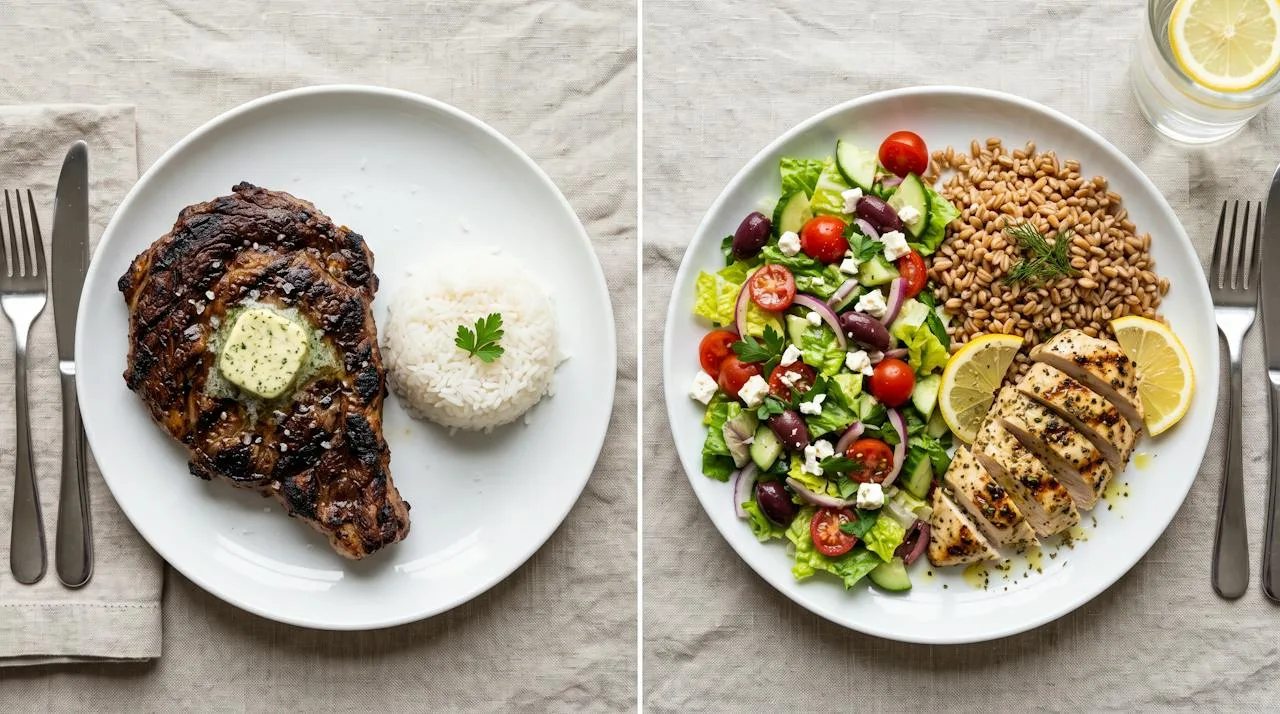
You don’t need recipes to start eating the Mediterranean way tonight. You need one simple template.
The Half-Quarter-Quarter Plate
This is the formula I use for nearly every dinner:
- Half the plate: vegetables. Roasted, raw, grilled, stewed. Aim for at least two colors.
- One quarter: whole grains or starchy foods. Farro, bulgur, brown rice, potatoes, or a slice of good bread.
- One quarter: protein. Beans, lentils, fish, eggs, or chicken.
- A drizzle of olive oil and a squeeze of lemon over everything.
- A flavor finisher: fresh herbs, a spoonful of yogurt, a few olives, or a sprinkle of feta.
The same balanced-plate idea shows up in the USDA’s MyPlate guidance. The Mediterranean version simply adds more olive oil, more herbs, and more beans.
READER STORY: Danielle from Charlotte, North Carolina, wrote to tell me she stopped trying to follow complicated meal plans and started using the half-quarter-quarter plate instead. “It was the first time I didn’t feel like I was on a diet,” she said. “I just looked at my plate and asked, where are the vegetables?”
Cooking Methods That Make It Easy
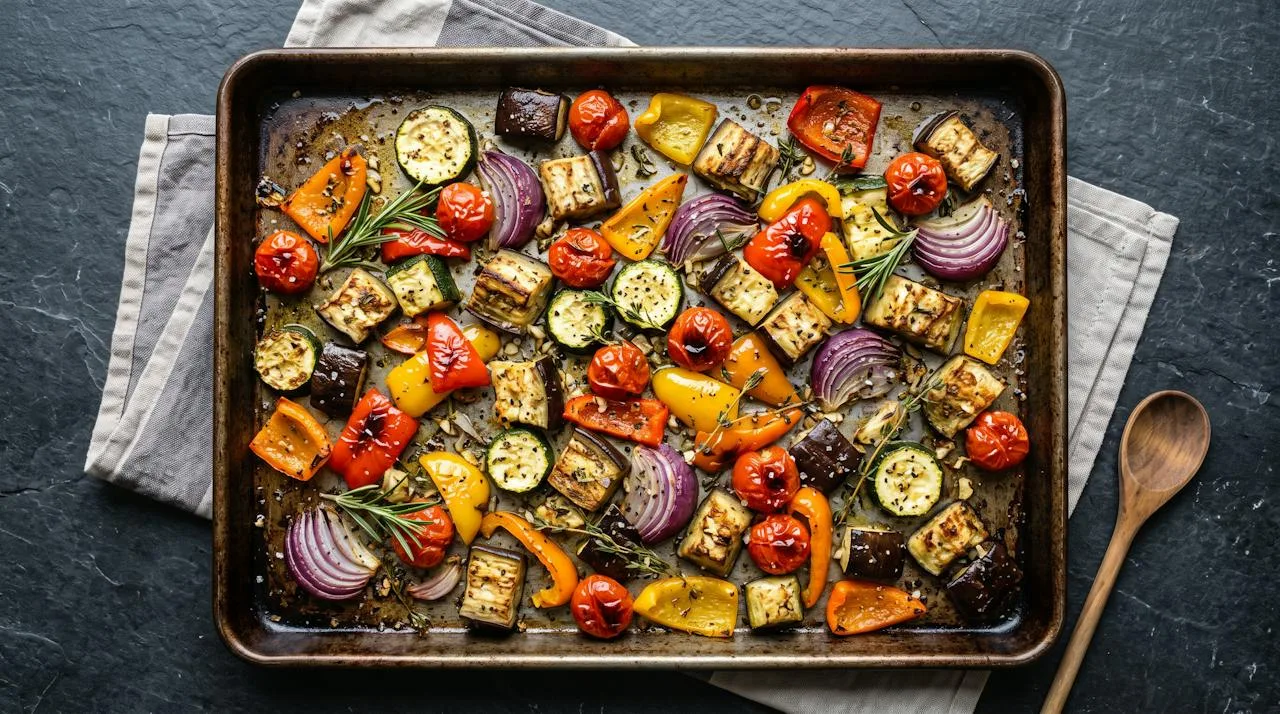
Most Mediterranean cooking comes down to four techniques. Master these and you can cook almost anything in this guide.
1. Roasting. Toss chopped vegetables with olive oil, salt, and a woody herb, then roast on a sheet pan at 425°F (220°C). The trick is space: spread everything in a single layer so it browns instead of steams. Pull the pan when the edges are deeply golden and the centers are tender when pierced with a knife, usually 25–40 minutes depending on the vegetable.
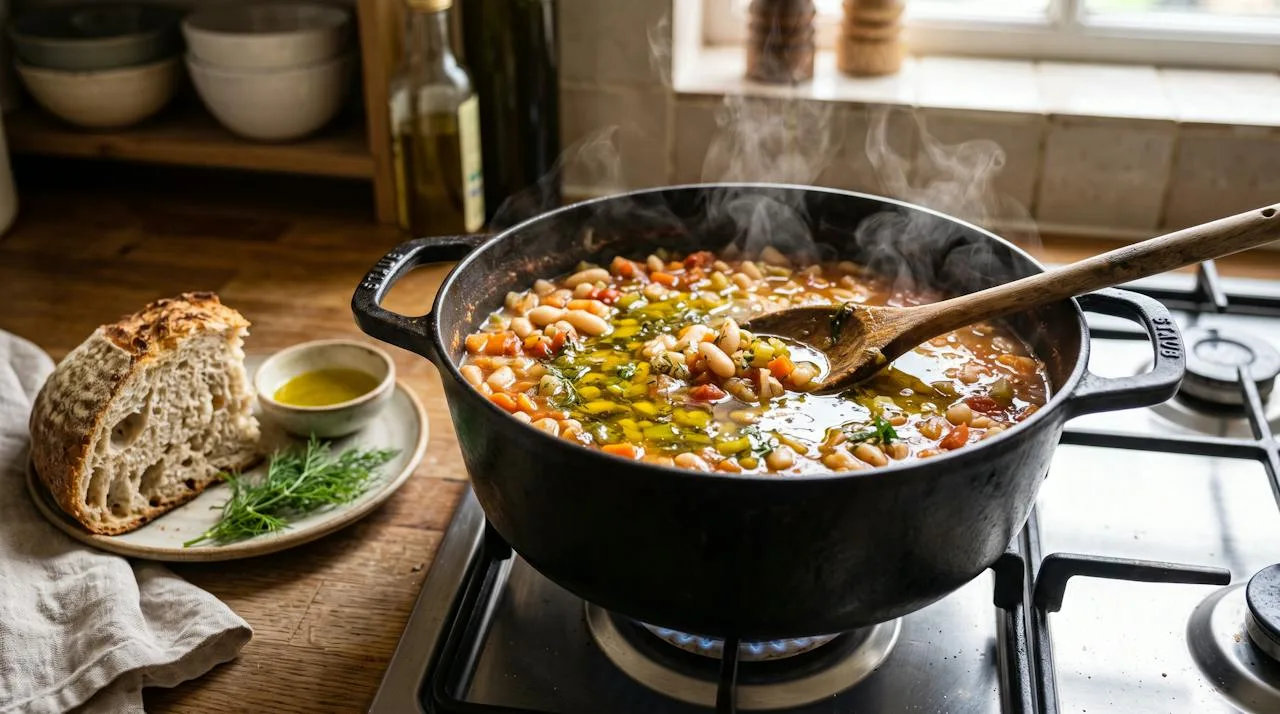
2. Slow-simmering. Beans, tomatoes, onions, and olive oil cooked gently together become Greek gigantes, Italian pasta e fagioli, or Moroccan chickpea stews. Keep the heat low enough that the pot barely bubbles.
3. Grilling and pan-searing. Fish, chicken, halloumi, and vegetables all love high heat. Pat them dry, oil the food rather than the pan, and resist the urge to flip too early. When fish releases easily from the pan, it’s ready to turn.
4. Raw and dressed. Salads, crudités, and simple tomato-and-cucumber plates dressed with olive oil, lemon, and salt are the fastest Mediterranean meals of all.
MEDITERRANEAN SECRET: Finish with raw olive oil. Cook with an everyday EVOO, then drizzle a little of your best bottle over the dish right before serving. That fresh, peppery hit is what makes restaurant Mediterranean food taste so alive.
A Simple Oven-Baked Fish to Build Confidence
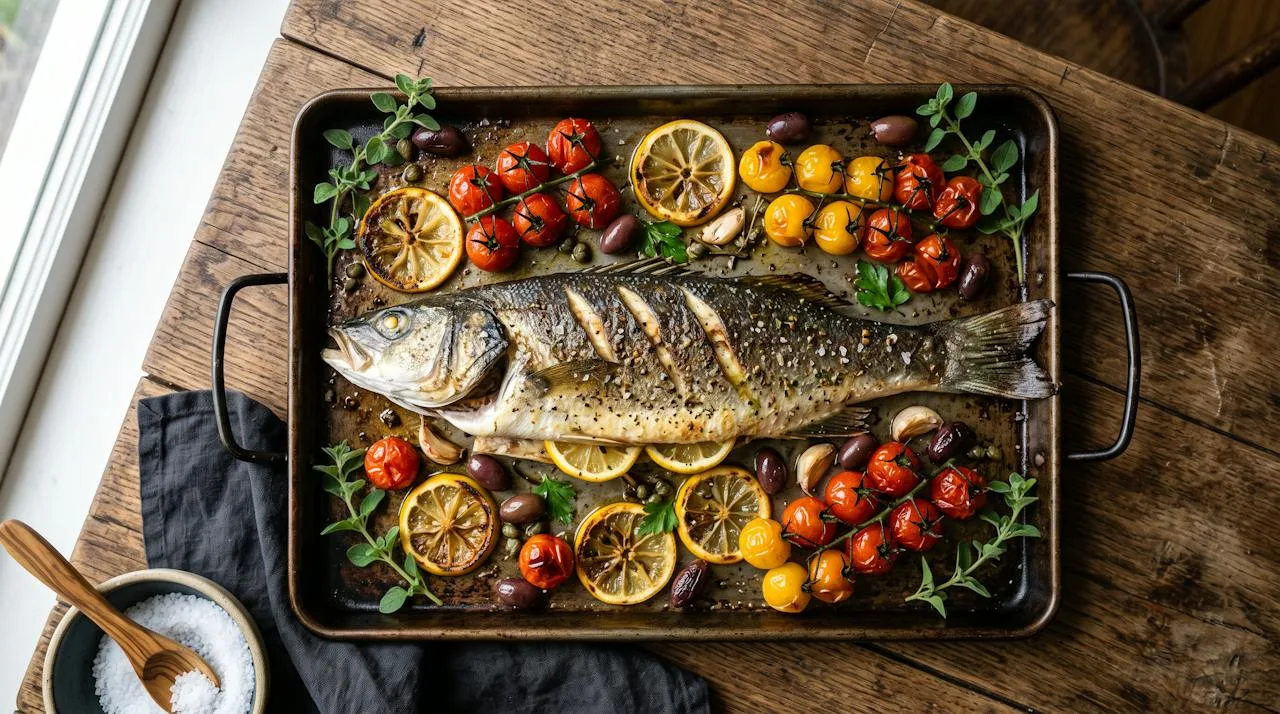
If cooking fish scares you, start with a sheet pan. Lay fillets (or a whole cleaned fish) on a lined tray, scatter cherry tomatoes, olives, capers, garlic, and lemon slices around them, drizzle generously with olive oil, and sprinkle with oregano. Bake at 400°F (200°C) until the flesh turns opaque and flakes easily with a fork. The USDA’s safe minimum internal temperature chart lists 145°F (63°C) for fish.
The tomatoes burst, the olive oil and fish juices mix into a pan sauce, and dinner is done in one pan in about 20 minutes.
Your Mediterranean Diet Shopping List
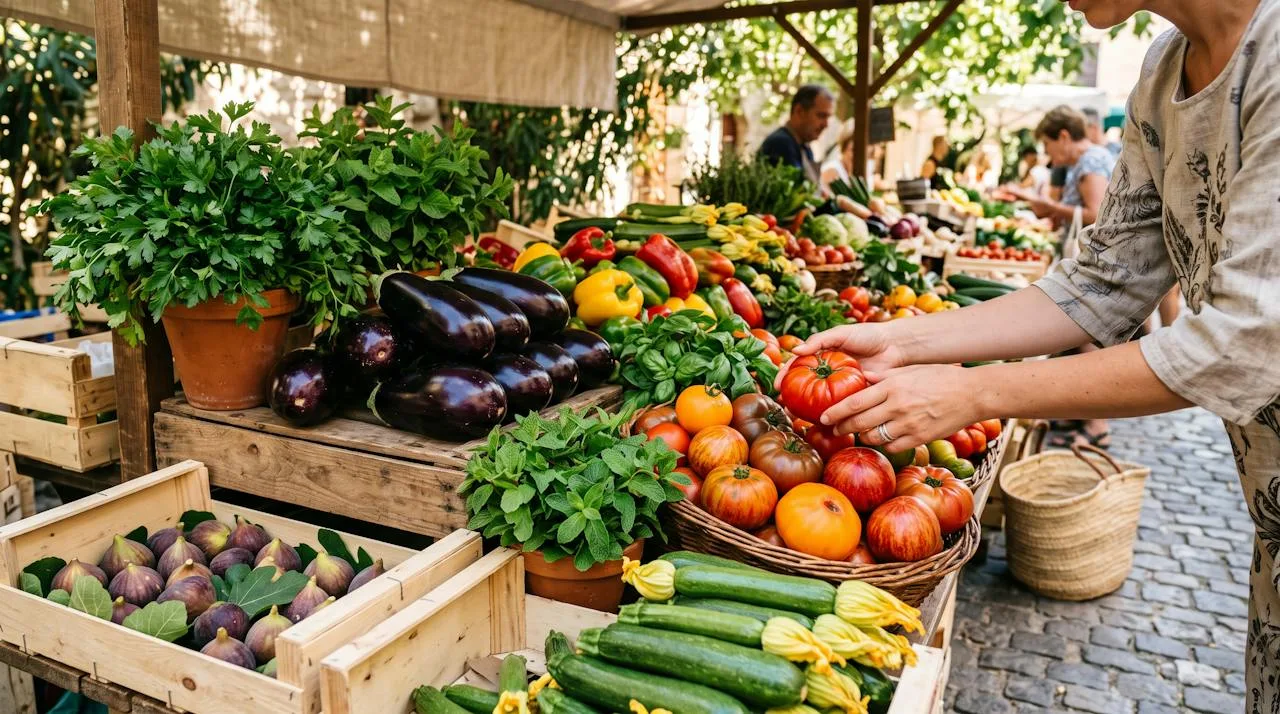
A Mediterranean kitchen starts in the grocery store, and it’s simpler than the fancy imported aisle wants you to believe.
Produce (Buy Weekly)
- Leafy greens: spinach, kale, arugula, romaine
- Tomatoes (fresh in summer, canned the rest of the year)
- Cucumbers, bell peppers, zucchini, eggplant
- Onions, garlic, shallots
- Lemons (you’ll use more than you think)
- Seasonal fruit: oranges, apples, grapes, berries, figs when you can find them
- Fresh parsley, mint, or dill
Buying in season is the most Mediterranean habit of all. Seasonal produce is cheaper, tastes better, and pushes you to vary your meals naturally. If you have a farmers market nearby, go once. It will change how you think about vegetables. It certainly changed me.
Pantry (Buy Monthly)
- Extra virgin olive oil
- Canned chickpeas, white beans, and lentils (or dried)
- Canned tomatoes and tomato paste
- Farro, bulgur, brown rice, whole-wheat pasta, whole-wheat couscous
- Canned sardines, tuna, or salmon
- Olives, capers, jarred roasted red peppers
- Nuts and seeds: walnuts, almonds, sesame seeds, tahini
- Dried figs, dates, or raisins
- Red wine vinegar and balsamic vinegar
- Spices: cumin, paprika, oregano, cinnamon, red pepper flakes
Fridge and Freezer
- Plain Greek yogurt
- Feta or another flavorful cheese
- Eggs
- Frozen fish fillets and frozen shrimp
- Frozen spinach, peas, and artichoke hearts
- Chicken thighs or breasts
What to Skip (or Limit)
- Processed meats like bacon, salami, and hot dogs (occasional at most)
- Sugary cereals, pastries, and sweetened drinks
- Refined snack foods, even ones labeled “Mediterranean”
- Heavily sweetened yogurts and granolas
COMMON MISTAKE: Trusting the word “Mediterranean” on a package. A frozen “Mediterranean bowl” can still be loaded with sodium and refined starch. Read the ingredient list. If you can’t picture the ingredients in a Greek grandmother’s kitchen, it probably doesn’t belong in yours.
Eating Mediterranean on a Budget
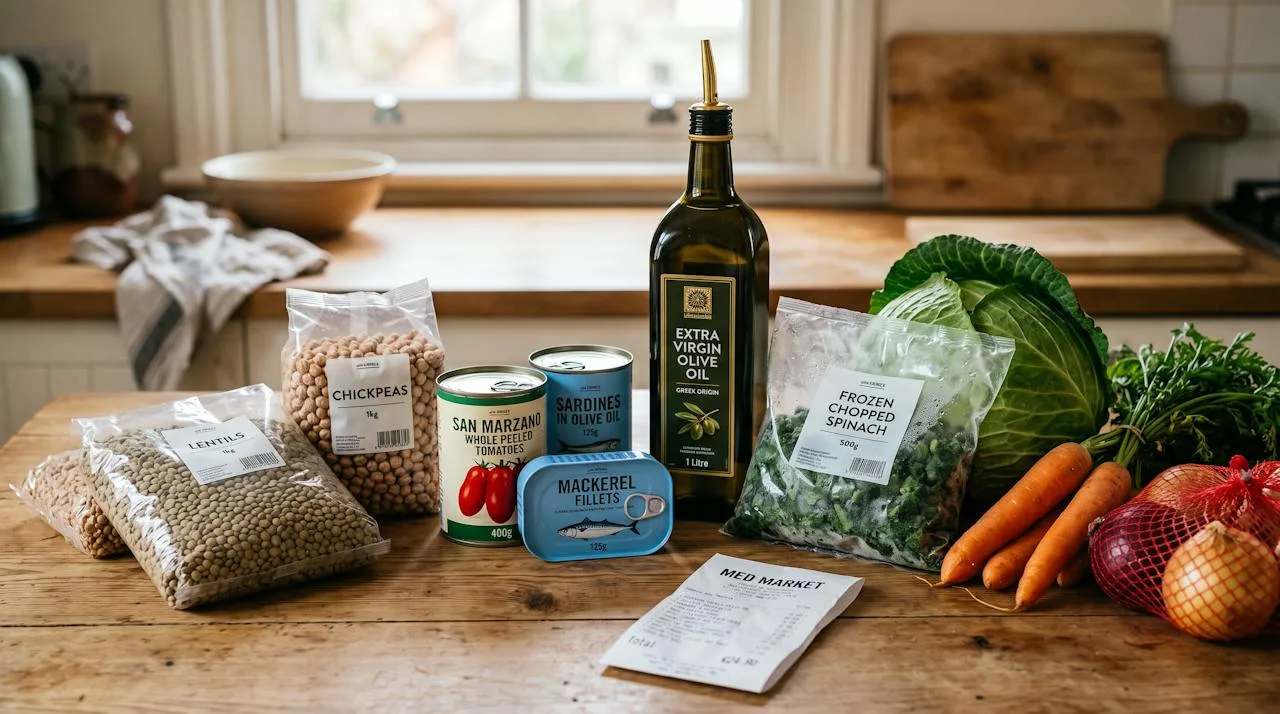
Remember my $240 of fancy imported products? Here’s how I’d spend that money today, and still have change left over.
The Budget Rules I Live By
The traditional Mediterranean diet grew up as peasant food. It’s built on beans, grains, and whatever vegetables were in season, which means it can be one of the most affordable ways to eat well.
- Make legumes your main protein at least four or five times a week. A pound of dried lentils costs very little and feeds a family multiple times.
- Buy frozen and canned produce. Frozen spinach, canned tomatoes, and frozen peas are picked at peak ripeness and cost a fraction of fresh out-of-season produce.
- Choose canned fish. Sardines and canned salmon deliver omega-3s for far less than fresh fillets.
- Buy olive oil in larger tins from a store with good turnover, and keep a smaller bottle for everyday use.
- Cook once, eat three times. A big pot of beans becomes soup, salad, and a grain bowl.
- Stretch meat. Use chicken or ground lamb as a flavoring in bean and vegetable dishes instead of as the main event.
The USDA’s Food Plans: Cost of Food reports show how much a nutritious diet can cost at different budget levels. Many of the lowest-cost staples (dried beans, oats, cabbage, carrots, onions, canned tomatoes) are exactly the foods the Mediterranean diet is built on.
READER STORY: Marcus from Columbus, Ohio, told me he cut his weekly grocery bill after swapping three meat-based dinners for lentil soup, chickpea stew, and a white bean pasta. “My kids didn’t even notice the meat was missing,” he wrote. “They noticed the garlic bread.”
A 7-Day Mediterranean Diet Meal Plan for Beginners
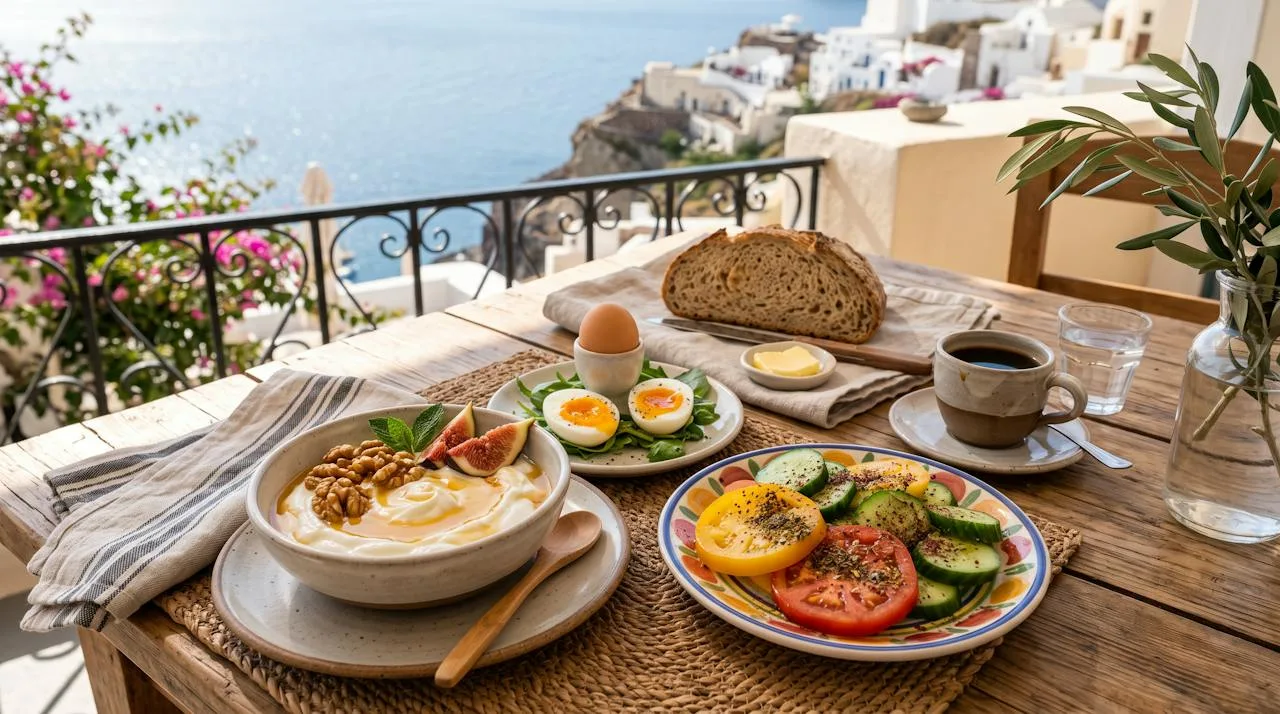
Plans are only useful if they’re realistic, so this one uses repeatable meals, lots of leftovers, and nothing you can’t find at a regular American supermarket.
How to Use This Plan
Treat this as a template, not a prescription. Swap days, repeat your favorites, and adjust portions to your appetite. Breakfasts and lunches repeat on purpose; that’s how real people eat.
Day 1
- Breakfast: Greek yogurt with walnuts, a drizzle of honey, and fresh fruit
- Lunch: Chickpea salad with cucumber, tomato, parsley, lemon, and olive oil
- Dinner: Sheet-pan chicken thighs with potatoes, red onion, and oregano; green salad
Day 2
- Breakfast: Whole-grain toast with smashed white beans, olive oil, and red pepper flakes
- Lunch: Leftover chicken over greens with feta and olives
- Dinner: Red lentil soup with cumin and lemon; crusty bread
Day 3
- Breakfast: Two eggs scrambled with spinach and feta
- Lunch: Leftover lentil soup
- Dinner: Oven-baked fish with cherry tomatoes, olives, and capers; farro
Day 4
- Breakfast: Oatmeal with chopped dates, cinnamon, and almonds
- Lunch: Farro bowl with leftover fish, arugula, and lemon-tahini dressing
- Dinner: Whole-wheat pasta with garlic, olive oil, broccoli, and white beans
Day 5
- Breakfast: Greek yogurt with walnuts, honey, and fruit
- Lunch: Leftover pasta and beans
- Dinner: Greek-style white bean and tomato stew with a big salad
Day 6
- Breakfast: Tomato, cucumber, and olive plate with a boiled egg and whole-grain bread
- Lunch: Pita stuffed with hummus, roasted vegetables, and greens
- Dinner: Grilled or pan-seared salmon with roasted zucchini and bulgur
Day 7
- Breakfast: Shakshuka (eggs poached in spiced tomato sauce) with bread
- Lunch: Leftover bean stew
- Dinner: A shared mezze night: hummus, olives, roasted vegetables, feta, whole-grain pita, and fruit for dessert
Snacks throughout the week: a handful of nuts, fresh fruit, hummus with carrots, or a few olives with a piece of cheese.
Meal Prep Makes It Stick
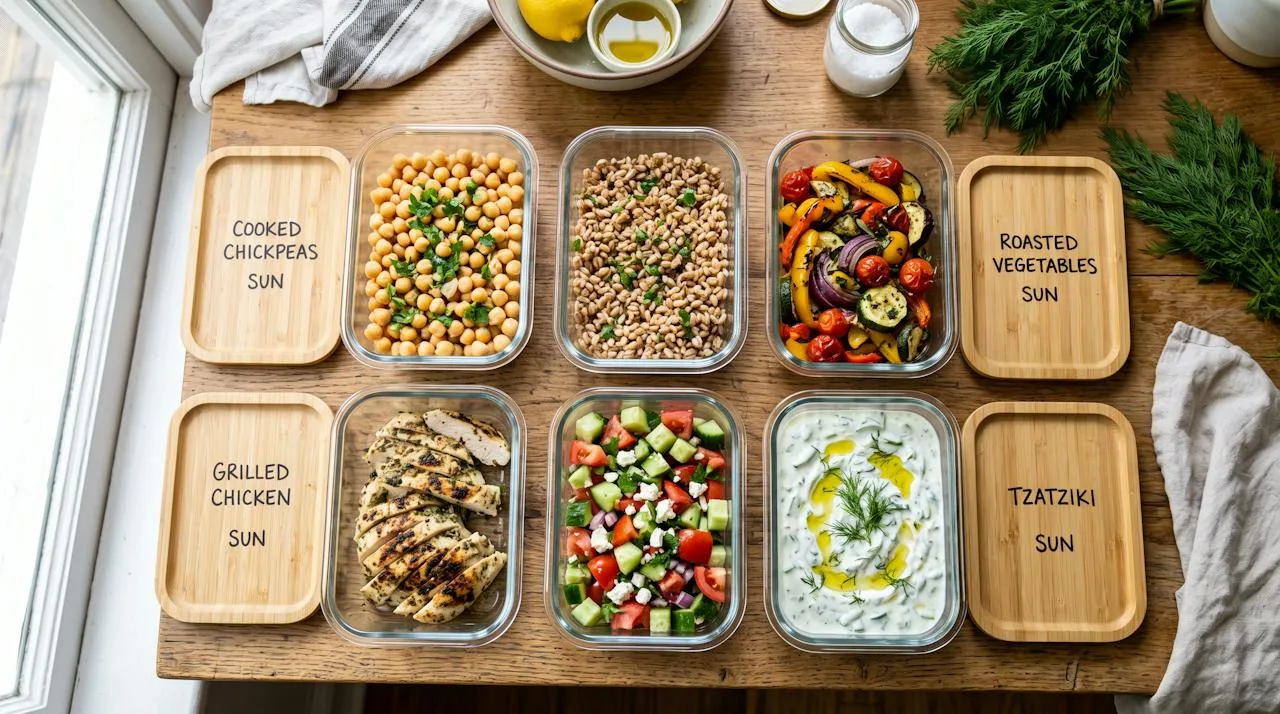
The single best thing you can do for this plan is spend one hour on Sunday:
- Cook a big pot of grains (farro or bulgur).
- Roast two sheet pans of vegetables.
- Cook or drain a batch of chickpeas.
- Whisk a jar of lemon-olive oil dressing.
- Wash and dry your greens.
With those five components in the fridge, a Mediterranean lunch takes about three minutes to assemble. Cooked grains and roasted vegetables generally keep well for three to four days in the refrigerator; the USDA’s leftovers and food safety guidance recommends eating refrigerated leftovers within three to four days.
🫒 MEDITERRANEAN SECRET: Dress grain salads while the grains are still warm. Warm farro or bulgur soaks up olive oil and lemon like a sponge, and the flavor stays bright for days.
Beyond Food: The Mediterranean Lifestyle
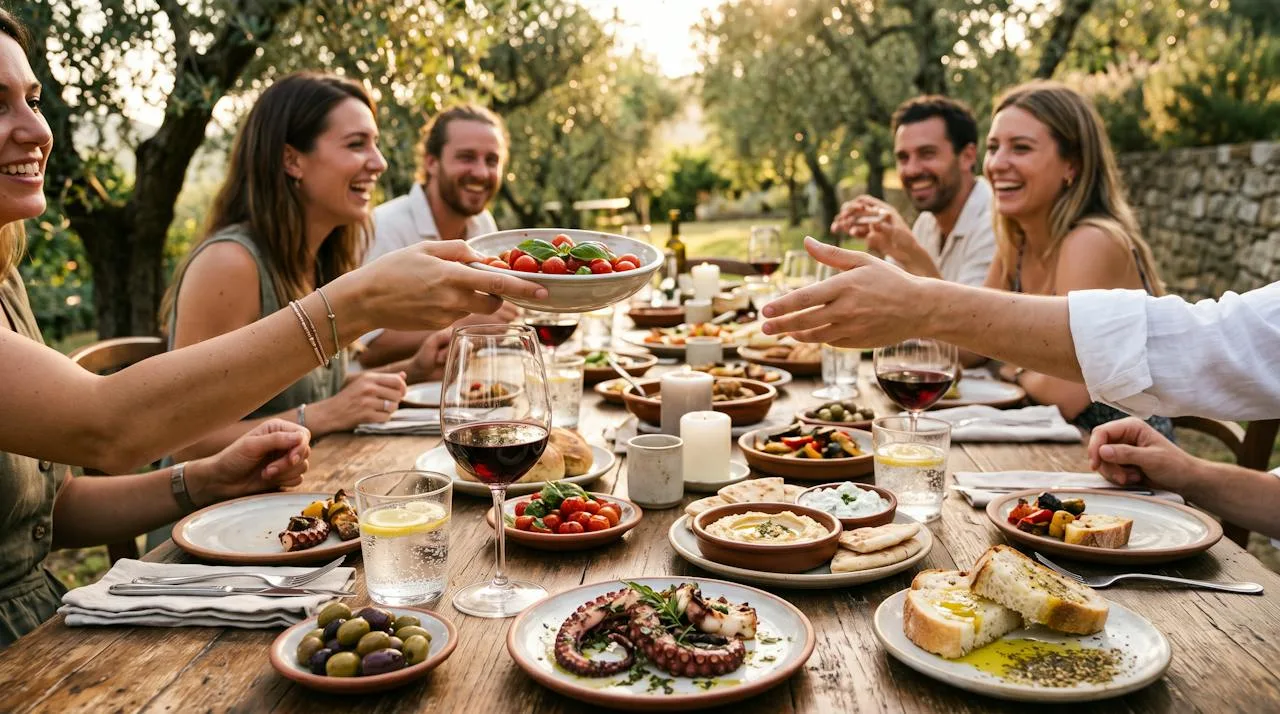
This is the part most American diet books skip, and it might be the most important part of all.
Eat Together and Eat Slowly
In Mediterranean cultures, meals are events. Lunch can last an hour. Dinner is shared. The table is where families talk, argue, laugh, and reconnect. The Oldways pyramid places shared meals at the very base for a reason: how you eat shapes what you eat. It’s hard to inhale a bag of chips when you’re sitting at a table passing a bowl of salad.
Start small: one screen-free dinner a week with the people you love. Then two.
Move Every Day
Traditional Mediterranean life involved a lot of walking, gardening, and physical work. You don’t need a gym membership to capture this; a daily walk after dinner (the Italian passeggiata) is a wonderful habit. The CDC’s physical activity guidelines recommend at least 150 minutes of moderate activity per week for adults, which works out to about 30 minutes a day, five days a week.
What About Wine?
Wine is often associated with the Mediterranean diet, but you don’t need to drink to follow this pattern. If you don’t drink, don’t start. If you do, the CDC defines moderate drinking as two drinks or fewer per day for men and one drink or fewer per day for women, and notes that drinking less is better for health than drinking more. Water, sparkling water with lemon, and herbal tea are just as Mediterranean.
Food and Mood
Researchers are also studying how diet affects mental well-being. In the small SMILES trial published in BMC Medicine, adults with depression who received dietary support to follow a modified Mediterranean diet showed greater improvement in symptoms than a social-support comparison group. It’s early research and never a replacement for professional care, but it’s another reason to think of food as more than fuel.
Regional Variations: One Pattern, Many Kitchens
Once the basics feel natural, the Mediterranean diet becomes a passport. Here are three regional styles to explore.
The Eastern Mediterranean: Mezze Culture
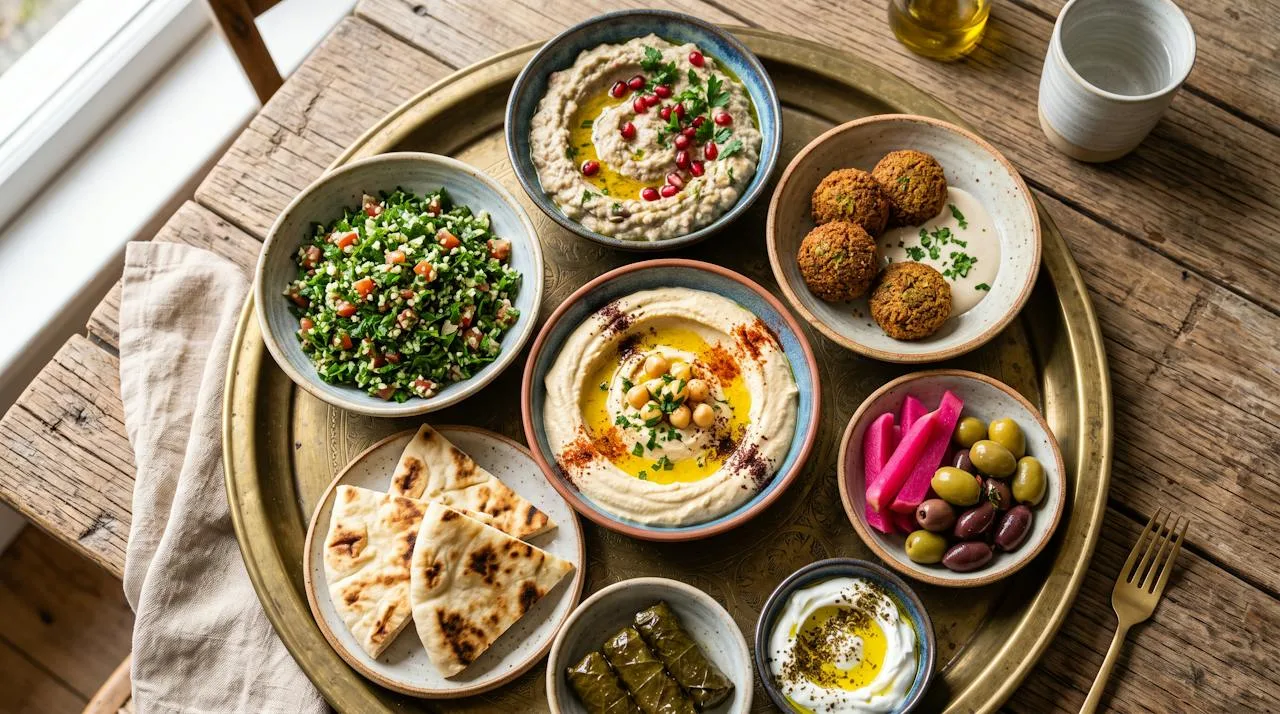
Lebanon, Syria, Turkey, and Greece share a love of small plates. A mezze table might include hummus, baba ghanoush, tabbouleh, stuffed grape leaves, olives, pickled vegetables, and warm bread. It’s the perfect beginner format: every dish is simple, most are plant-based, and everyone serves themselves.
Tabbouleh, for example, is really a parsley salad with a little bulgur, not the other way around. Lemon, olive oil, mint, and tomato do the rest.
North Africa: Spices and Slow Cooking
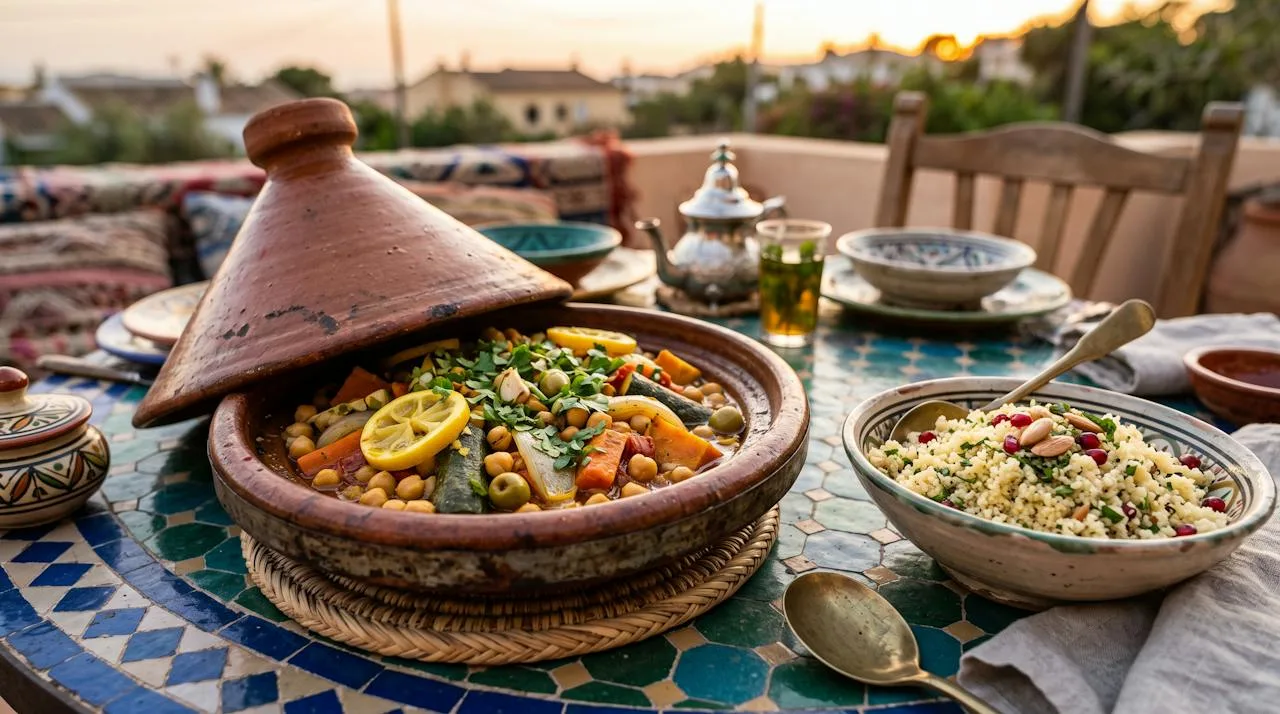
Moroccan, Tunisian, and Algerian cooking bring warm spices into the Mediterranean pattern: cumin, cinnamon, ginger, turmeric, and saffron. A tagine of chickpeas, carrots, and squash, finished with preserved lemon and olives, is one of the most satisfying plant-based dinners you’ll ever eat. Morocco, fittingly, is one of the countries named in UNESCO’s recognition of the Mediterranean diet.
Southern Europe: Simplicity and Seasons
Italian, Greek, and Spanish home cooking is built on very few ingredients treated with great respect. A summer tomato with salt and olive oil. Pasta with chickpeas. Grilled sardines with lemon. Greek horta (wild greens) boiled and dressed with lemon and oil. This is where you learn restraint: the fewer the ingredients, the better each one needs to be.
The Modern Plant-Forward Bowl
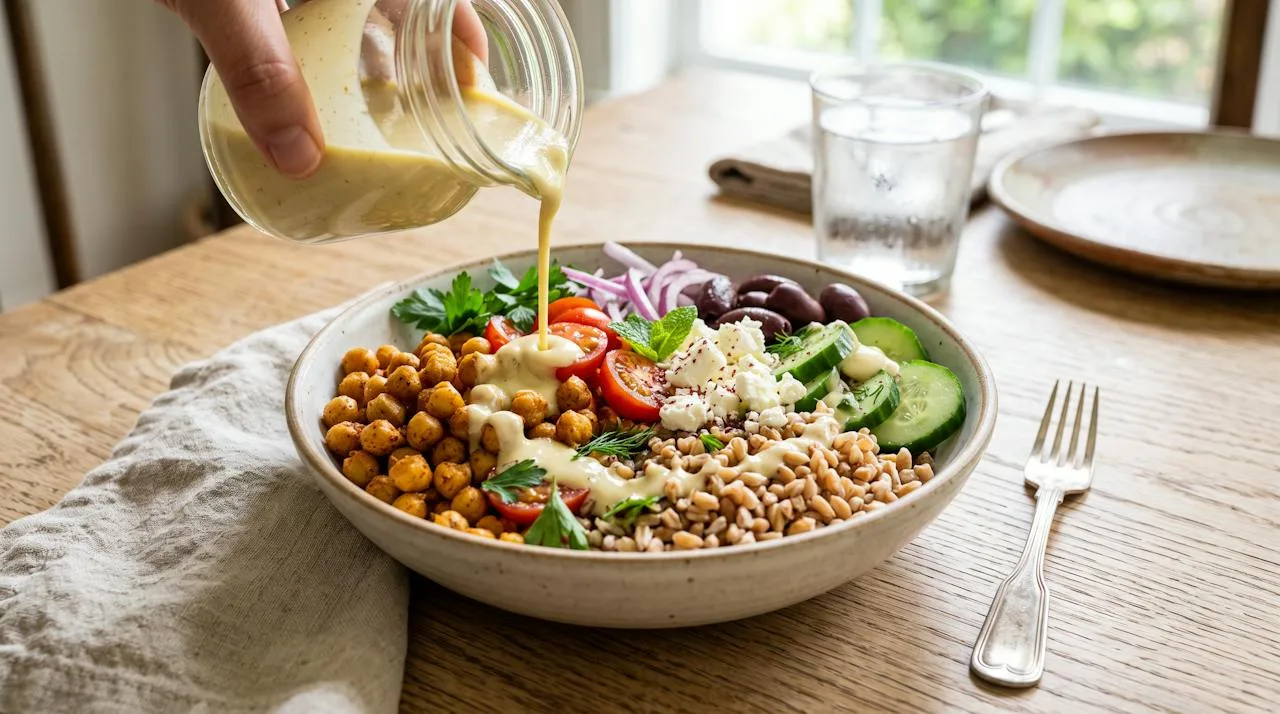
Not traditional, but deeply Mediterranean in spirit: the grain bowl. Start with farro or bulgur, add roasted vegetables and chickpeas, pile on something raw and crunchy, finish with feta or olives, and drizzle with tahini-lemon dressing. It’s the half-quarter-quarter plate in a bowl, and it’s my most-made lunch.
READER STORY: Priya from Austin, Texas, told me that cooking one new regional dish a week kept her from getting bored. “Week one was shakshuka, week two was a chickpea tagine,” she wrote. “By week six I’d stopped thinking of it as a diet and started thinking of it as travel.”
Troubleshooting: Common Mediterranean Diet Mistakes
Almost everyone hits a snag in the first month. Here are the problems I hear about most, and how to fix them.
“I’m Eating Mediterranean Food, but I Feel Heavy or Sluggish”
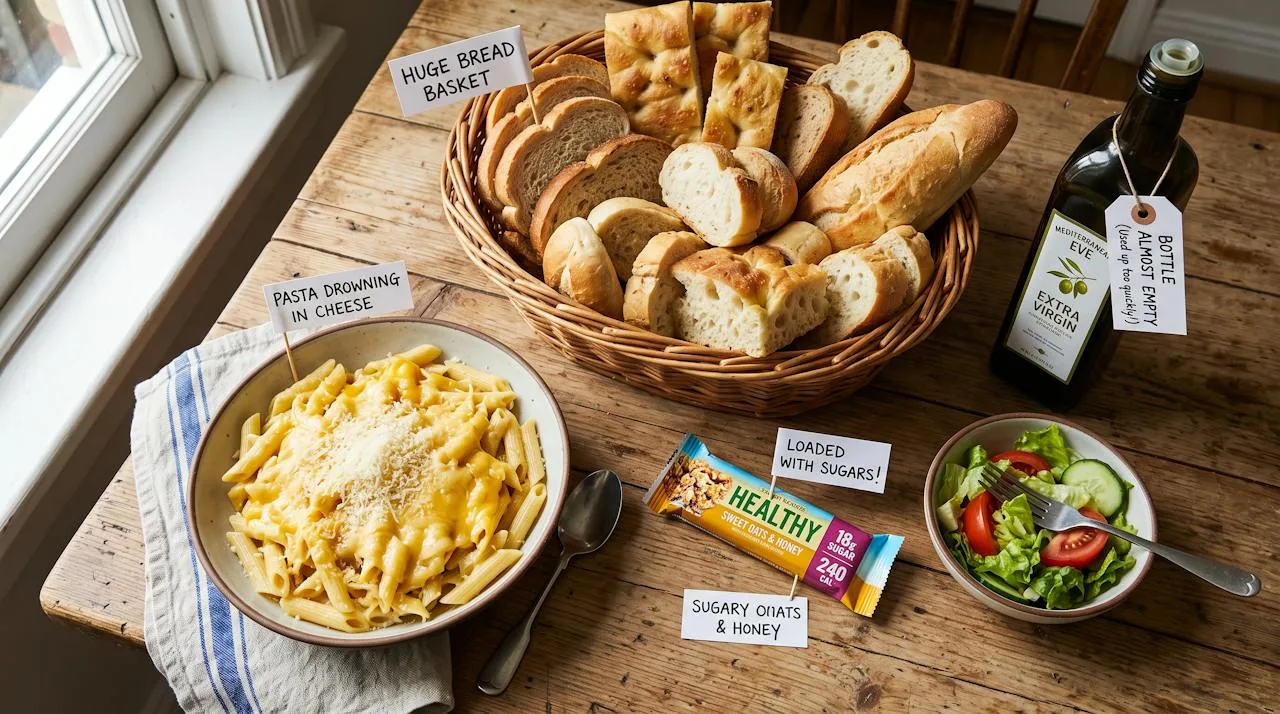
This usually comes from portions of the calorie-dense foods creeping up while the vegetables quietly shrink. Olive oil, cheese, nuts, bread, and pasta are all Mediterranean, but they’re also energy-dense. The fix:
- Go back to the half-quarter-quarter plate and fill the vegetable half first
- Measure olive oil for a week or two so you learn what a tablespoon actually looks like
- Treat pasta as a first course or side portion, the way it’s served in Italy, rather than a giant bowl
- Keep cheese as a garnish, not a main ingredient
The research supporting this pattern, including the Mayo Clinic’s overview, always frames olive oil and nuts as replacements for less healthy fats, not extras.
“It Feels Expensive”
Usually this means the shopping cart is full of specialty products. Go back to the budget rules: legumes as your main protein, frozen and canned produce, canned fish, and seasonal vegetables. The imported artisan products are lovely, but they’re optional.
“My Family Won’t Eat It”
Don’t announce a new diet. Just cook familiar dishes the Mediterranean way:
- Tacos with black beans and a big cabbage slaw instead of mostly ground beef
- Pizza night on whole-wheat dough loaded with vegetables
- Burgers made from half ground beef, half finely chopped mushrooms or lentils
- Pasta with a garlicky tomato sauce and white beans stirred in
“I Don’t Have Time to Cook”
Lean on the Sunday meal prep routine, sheet-pan dinners, and five-minute assemblies: canned chickpeas, bagged greens, jarred roasted peppers, feta, and olive oil make a real Mediterranean lunch without turning on the stove.
TROUBLESHOOTING FLOWCHART:
- Feeling heavy → Too much oil, cheese, or bread → Refill the vegetable half of your plate first
- Spending too much → Specialty products in the cart → Switch to legumes, frozen produce, canned fish
- Getting bored → Same five meals on repeat → Cook one new regional dish per week
- Family resistance → Announcing a “diet” → Mediterranean-ize their favorite meals instead
- No time → Cooking from scratch every night → One-hour Sunday prep plus sheet-pan dinners
Your Journey to Mediterranean Mastery
The Mediterranean Advantage: 5 Key Takeaways
- The Mediterranean diet is a pattern, not a set of rules: plants first, olive oil as your main fat, fish often, meat and sweets occasionally.
- The research, including PREDIMED and long-term studies of women’s heart health, supports the whole pattern eaten over time, not single ingredients.
- The half-quarter-quarter plate is the simplest way to eat Mediterranean at every meal.
- Built on beans, grains, and seasonal vegetables, it can be one of the most affordable ways to eat well.
- Shared meals, daily movement, and slowing down are part of the diet, not extras.
Your 30-Day Mediterranean Journey
Week 1: Foundation. Swap your main cooking fat to extra virgin olive oil. Add one extra serving of vegetables to lunch and dinner every day. Stock the basic pantry from the shopping list above.
Week 2: Legumes and Grains. Cook beans or lentils as your main protein at least three times. Try two new whole grains, like farro and bulgur. Start the one-hour Sunday meal prep.
Week 3: Fish and Flavor. Eat fish twice this week (canned counts). Replace one salty sauce or dressing with herbs, lemon, garlic, and olive oil. Build one full mezze-style meal.
Week 4: Lifestyle and Variety. Cook one regional dish you’ve never tried, such as a tagine, shakshuka, or Greek bean stew. Share at least three screen-free meals with others. Add a 20–30 minute walk after dinner most days.
Frequently Asked Questions
Why is the Mediterranean diet considered so healthy?
The Mediterranean diet combines several habits that research links to better health: lots of fiber-rich plant foods, healthy monounsaturated fats from olive oil and nuts, omega-3s from fish, and relatively little processed food, added sugar, and red meat. Large studies like PREDIMED found lower rates of major cardiovascular events in people following this pattern with extra olive oil or nuts, and long-term observational research links higher adherence to lower heart disease risk. It’s also flexible and enjoyable, which makes it easier to stick with for years. That long-term consistency is where most of the benefits come from. Like any eating pattern, it works best as part of a lifestyle that includes regular movement, good sleep, and routine checkups with your doctor.
Can I lose weight on the Mediterranean diet?
Many people do, but it isn’t designed as a weight-loss plan. The diet’s high fiber and protein from vegetables, beans, and whole grains help you feel full, and replacing processed snacks with whole foods often reduces calorie intake naturally. However, olive oil, nuts, cheese, and bread are energy-dense, so portions still matter. If weight loss is your goal, fill half your plate with vegetables, measure olive oil for a while, and keep bread and pasta to moderate servings. Pair it with daily movement. For personalized weight goals, especially if you have a medical condition, a registered dietitian can help tailor the Mediterranean pattern to your needs.
How long does it take to see results on the Mediterranean diet?
Some changes come quickly. Many people notice they feel more satisfied after meals and have steadier energy within the first couple of weeks, simply from eating more fiber and fewer ultra-processed foods. Changes in health markers like cholesterol, blood pressure, or weight usually take longer and vary from person to person. The major studies on heart health followed participants for years, not weeks. The best approach is to think of the Mediterranean diet as a permanent upgrade rather than a short-term program. If you’re tracking specific health numbers, check in with your doctor after a few months so you can see how your body is responding.
What’s the minimum I need to change to start?
If you only change one thing, switch your main cooking and dressing fat to extra virgin olive oil in place of butter and other saturated fats. If you change two things, add a vegetable to every lunch and dinner. If you change three, eat beans or lentils as your main protein a few times a week. Those three habits alone move you most of the way toward the Mediterranean pattern. Once they feel automatic, add fish twice a week, swap refined grains for whole grains, and eat fruit for dessert. Small, stackable changes are much more likely to last than a complete overhaul on day one.
Is it possible to follow the Mediterranean diet as a vegetarian?
Absolutely. The traditional Mediterranean diet is already mostly plant-based, and many classic dishes are naturally vegetarian: lentil soups, chickpea stews, bean salads, vegetable tagines, stuffed peppers, and pasta with vegetables. Vegetarians can get protein from beans, lentils, chickpeas, eggs, Greek yogurt, cheese, nuts, and whole grains. The main nutrient to think about is omega-3 fatty acids, since fish is a key source; walnuts, flaxseed, and chia seeds provide a plant form of omega-3. If you’re vegan or have specific health concerns, a registered dietitian can help you check nutrients like vitamin B12, iron, and omega-3s.
How do I start the Mediterranean diet on a tight budget?
Build your meals around the cheapest foods in the pattern: dried or canned beans, lentils, chickpeas, oats, brown rice, cabbage, carrots, onions, canned tomatoes, frozen vegetables, and canned sardines. Buy olive oil in larger tins from a store with good turnover. Cook big batches of soup, stew, or beans that stretch across several meals. Use small amounts of meat or cheese as flavorings rather than main courses. Shop seasonal produce, which is usually cheaper and tastes better. Skip the packaged “Mediterranean” convenience foods. The traditional Mediterranean diet grew out of frugal home cooking, so it’s naturally suited to tight budgets.
Can I substitute other oils for olive oil?
You can, but olive oil is central to the Mediterranean diet for good reason: it’s the traditional fat of the region and was a key part of the PREDIMED research. If you need an alternative for very high-heat cooking or a neutral flavor, oils rich in unsaturated fats such as avocado oil or canola oil are reasonable choices. What matters most is replacing saturated fats like butter, lard, and coconut oil with unsaturated oils. For dressings, dips, drizzling, and most everyday cooking, extra virgin olive oil is still the best choice, both for flavor and for staying true to the pattern the research actually studied.
Why does the Mediterranean diet include bread and pasta?
Because they’ve always been part of Mediterranean life. The difference lies in type and portion. Traditional Mediterranean bread is often whole-grain or rustic, eaten alongside vegetables, beans, and olive oil rather than on its own. Pasta is usually served as a moderate first course, often with vegetables, beans, or seafood, instead of a giant plate smothered in cream. Choose whole-grain bread and pasta more often, keep portions reasonable, and pair them with plenty of vegetables and protein. That combination slows digestion and keeps you satisfied. Cutting out bread and pasta entirely isn’t necessary, and for many people it makes the diet harder to sustain.
How do I know if I’m following the Mediterranean diet correctly?
Look at your week rather than any single meal. Ask yourself: Are vegetables on my plate at most lunches and dinners? Is olive oil my main fat? Did I eat beans or lentils several times? Did I have fish at least twice? Were red meat, processed meat, and sweets occasional rather than daily? Did I eat mostly whole grains? Did I share meals and move my body? If you can answer yes to most of these, you’re on track. Perfection isn’t the goal. Mediterranean families eat birthday cake and grilled lamb too. What matters is the overall pattern, week after week.
What’s the best way to start the Mediterranean diet as a complete beginner?
Start with your kitchen, not a meal plan. Stock extra virgin olive oil, canned beans, whole grains, canned tomatoes, frozen vegetables, lemons, garlic, and a few herbs and spices. Then use the half-quarter-quarter plate: half vegetables, one quarter whole grains, one quarter protein, finished with olive oil and lemon. Cook two or three simple dishes you enjoy (a lentil soup, a sheet-pan chicken or fish, a big chopped salad) and repeat them until they feel effortless. After that, follow the 30-day journey in this guide, adding one new habit each week. Slow, steady changes are what make this way of eating last.
Professional Tips for Long-Term Success
OVERNIGHT TECHNIQUE: Soak dried chickpeas overnight in plenty of water. They cook faster, more evenly, and more creamily than unsoaked beans, and they make hummus far smoother than canned.
SCIENCE TIP: Pair beans and leafy greens with something acidic, like a squeeze of lemon or a splash of vinegar. Vitamin C helps your body absorb the non-heme iron found in plant foods, as the NIH Office of Dietary Supplements explains.
ADVANCED TECHNIQUE: Bloom your spices. Warm ground cumin, paprika, or cinnamon in olive oil for 30–60 seconds, until fragrant, before adding the rest of your ingredients. It deepens the flavor of stews and tagines dramatically.
RATIO TIP: For a classic Mediterranean vinaigrette, use 3 parts olive oil to 1 part lemon juice or vinegar, plus a pinch of salt and a little Dijon or minced garlic. Shake it in a jar and it keeps in the fridge for about a week.
🫒 MEDITERRANEAN SECRET: Keep a “flavor jar” shelf: olives, capers, preserved lemons, roasted peppers, and sun-dried tomatoes. One spoonful turns plain beans or grains into a complete meal.
Take Action: Start Your Mediterranean Journey Today
You don’t need to wait for Monday, a new month, or a perfect grocery haul. Pick the path that matches where you are right now:
- Beginner: Tonight, make one half-quarter-quarter plate using whatever vegetables you have, drizzled with olive oil and lemon.
- Intermediate: This week, cook beans or lentils as your main protein three times and try one new whole grain.
- Advanced: This month, cook a dish from each region in this guide (a mezze spread, a North African tagine, and a Southern European bean stew) and host one long, slow, shared dinner.
📊 Track Your Progress
- Count your vegetable servings for one week to find your starting point
- Note how many dinners featured beans, lentils, or fish
- Keep a simple list of new Mediterranean dishes you’ve cooked
- Write down how you feel (energy, fullness, mood) at the end of each week
🎓 Continue Learning This is the first guide on Fig & Brine, and it’s the foundation for everything coming next. In the weeks ahead, I’ll go deep on cooking with olive oil, roasting vegetables the Mediterranean way, building a fresh herb pantry, making grain bowls, and my favorite subject of all: brining olives and preserving lemons at home.
That morning at the farmers market, I thought I’d found a new diet. What I really found was a new way of cooking and a slower, warmer way of eating. The figs I carried home that day ended up split open on a plate with a little yogurt, a drizzle of honey, and a scattering of toasted walnuts. Nothing fancy. Nothing imported. Just good food, eaten slowly, at a table with people I love.
That’s what I want for you. Not perfection, not a list of rules, but a kitchen that smells like garlic and thyme and golden olive oil, and a table you look forward to sitting at. Start with one plate. Then one week. Then one month. And when you make your first pot of beans that tastes like it simmered all day, come tell me about it. I can’t wait to cook alongside you.
With olive oil on my hands and figs on the counter, Nevaeh Hall


