

Pasta e Ceci (Creamy Italian Pasta and Chickpeas With Rosemary)
Pasta e ceci is what happens when an Italian kitchen has almost nothing in it: a pot of chickpeas, a handful of small pasta, garlic, rosemary and good olive oil. It smells like a Roman trattoria on a cold evening, piney and warm, and almost all of it comes from the pantry. In Rome it’s a Friday tradition, a meatless dish from the old lean days, and Turismo Roma notes that the classic version adds a few salted anchovies. Mine leaves them out and stays vegetarian.
Four batches taught me one thing: blend one-third of the chickpeas. Blending none left a thin broth. Blending half turned the pot almost solid after resting. One-third gave a silky, spoonable sauce with plenty of whole chickpeas, and no cream, flour or extra oil.
Chickpeas are pulses, which the Harvard T.H. Chan School of Public Health describes as an inexpensive source of protein and fiber. If you’re starting from a dry bag, my guide on how to cook dried chickpeas covers the basics. Follow this recipe, and you’ll get a creamy pasta stew where the pasta, the broth and the chickpeas land on the same spoon.
What I Learned From Testing This Recipe
Recipe Testing Note Tested in 4 batches: three side by side on September 24, 2026, and a confirmation batch on October 2, 2026. The final version is batch 4. Key variable tested: how many of the chickpeas are blended into the broth (0 g, 77 g or 115 g of 230 g). Measured: 400 g dried chickpeas to about 860 g soaked and about 920 g cooked; about 2.4 to 2.5 liters of cooking liquid left after 78 minutes; 550 ml liquid per batch; about 820 g finished weight off the heat and 805 to 810 g after resting.
I cooked 400 g of dried chickpeas once, split them into four 230 g portions and made the first three batches side by side. Everything matched: 100 g ditalini, 15 g olive oil, 6 g garlic, 2 g fresh rosemary, 12 g tomato paste and 550 ml of the chickpea cooking liquid. The only change was how many chickpeas went into the blender.
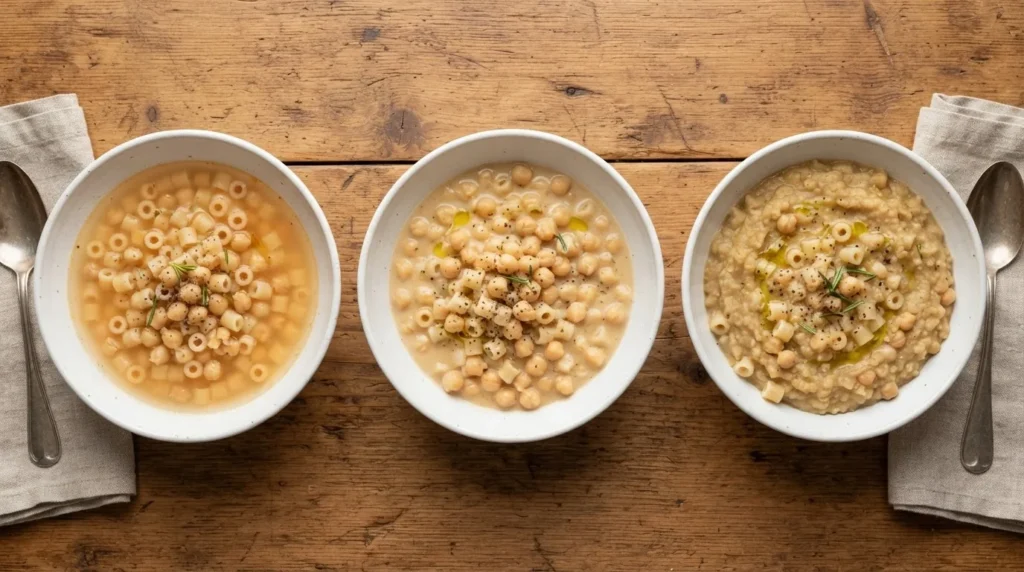
Batch 1, with nothing blended, looked like pasta floating in broth. The chickpeas and pasta sat apart, the rosemary and garlic were clear but the broth felt light, and after 10 minutes of rest there was still liquid pooling at the bottom of the bowl. Batch 3, with half blended, went the other way: thick and creamy at first, then almost spoon-standing after resting, with the pasta half buried.
Batch 2, with one-third blended, was the one. Batch 4 repeated it on October 2 to check the texture held, and it’s the version written here.
What I changed after testing: Blended chickpeas went from 0 g to 77 g (one-third of 230 g), blended with 60 ml of the cooking liquid. The unblended pot stayed brothy, and blending 115 g made it too thick after the 10-minute rest.
Side-by-Side Results
| What I compared | None blended (0 g) | One-third blended (77 g) | Half blended (115 g) |
|---|---|---|---|
| Right after cooking | Thin, brothy sauce; pasta and chickpeas looked separate | Creamy beige broth that lightly coated the ditalini | Thick, creamy sauce; pasta partly sunk in purée |
| After 10 minutes | Slightly thicker, still a brothy soup with liquid at the bottom | Thicker and silky, clinging to the spoon without going stiff | Very thick, almost spoon-standing |
| Whole chickpeas visible | All | About two-thirds | About half |
| Pasta definition | Clear | Clear | Less distinct |
| My pick | Too loose | Best balance | Too thick |
How this recipe evolved
Tap each batch to see what changed and why.
Batch 1 (September 24): none blended
0 g of the 230 g chickpeas blended.
Thin, brothy sauce; pasta and chickpeas looked separate.
After 10 minutes: still a brothy soup with liquid at the bottom of the bowl.
Batch 2 (September 24): one-third blended
77 g chickpeas blended with 60 ml cooking liquid.
Creamy beige broth that lightly coated the ditalini.
After 10 minutes: silky and spoonable, with whole chickpeas still visible.
Batch 3 (September 24): half blended
115 g chickpeas blended.
Thick and creamy at first, pasta partly sunk in purée.
After 10 minutes: almost spoon-standing. Too thick.
Batch 4 (October 2): the final recipe
Repeated the one-third method to check the texture held.
About 820 g off the heat, 805 to 810 g after resting: 2 servings of about 400 g.
Taster Notes
Three family members tasted the side-by-side batches. Two preferred the one-third version for the way the sauce coated the pasta while whole chickpeas stayed visible. One preferred the brothy batch with nothing blended, because she likes a looser, soupier bowl. One of the one-third fans would have used a little less rosemary.
Ingredients
Makes 2 servings (about 400 g each)
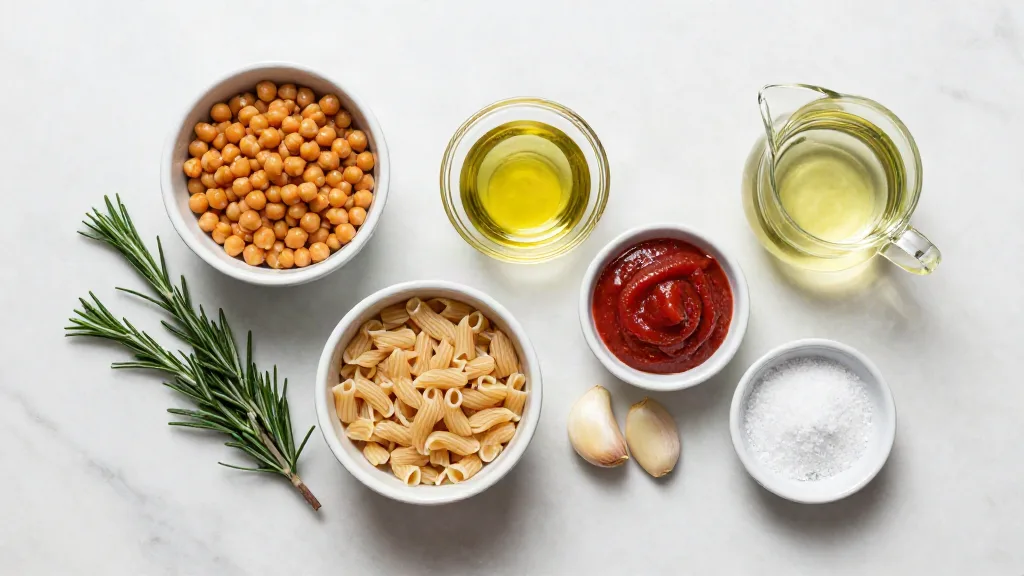
- 230 g cooked chickpeas, from about 100 g dried medium kabuli chickpeas (see the chickpea step below)
- 550 ml chickpea cooking liquid, reserved from cooking the chickpeas (450 ml to start, 100 ml during the pasta)
- 100 g dried ditalini
- 15 g extra-virgin olive oil (a generous tablespoon)
- 6 g garlic, about 2 cloves, thinly sliced
- 2 g fresh rosemary leaves, finely chopped (about a tablespoon; I kept it restrained so it doesn’t bury the chickpeas)
- 12 g tomato paste (about 2 teaspoons; just enough for color and savory depth, not a tomato sauce)
- Up to 0.5 g fine salt (a small pinch), added only after tasting
For cooking the chickpeas (enough for four pots of this recipe)
- 400 g dried chickpeas
- 3 liters fresh water
- 8 g fine salt
Shopping list
Send the list to yourself via WhatsApp or email.
- 400 g dried chickpeas (medium kabuli; makes enough for four pots)
- 100 g dried ditalini
- Extra-virgin olive oil (15 g)
- Garlic (2 cloves, about 6 g)
- Fresh rosemary (2 g leaves)
- Tomato paste (12 g)
- Fine salt (8 g for the chickpeas, plus a pinch to finish)
By the Numbers
- Dried to cooked: 400 g dried chickpeas, about 860 g after a 12-hour soak, about 920 g cooked and drained
- Chickpea cooking: about 78 minutes at a gentle simmer in 3 liters of water with 8 g salt
- Cooking liquid left: about 2.4 to 2.5 liters, enough for four pots
- Per pot: 230 g chickpeas, 77 g of them blended, 100 g ditalini, 550 ml liquid
- Pasta time: 9 minutes, one minute under the 10-minute package time
- Finished weight: about 820 g off the heat, 805 to 810 g after the 10-minute rest
Before You Start: What to Watch For
- Keep the chickpea cooking liquid. It’s the broth for the whole dish, and the pasta cooks right in it. Plain water would give you a much flatter pot.
- Cook the chickpeas fully. They’re ready when you can crush one easily between two fingers with no chalky center, but they still hold their shape when stirred. I started checking at 60 minutes and they needed about 78.
- Keep the garlic pale. Over medium-low heat it needs only 45 to 60 seconds to smell fragrant and turn pale golden. My guide to cooking with olive oil explains why gentle heat suits garlic in good oil.
- Cook the tomato paste for a minute. It should darken slightly and smell savory rather than raw.
- Keep hot liquid nearby. The pot thickens while the pasta cooks and again while it rests, and a little extra liquid fixes it instantly.
- Pull the pasta a minute early. It keeps softening during the 10-minute rest, so take the pot off the heat while the ditalini still have a slight bite.
Doneness Cues at a Glance
| Stage | Look | Feel or sound | Smell or taste |
|---|---|---|---|
| Chickpeas | Hold their shape when stirred | Crush easily between two fingers, no chalky center | |
| Garlic | Pale golden | Fragrant | |
| Tomato paste | Slightly darker | Savory, not raw | |
| Chickpeas in broth (8 minutes) | Chickpeas still intact | Broth more flavorful | |
| Ditalini (9 minutes) | Broth already slightly creamy | Tender with a slight bite | |
| After the 10-minute rest | Whole chickpeas and pasta still visible | Creamy but spoonable |
What time do you want to eat?
Start with cooked chickpeas, pick the column with your dinner time and see when to start each step.
| Step | Eat at 18:00 | Eat at 18:30 | Eat at 19:00 |
|---|---|---|---|
| Warm the oil, cook the garlic, then the rosemary | 17:29 | 17:59 | 18:29 |
| Toast the tomato paste for 1 minute | 17:31 | 18:01 | 18:31 |
| Add chickpeas and 390 ml liquid, simmer 8 minutes | 17:32 | 18:02 | 18:32 |
| Blend 77 g chickpeas with 60 ml liquid, stir back in | 17:40 | 18:10 | 18:40 |
| Add the ditalini, simmer about 9 minutes | 17:41 | 18:11 | 18:41 |
| Add the extra 100 ml liquid | 17:45 | 18:15 | 18:45 |
| Taste, salt if needed, rest off the heat 10 minutes | 17:50 | 18:20 | 18:50 |
Method
- Soak the chickpeas. Cover 400 g dried chickpeas with 2 liters of water and soak for 12 hours. Drain and rinse, discarding the soaking water. They’ll roughly double in weight, to about 860 g.
- Cook the chickpeas. Put them in a pot with 3 liters fresh water and 8 g fine salt. Bring to a boil, then lower to a gentle simmer for about 78 minutes, checking from 60 minutes on. They’re done when one crushes easily between your fingers with no hard center.
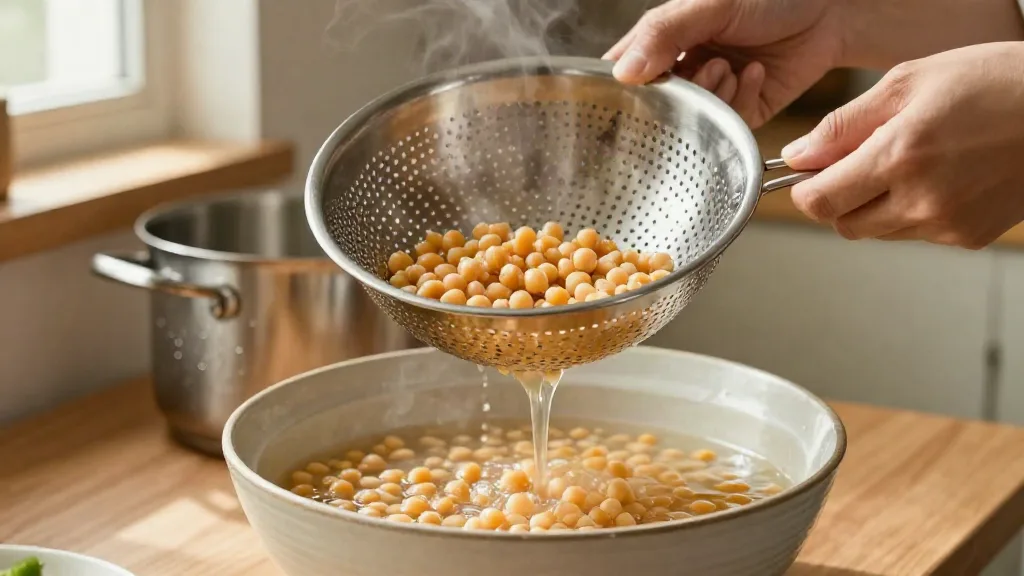
- Drain and save the liquid. Drain over a large bowl so you keep the cooking liquid; I had about 2.4 to 2.5 liters left. Weigh out 230 g chickpeas and 550 ml liquid for this recipe. The rest makes three more pots, or a batch of creamy hummus from dried chickpeas.
- Measure the liquid in two parts. Pour 450 ml cooking liquid into a jug, then take 60 ml out of it and set that aside for blending. Keep the other 100 ml separate for the pasta.
- Cook the garlic and rosemary. Warm 15 g olive oil in a pot over medium-low heat. Add 6 g sliced garlic and cook for 45 to 60 seconds, until fragrant and pale golden. Add 2 g chopped rosemary and stir for 20 to 30 seconds.
- Toast the tomato paste. Add 12 g tomato paste and cook for about 1 minute, stirring constantly, until it darkens slightly and smells savory.
- Simmer the chickpeas. Add the 230 g chickpeas and the remaining 390 ml from the jug. Simmer gently for 8 minutes. The broth tastes fuller and the chickpeas stay whole.
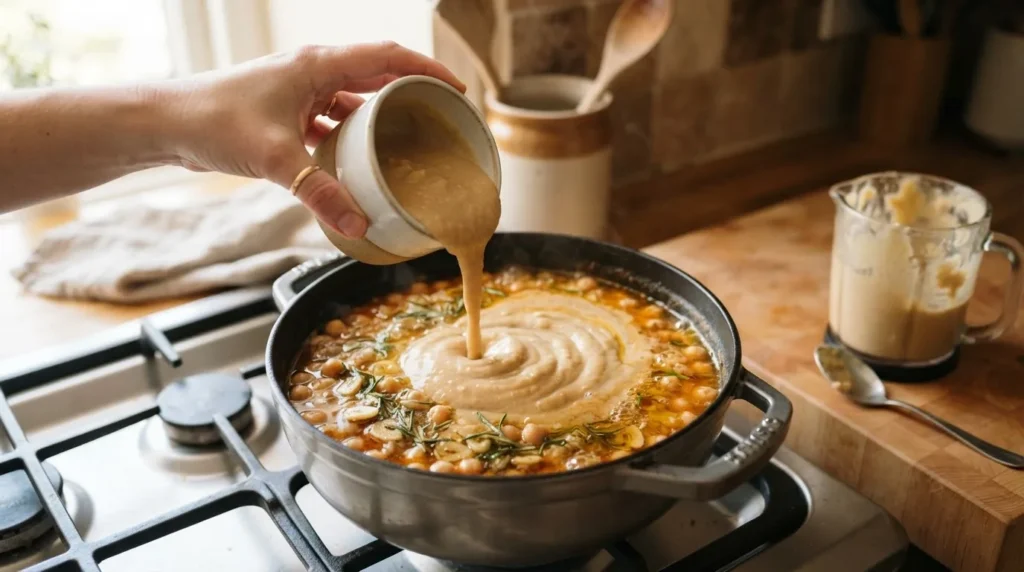
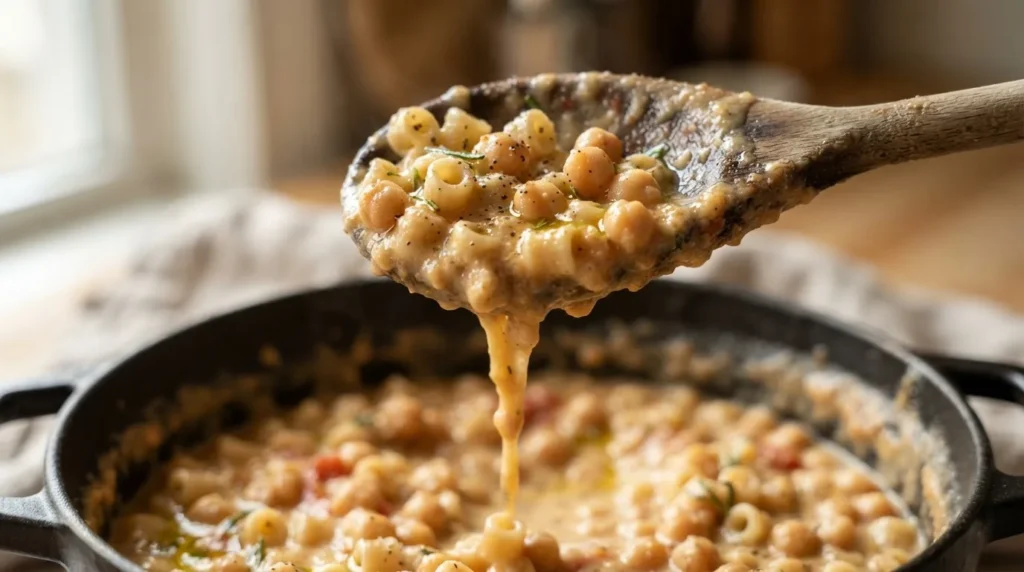
- Blend one-third. Scoop 77 g of chickpeas out of the pot and blend them with the 60 ml of liquid you set aside until smooth. Pour the purée back in and stir. This is the step that makes the dish creamy, so weigh it if you can.
- Cook the ditalini in the pot. Add 100 g ditalini and simmer for about 9 minutes, stirring often so the pasta doesn’t stick to the bottom.
- Add the extra liquid at 4 minutes. When the pasta has cooked for about 4 minutes, it starts drinking up the broth and the bottom of the pot looks too thick. Pour in the 100 ml of reserved liquid then.
- Check the pasta and taste. At 9 minutes the ditalini should be tender with a slight bite, and the broth should already look a little creamy. Taste first, then add up to 0.5 g salt only if it needs it. Mine needed only that small pinch, because the chickpeas were cooked in salted water.
- Rest for 10 minutes. Take the pot off the heat and let it stand for 10 minutes. It thickens into a creamy but spoonable stew with whole chickpeas and pasta still visible. If it looks too thick for you, stir in a splash of hot cooking liquid.
Tested Substitutions
| Original ingredient | Tested substitute | Result |
|---|---|---|
| One-third of the chickpeas blended (77 g) | None blended (tested) | A brothy, rustic pasta soup with separate chickpeas. One of my tasters preferred it. |
| One-third of the chickpeas blended (77 g) | Half blended, 115 g (tested) | Rich and hearty, but very thick after resting. Add more hot liquid if you go this way. |
| Cooked dried chickpeas | Canned chickpeas, about 230 g drained (untested) | I haven’t tried this yet. They’re softer, and you’d lose the homemade cooking liquid. Let me know in the comments. |
| Ditalini | Broken spaghetti or mixed pasta (untested) | I haven’t tried this yet. Let me know in the comments. |
| Fresh rosemary | Dried rosemary (untested) | I haven’t tried this yet. My fresh vs. dried herbs conversion guide is a good starting point. |
| No anchovy | A few anchovies, as in the Roman version (untested) | I kept this version vegetarian and haven’t tested it with anchovies. |
Why This Recipe Can Fail (And How to Fix It)
Every problem below either showed up in my test pots or is the cue I watched to avoid it.
Common Problems
- Thin and brothy: Nothing was blended, so there’s no chickpea purée to connect the pasta and broth. Blend 77 g of the chickpeas with 60 ml of the cooking liquid and stir it back in before adding the pasta.
- Too thick after resting: Half the chickpeas were blended, which made the pot almost spoon-standing after 10 minutes. Stay at one-third, and loosen a pot that’s gone too far with hot cooking liquid.
- Pasta sticking to the bottom: The ditalini absorb liquid fast, and the pot thickens around the 4-minute mark. Stir often and add the extra 100 ml of liquid at 4 minutes.
- Bitter or harsh garlic: Watch the heat. Medium-low heat for 45 to 60 seconds keeps the garlic pale golden and fragrant; take the pot off the heat for a moment if it starts coloring faster.
- Rosemary too strong: One of my tasters wanted less. Stay at 2 g of finely chopped leaves, or try 1 g if you’re sensitive to it (I haven’t tested that yet).
- Leftovers set solid: The pasta keeps absorbing liquid overnight. Loosen the full batch with 90 to 120 ml water or cooking liquid over low heat.
What went wrong?
Tap your problem to see the cause and the fix.
Thin and brothy
Cause: Nothing was blended, so no chickpea purée connects the pasta and broth.
Fix: Blend 77 g of the chickpeas with 60 ml cooking liquid and stir it back in before the pasta.
Too thick after resting
Cause: Half the chickpeas were blended, which made the pot almost spoon-standing after 10 minutes.
Fix: Stay at one-third, and loosen a pot that went too far with hot cooking liquid.
Pasta sticking to the bottom
Cause: The ditalini absorb liquid fast, and the pot thickens around the 4-minute mark.
Fix: Stir often and add the extra 100 ml liquid at 4 minutes.
Bitter or harsh garlic
Cause: The heat is too high for the garlic.
Fix: Use medium-low heat for 45 to 60 seconds so the garlic stays pale golden and fragrant.
Rosemary too strong
Cause: Rosemary is piney and can take over the chickpeas.
Fix: Stay at 2 g finely chopped leaves, or try 1 g (not tested yet).
Leftovers set solid
Cause: The pasta keeps absorbing liquid overnight.
Fix: Add 90 to 120 ml water or cooking liquid to the full batch and reheat over low heat for 4 to 5 minutes.
Serving Suggestions
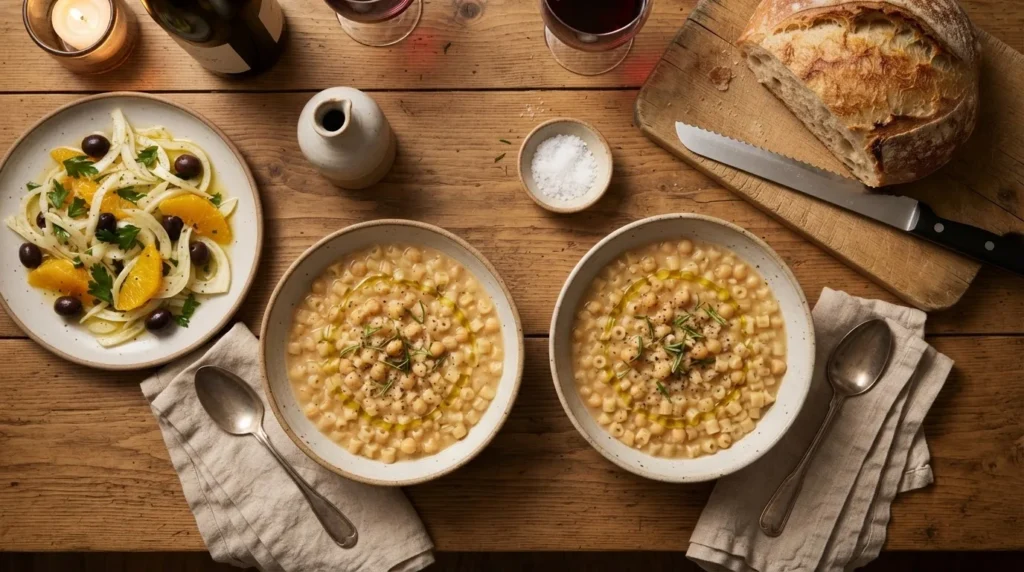
Serve pasta e ceci in warm shallow bowls with a thin thread of your best olive oil over the top and a little extra rosemary. Crusty bread is all it needs alongside. For something bright against all that creaminess, a Sicilian orange and fennel salad with olives cuts through it with citrus and crunch.
Storage, Reheating & Make-Ahead
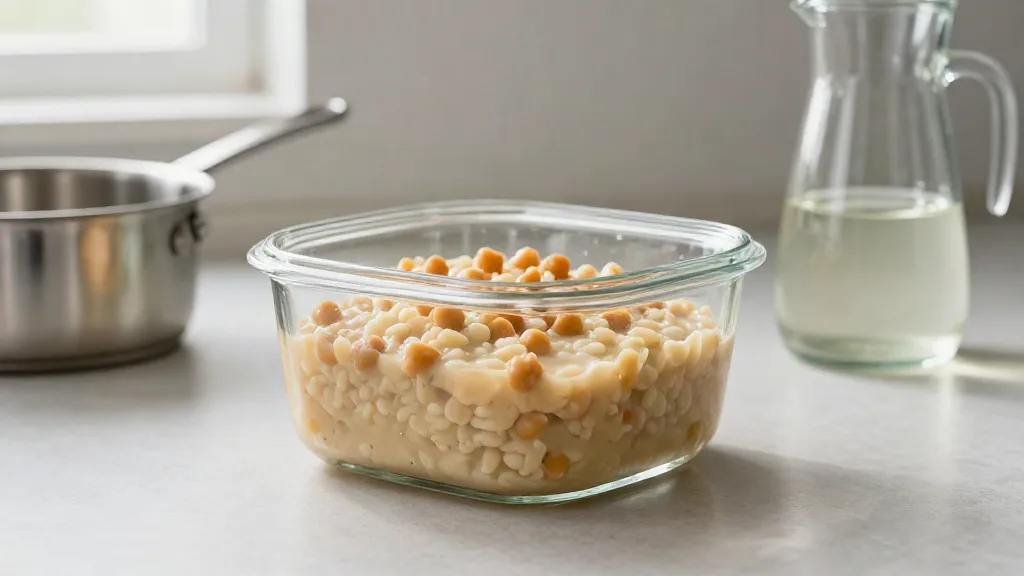
Store leftovers in an airtight container in the fridge. The USDA recommends using refrigerated leftovers within 3 to 4 days. I only tracked mine overnight.
Expect a big change by the next day. The pasta keeps absorbing liquid and the blended chickpeas thicken the sauce, so mine looked more like a soft risotto than a loose stew. The rosemary also mellowed while the chickpea flavor came forward.
To reheat the full two-serving batch, add 90 ml water or reserved chickpea cooking liquid and warm over low heat for 4 to 5 minutes, stirring gently until it loosens and the center is hot. Add up to 120 ml in total only if it needs more. Freezing wasn’t tested.
To get ahead, you can cook the chickpeas earlier and keep them chilled in their liquid, then make the pasta part in about 30 minutes. I didn’t track how many days cooked chickpeas keep for this recipe, so follow the same 3 to 4 day guideline.
What I’d Test Next
- 1 g vs. 2 g fresh rosemary, keeping the blend, chickpeas, pasta and liquid exactly the same, since one taster wanted less.
- Homemade cooking liquid vs. canned chickpea liquid at the same volume, to see how much the homemade broth matters.
- Canned chickpeas, about 230 g drained per pot, with the same sauce and liquid.
Continue Cooking
- Spaghetti alle vongole with clams, garlic and white wine
- The Mediterranean herbs and spices guide
- The Mediterranean diet for beginners

Pasta e Ceci
- Total Time: 93 minutes
- Yield: 4 servings
- Diet: Vegetarian
Description
A creamy Italian pasta stew with chickpeas, garlic, and rosemary, perfect for a cozy meal.
Ingredients
- 230 g cooked chickpeas, from about 100 g dried medium kabuli chickpeas
- 550 ml chickpea cooking liquid
- 100 g dried ditalini
- 15 g extra-virgin olive oil
- 6 g garlic, thinly sliced
- 2 g fresh rosemary leaves, finely chopped
- 12 g tomato paste
- Up to 0.5 g fine salt
Instructions
- Soak the chickpeas in water for 12 hours, then drain and rinse.
- Cook the chickpeas in 3 liters of water with 8 g salt for about 78 minutes, until easily crushed.
- Drain the chickpeas, reserving the cooking liquid.
- Warm 15 g olive oil in a pot over medium-low heat. Add 6 g sliced garlic and cook until fragrant.
- Add 2 g chopped rosemary and stir for a few seconds.
- Toast 12 g tomato paste for about 1 minute until it darkens slightly.
- Add 230 g chickpeas and 390 ml reserved cooking liquid. Simmer for 8 minutes.
- Blend 77 g of chickpeas with 60 ml cooking liquid until smooth, then stir back into the pot.
- Add 100 g ditalini and cook for about 9 minutes, stirring often.
- Once cooked, check seasoning and let rest off the heat for 10 minutes before serving.
Notes
Serve with a drizzle of olive oil and extra rosemary. Pair with crusty bread.
- Prep Time: 15 minutes
- Cook Time: 78 minutes
- Category: Main Course
- Method: Cooking
- Cuisine: Italian


